• Blog
  • Shop
  • Podcast
  • Resources
  • Archive
  • About
  • Contact
  • Cart
  • Sign In My Account
Menu

The Gentleman Stationer

Vintage Living in the Modern World.
  • Blog
  • Shop
  • Podcast
  • Resources
  • Archive
  • About
  • Contact
  • Cart
  • Sign In My Account

The TWSBI Vac Mini, with a medium nib.  The ink used in this review is Callifolio Equinoxe 6, from Vanness Pens. 

Pen Review: The TWSBI Vac Mini

February 24, 2016

I'm prepared to eat my words on the Vac Mini.  After a less-than-stellar experience with the Vac 700, the idea of a miniature version of TWSBI's vacuum filler didn't excite me in the least, and I dropped one in my Amazon shopping cart as an afterthought when I was stocking up on something else.  I fully expected this to be a "review purchase," after which I'd resell the pen.  I was wrong, and I'm pleasantly surprised by TWSBI's latest "mini" model.  

A Recap of the Vac 700 and "Vacuum Fillers"

In 2012, TWSBI introduced the Vac 700, which at $70 was the most reasonably priced "Vacuum Filler" fountain pen available on the market.  The vacuum filling system is cool. The technical niceties are better explained elsewhere, but in short you stick the nib into an ink bottle, depress a plunger rod, and at the end of the downstroke the negative pressure causes the barrel of the pen to fill with ink. The Vac 700 was admired for bringing a unique filling system to the masses at a favorable price point, but has been criticized over the years for its somewhat clunky aesthetics and early quality control problems with the nibs.  I eventually sold mine after a couple of months, and haven't been tempted by another vacuum filler other than Pilot's higher-end Custom 823 (which is still on "The List"). [2021 Update: TWSBI has released a new version of the Vac 700, dubbed the Vac700R, which adjusted the filling system and valve to increase ink flow and solves many of the early problems I and others had with the pen. It’s definitely worth checking out, though the Vac Mini probably remains my favorite due to the pocketable format.]  

Note:  A "vacuum filling" fountain pen is not the same thing as a "vacumatic" fountain pen. Despite the similar sounding names, a "vacumatic" filling fountain pen uses a pump.  I am working on my own video demonstrating these filling systems, and will supplement this review at some point in the future.  For now, please check out Brian Goulet's video here on how to fill a vacuum-fill fountain pen.

The Build of the Vac Mini

The Vac Mini is not just a slimmed down version of the Vac 700: it's an entirely new design, and a good one at that.  The Vac Mini has none of the clunky, mismatched styling that I disliked so much with its larger sibling (err, cousin?).  It's much smaller, and works well as a pocket carry option for those days when you plan to be on the move and don't want to carry a full bag or pen case, but still have some serious writing to do and need a pen with a large ink capacity.  

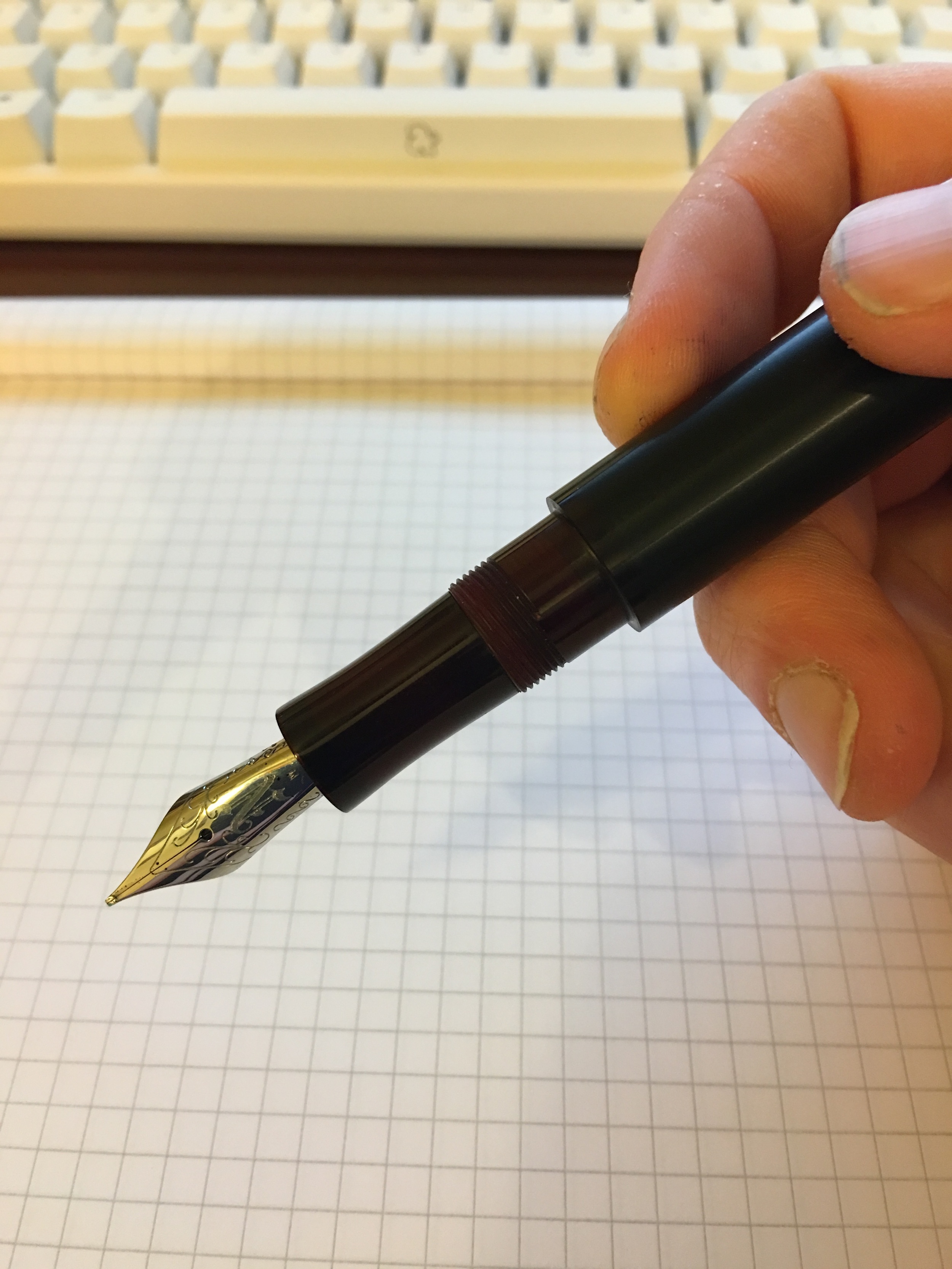
A shot of the Vac Mini's streamlined aesthetics.  Note the slight, yet noticeable, "step" from the barrel to the nib section.  

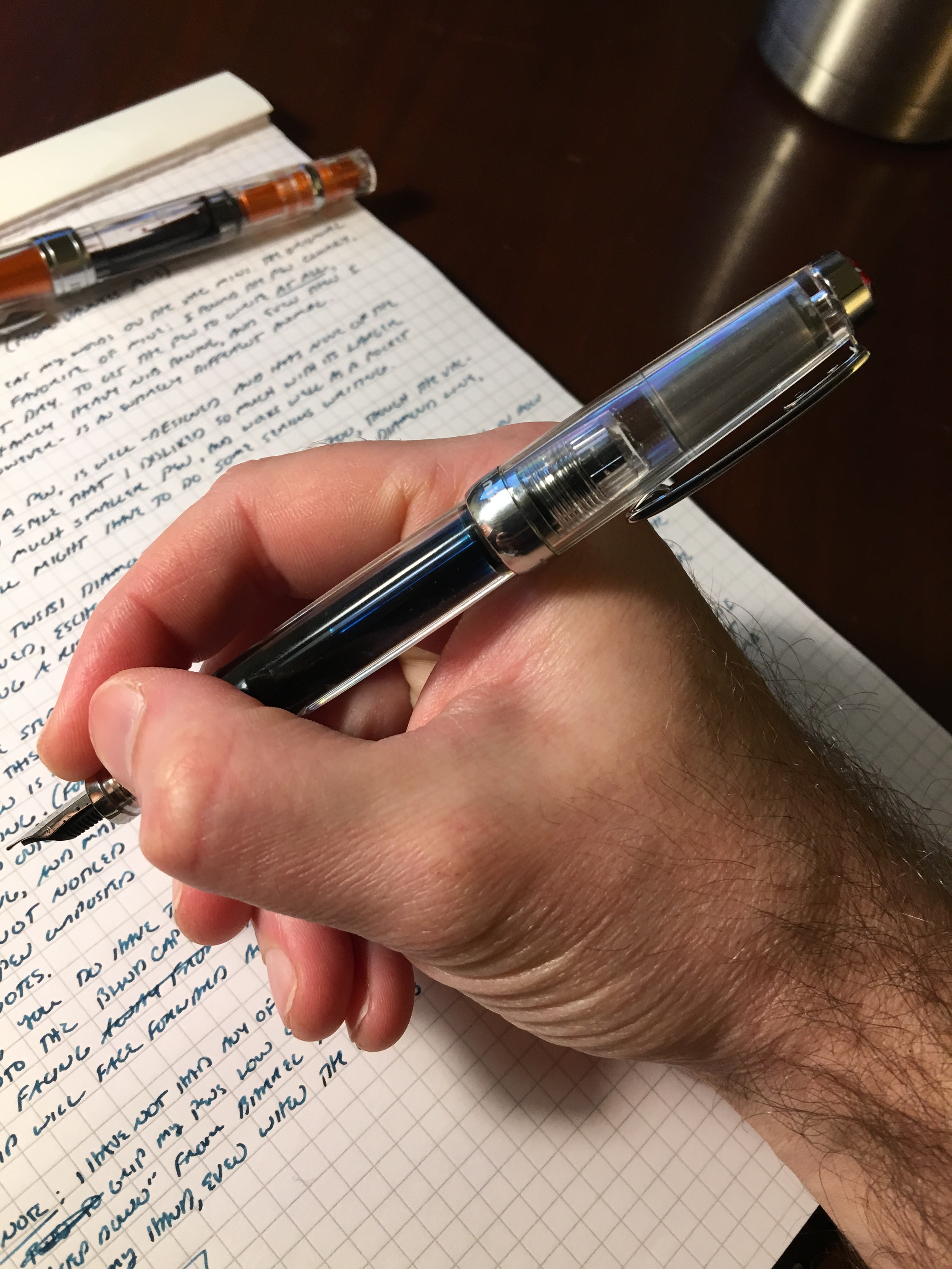
The design reminds me more of the Diamond Mini than the Vac 700, though the Vac Mini is more streamlined and foregoes the sharp facets of the Diamond 580 line (which probably lowers the risk of the plastic cracking).  There is a noticeable "step" from the barrel to the nib section (see picture above), and depending on how/where on the section you grip your pen, this could range from being a non-issue to a deal-breaker. Similarly, this pen is not one that you can use unposted for long periods of time, though for short jottings I've found that it works fine.  

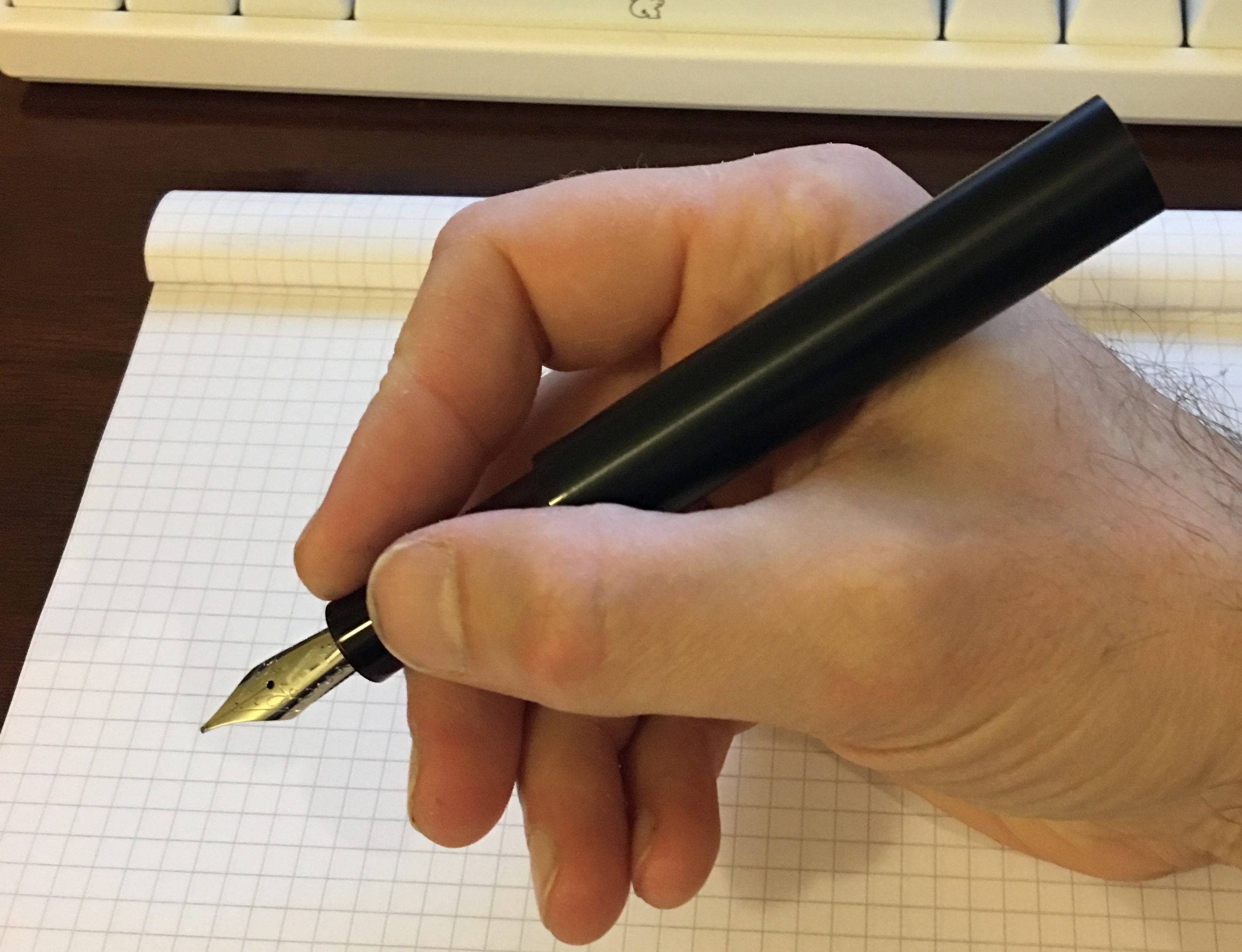
The TWSBI Vac Mini unposted.  I've found that it works fine for short notes.

Which brings me to a second commonly heard criticism of the Vac Mini:  to post the pen, you have to screw the cap onto the threaded end of the pen (the "end cap").  Some users have complained that this process takes too long, and makes this "pocket pen" too inconvenient to carry if you're someone who constantly caps/uncaps/posts/unposts the pen to take notes in short bursts. As I noted above, I've not had too much trouble in this regard, since I find the Vac Mini fine to write with unposted for brief periods of note-taking.  

Many people will also have to pay attention to the orientation of the clip when you post the cap.  The end cap is double-threaded, meaning that there's more than one way to screw on the cap, and as a result the clip can end up facing up or down. To some people, this means that the clip will end up "digging into your hand" or "not digging into your hand."  My hands aren't large enough to make this an issue, but I can see how it could be extremely uncomfortable for some people.  I've taken two pictures (below), attempting to demonstrate what people are complaining about:  
View fullsize Vac Mini Cap Posted "Incorrectly"
View fullsize Vac Mini Posted "Correctly"

At least on my pen, I've found that if you start threading the cap with the clip facing "down" (away from the top of the nib), you'll end up posting the pen with the clip facing away from your hand, and shouldn't have an issue with the clip bothering you as you write. 
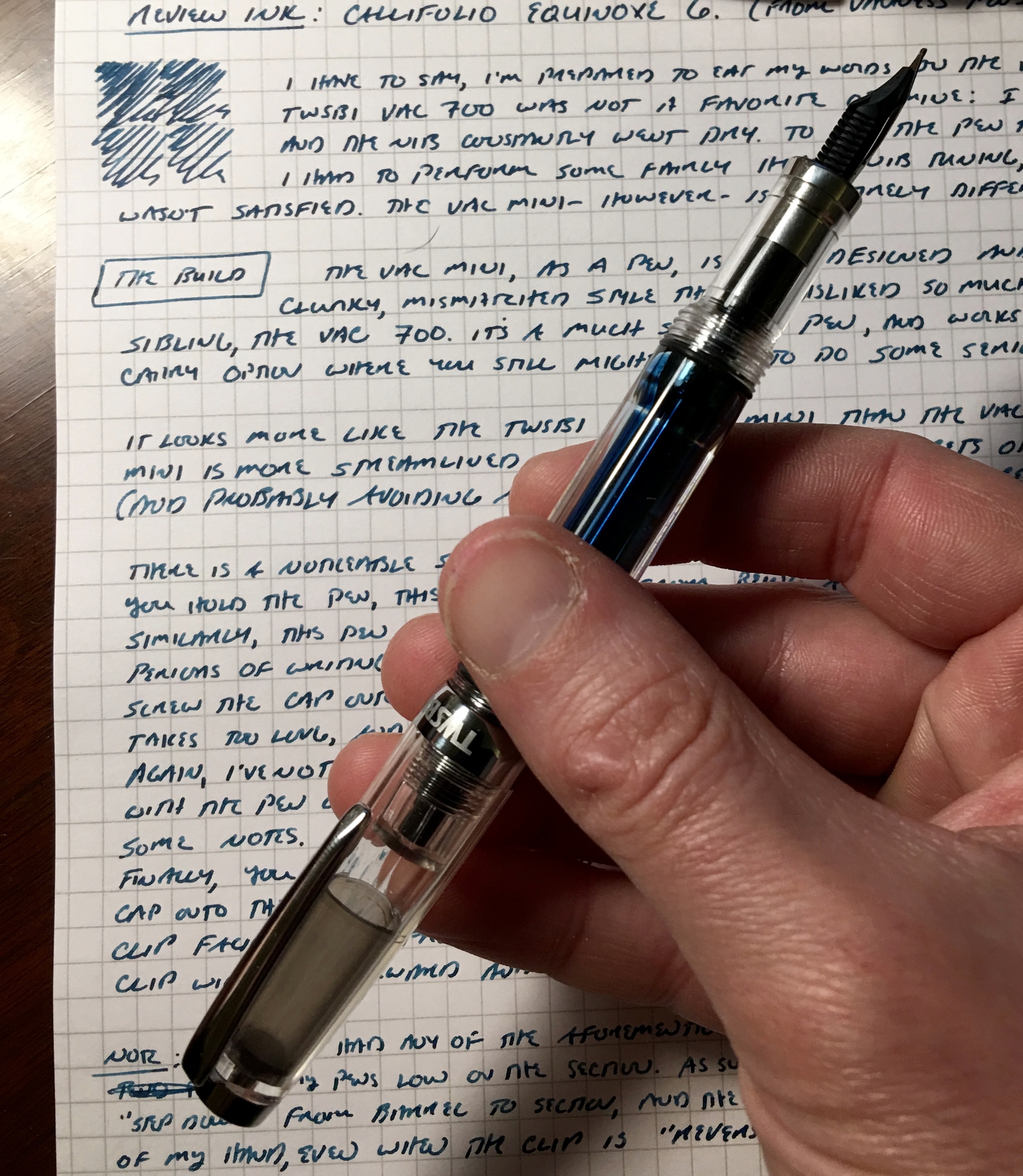
To ensure the cap posts "correctly", with the clip facing away from your hand, start threading the cap with the clip facing the feed, not the top of the nib.  Annoying at first but pretty soon it becomes second nature.  

To ensure the cap posts "correctly", with the clip facing away from your hand, start threading the cap with the clip facing the feed, not the top of the nib.  Annoying at first but pretty soon it becomes second nature.  

The Nib

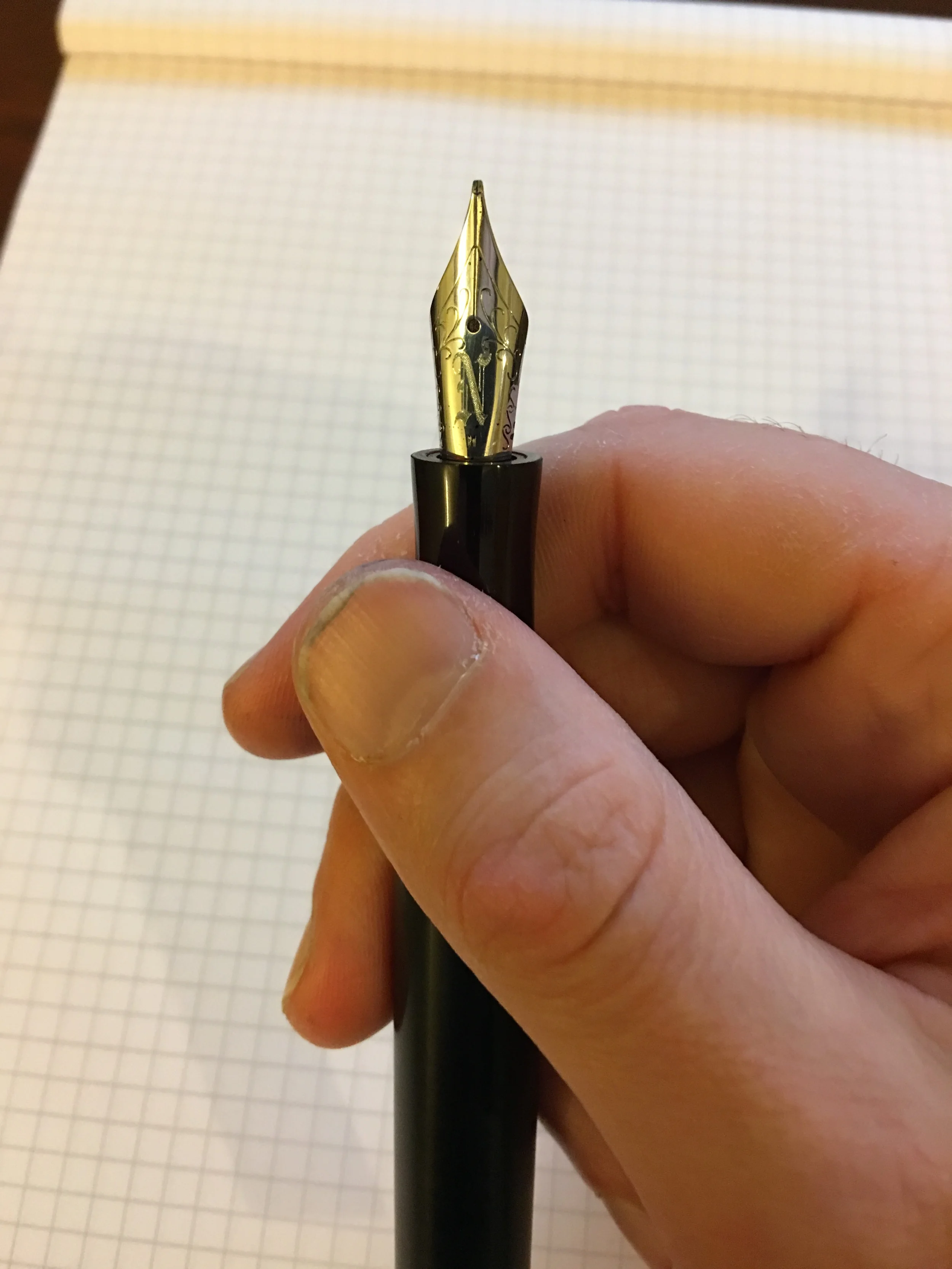
I purchased my pen with a medium nib.   TWSBI's medium nibs are what I would call a "true medium"--not too fine, but also not too broad.  This one is particularly smooth and wet, and one of the better TWSBI nibs that I've owned.  

I've always liked TWSBI's nibs (now made by JoWo), and their logo engraved on the front. Unfortunately, I don't believe the Vac Mini nib units are interchangeable.  

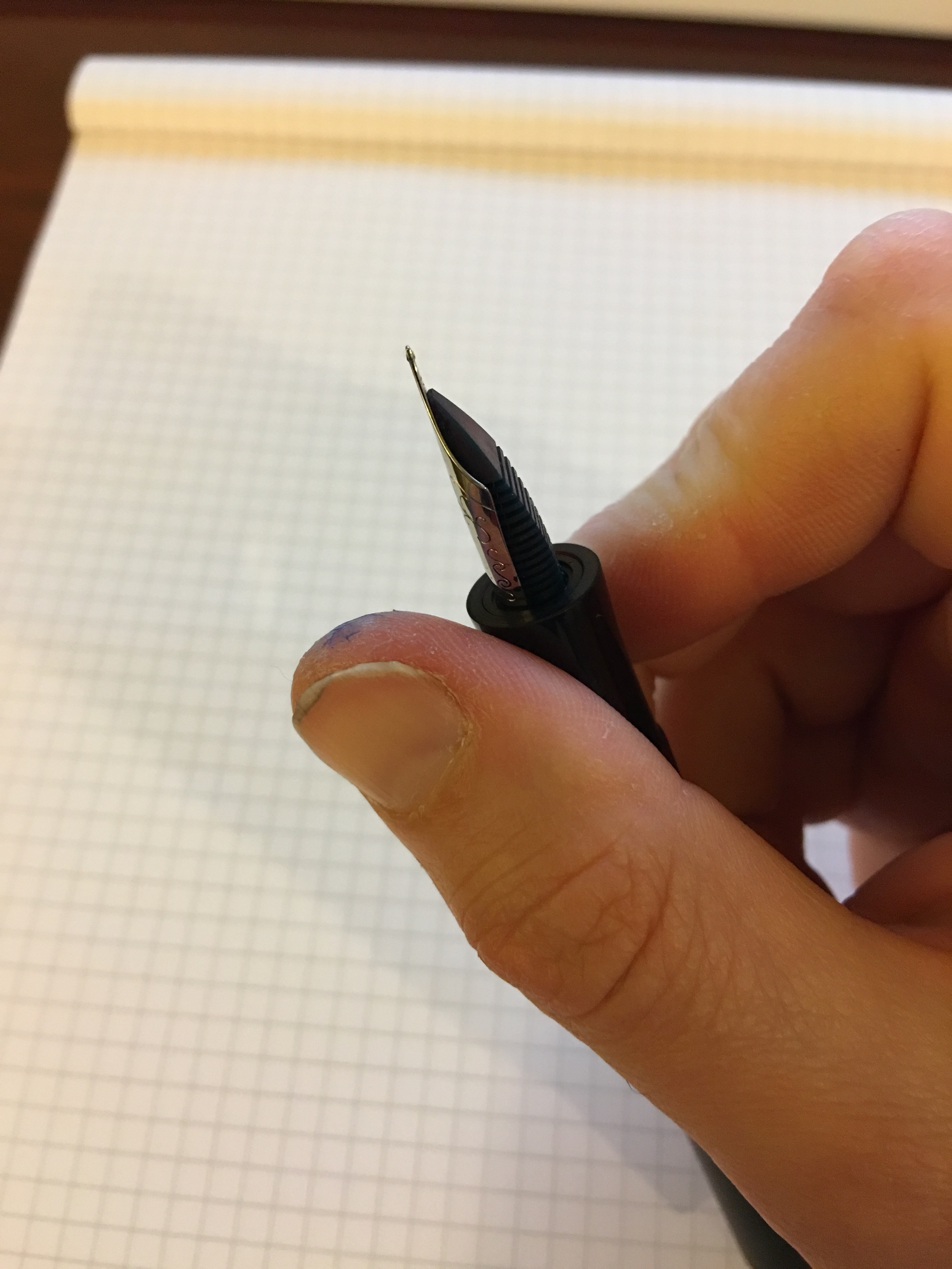
One thing to be sure to remember on a vacuum filler fountain pen:  If you are writing for a long-ish period of time (as in, more than half a page), unscrew the end cap slightly.  The metal rod that makes up the filler mechanism has a small O-ring at the end, which seals the nib and feed and prevents leaks when the end cap is closed all the way.  It's a handy feature to have on a pen that holds this much ink, and makes this a good option for airplane travel, but you'll need to open the seal before writing to allow the ink to flow freely. 

On the Vac Mini (and any vacuum-filling pen, for that matter) you should open the end-cap for longer writing sessions, to allow the ink to flow.  

Takeaways

I purchased this pen a few weeks ago, and I love having it as a part of my carry.  It's everything that I want in a pocket pen: it has a large ink capacity and writes reliably. I also prefer the more streamlined look of the Vac Mini to the sharp facets of the TWSBI Diamond 580 and the Diamond Mini. At its price point ($60), this pen will get a lot of use from me. In my opinion, TWSBI generally represents excellent value regardless of your level of experience with fountain pens. As of 2021, you can now purchase the TWSBI Vac Mini directly from T.G.S. via The Curated Shop.  

I am not, however, going to add the Vac Mini to my list of Top Fountain Pens under $75.  Why not?  Risk of new user confusion. I think the filling system and the mechanism for posting the cap are too complex for most users to want to bother with. I'm a pen geek, and things like screw-on caps and vacuum filling systems are fun for me to play with. The average user, or someone looking to buy their first fountain pen, probably should not buy this pen over a cartridge/converter pen or a piston filler. The filling mechanism is more complex, and between having to unscrew the end cap for longer writing sessions, threading the cap to post, and paying attention to how the clip is oriented to prevent discomfort, that's a lot for a new user to have to deal with. If you are just getting into fountain pens, the TWSBI Eco is probably the better buy for a fountain pen newbie, at half the price.     

AND....it wouldn't be a TWSBI without the famous red logo on the top of the cap!  

Further Reading

On the whole, the reaction to the Vac Mini has been positive.  As I mentioned above, however, some people have found the Vac Mini too difficult to post/unpost quickly, making it less unusable for them as a pocket carry.  Check out Matthew's review over at Nib & Ink for this perspective.  Azizah over at Gourmet Pens liked the pen, on the whole, but wasn't crazy about the aesthetics of the pen and thought her broad nib was on the dry side.     

DISCLAIMER:  I purchased this pen with my own money, for my own collection.  In the years since this post was originally published I have opened the T.G.S. Curated Shop (which is an authorized retailer of TWSBI and certain other select brands) and the T.G.S. Patreon Program, both of which allow me to support the site directly. All levels of support are greatly appreciated (but far from obligatory - my content here is free)! 
In Pens Tags Pen Review, TWSBI, TWSBI Vac Mini
4 Comments

The Lamy 2000 Stainless Steel:  the most recent evolution of a classic design. 

Pen Review: Lamy 2000 Stainless Steel

February 17, 2016

I'll be straight with you up front:  I am an unabashed Lamy 2000 fan and consider it to be one of the greatest pens ever designed.  I have two of the black Makrolon models:  one in an extra-fine nib, and one with a custom .6mm stub.  You could say it was inevitable that I'd eventually get around to adding the Stainless Steel model to my collection.  While I wouldn't grant this pen the same "legendary" status as its cousin, it's close, and this pen has earned a spot in my regular rotation.

First Impressions / Design

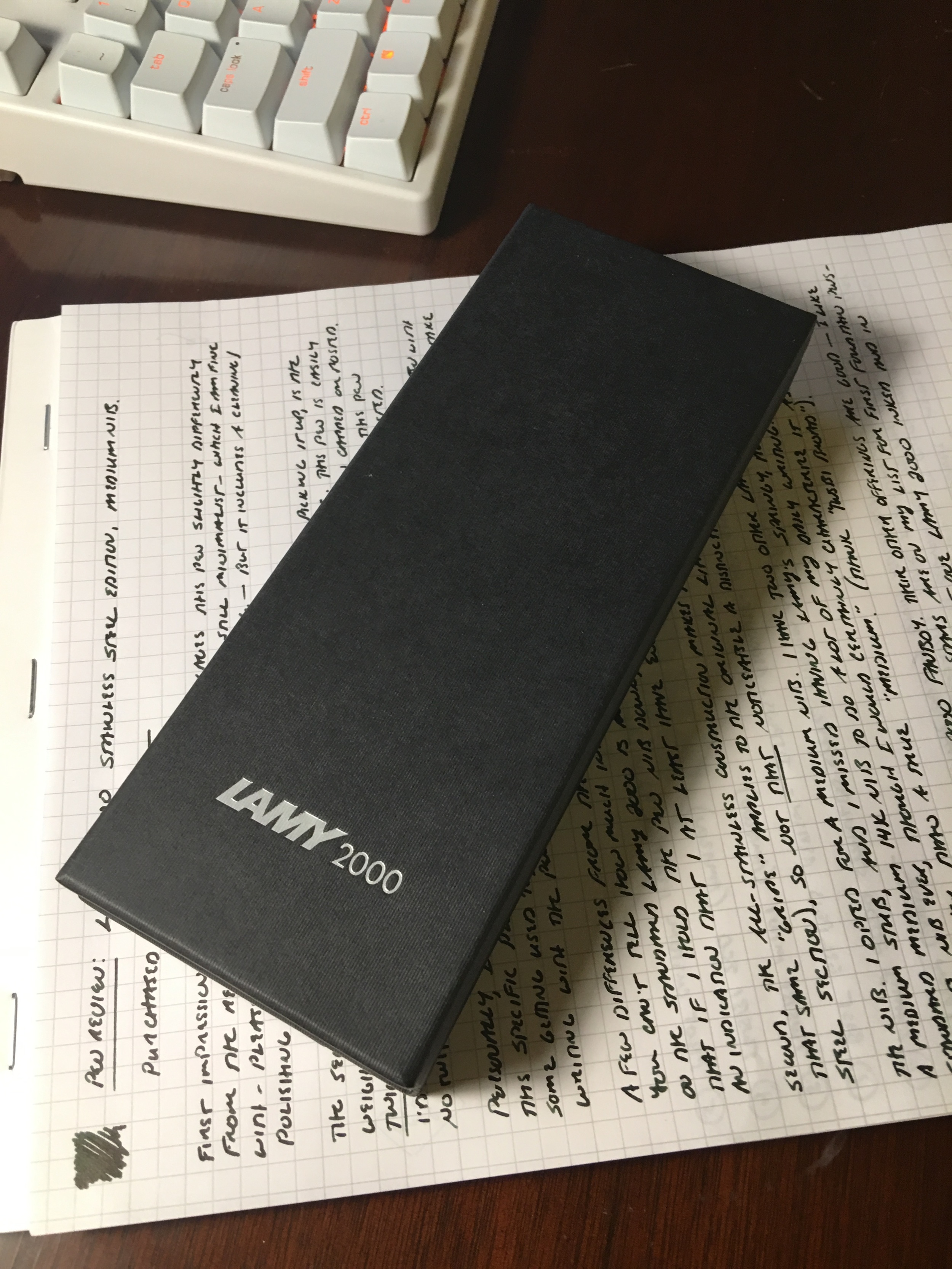
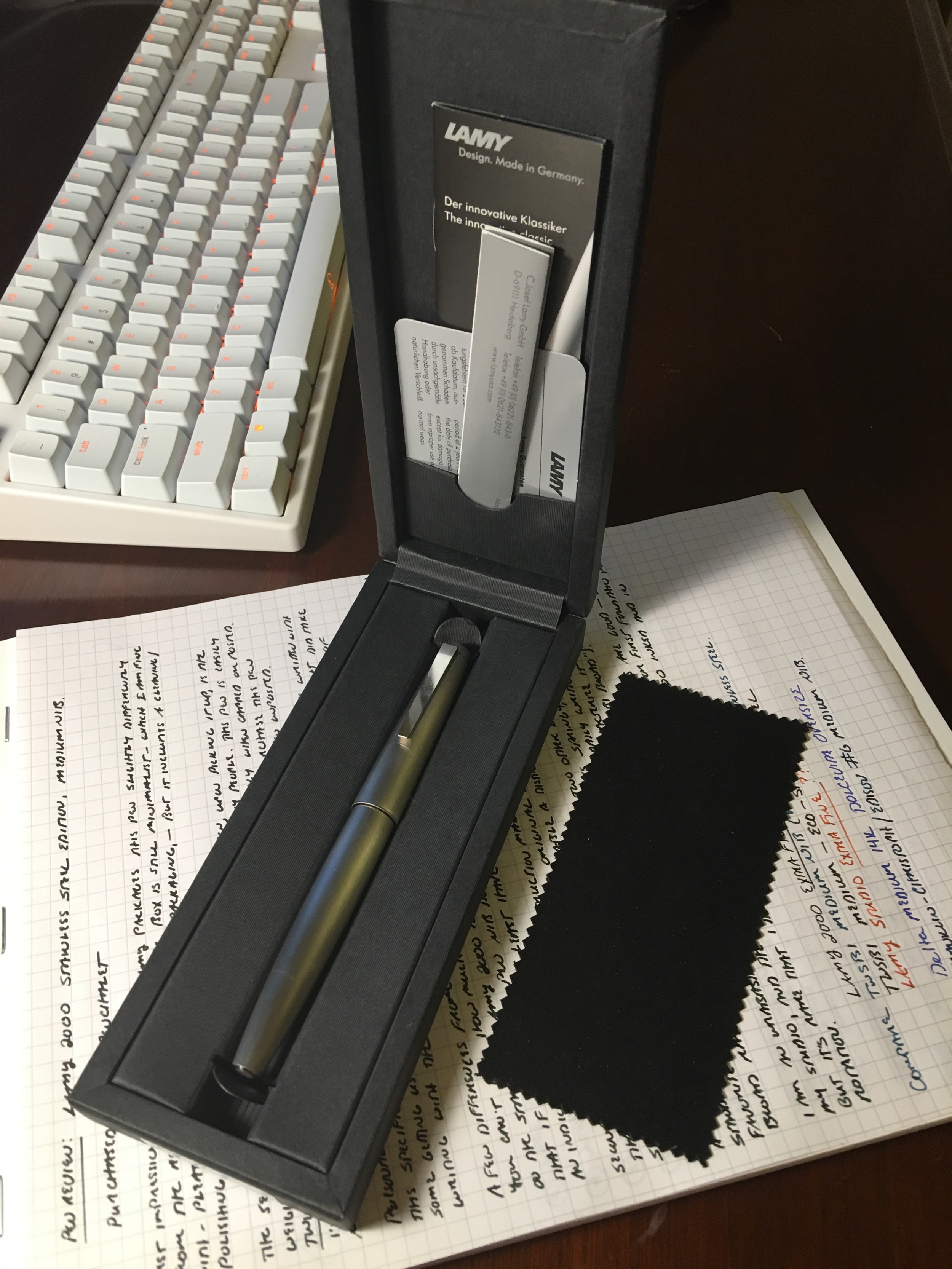
Packaging. The packaging on this pen is slightly nicer than the packaging on the original Lamy 2000, but it's still just a cardboard box. A well-crafted and somewhat eye-catching cardboard box, but still.  None of this matters to me because packaging isn't something I take great interest in unless I can repurpose it as a pen or pencil chest, like some of the more ornate wooden boxes that Delta sells with its more expensive limited edition pens.  One thing I do like, however, is that Lamy has included a polishing cloth.  It's a nice touch.  

View fullsize Lamy 2000 Stainless Packaging
View fullsize Lamy 2000 Stainless Clamshell box

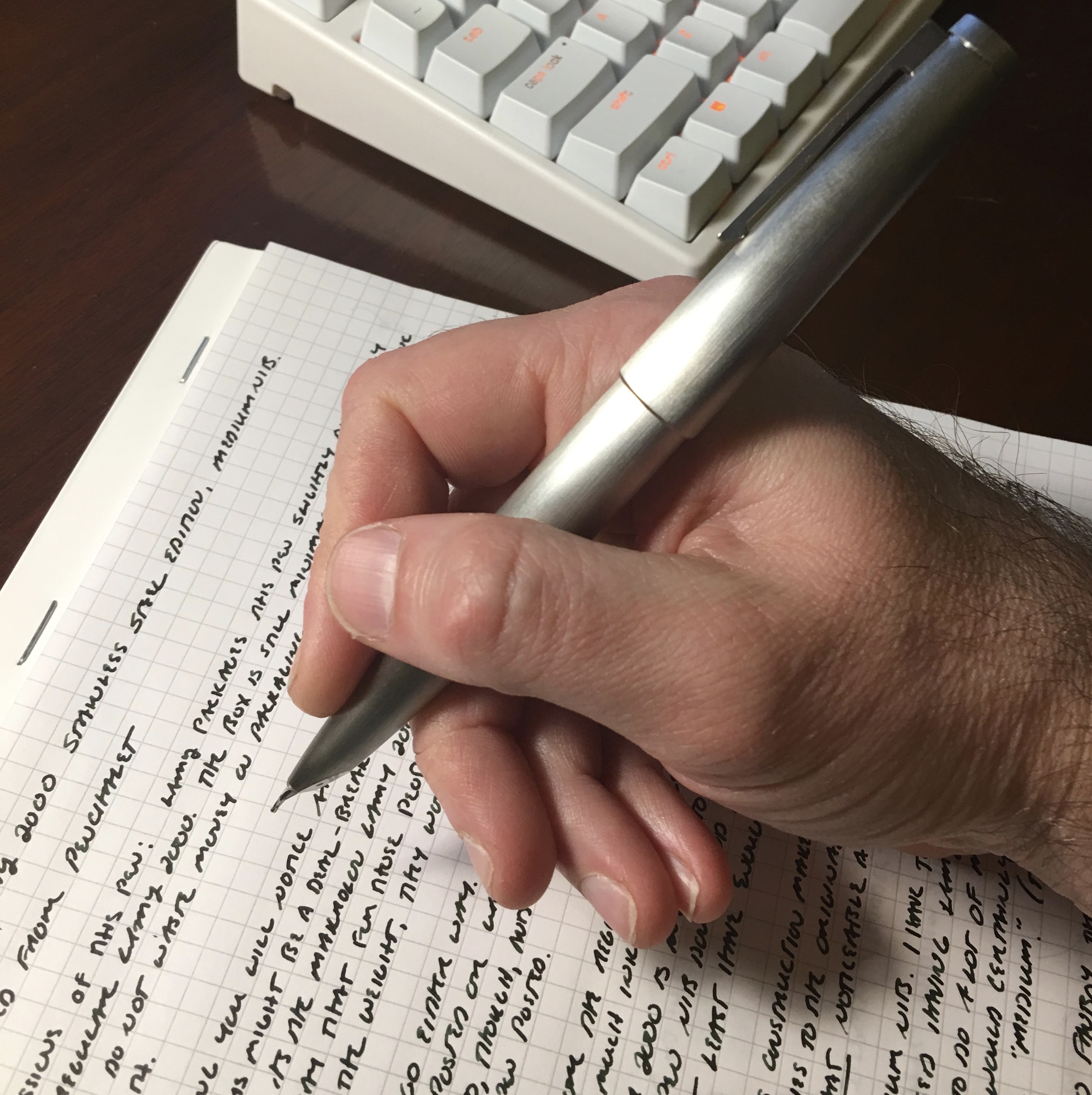
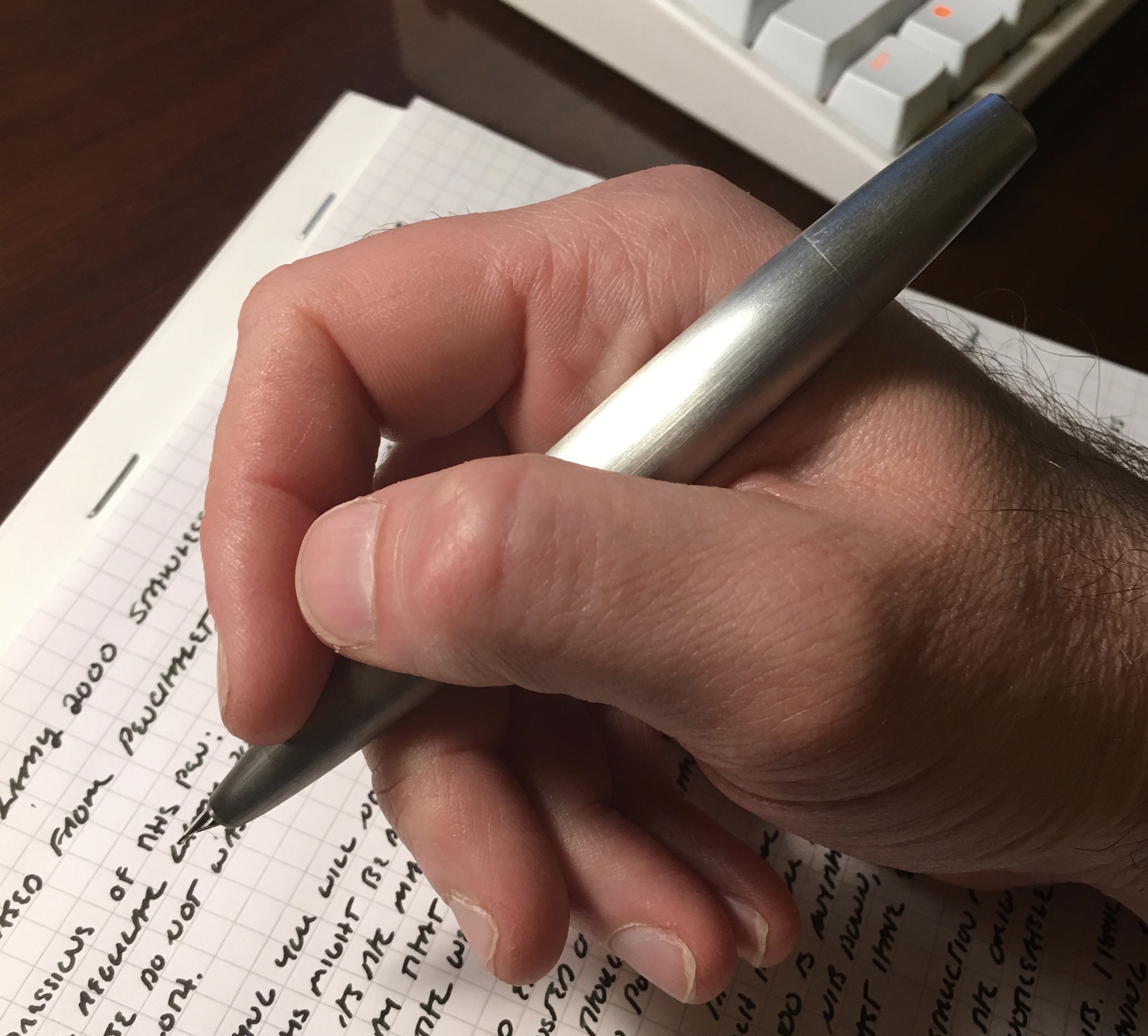
Weight.  The first thing that will strike you about this pen is that it is heavy.  Everyone who reviews it comments on the weight, and how it's probably twice as heavy as the standard Lamy 2000 (maybe more).  The weight might be a deal-breaker for many people, especially if you don't like to use a pen unposted.  

View fullsize Lamy 2000 Stainless Steel Posted
View fullsize Lamy 2000 Stainless Steel Unposted

Personally, the weight doesn't bother me.  I find this pen well balanced for how heavy it is, and I've written with it both posted and unposted for significant periods of time.  Sure, the first extended writing session will make your hand a bit tired, but you will get used to it after a couple outings.  (If you have serious RSI issues, you probably won't, but then again, you're probably not scoping out the market for heavy metal pens anyway.)  On the whole, I prefer to use the pen unposted.  

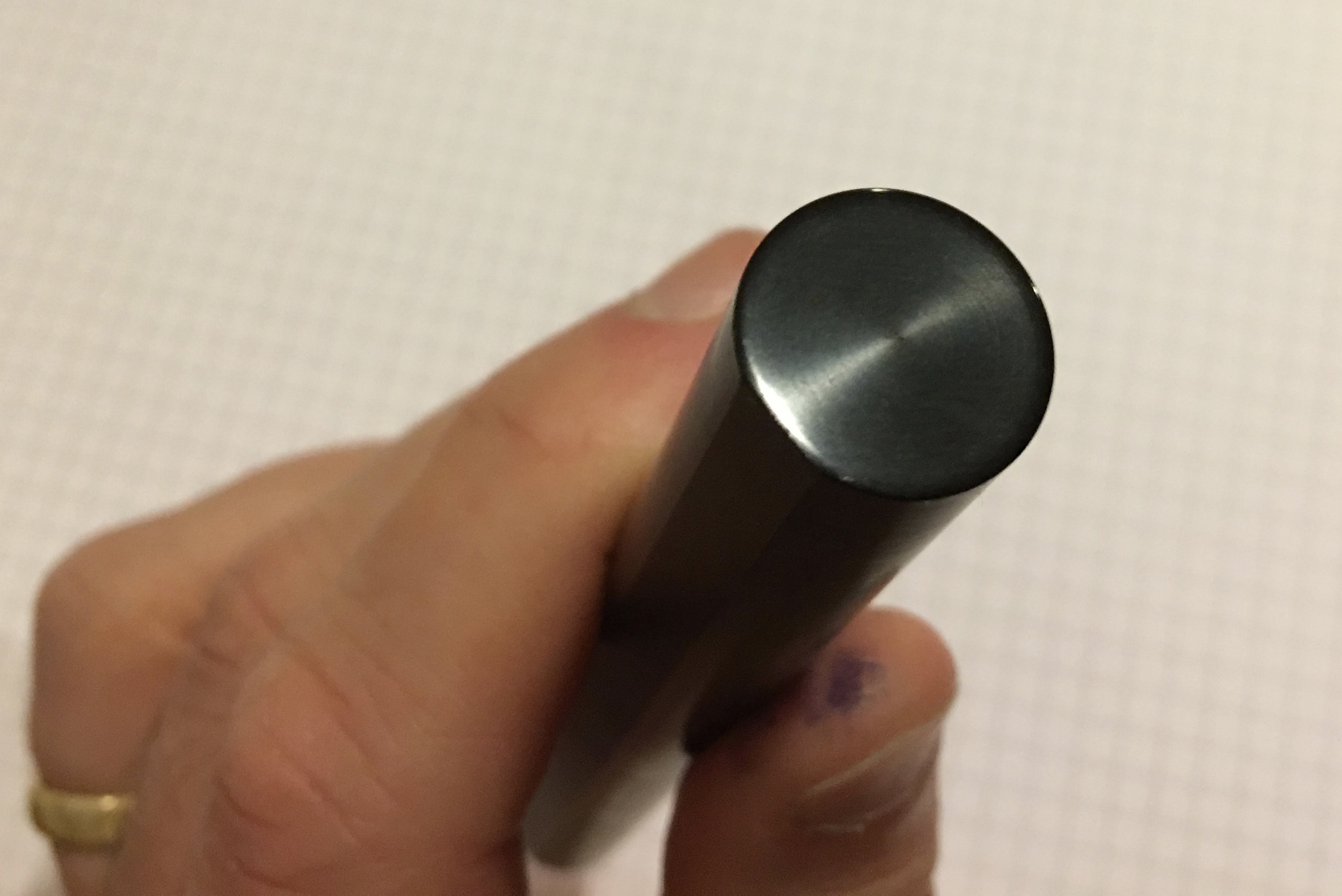
Design.  The Lamy 2000 Stainless Steel is, for all intents and purposes, the same pen as the standard Lamy 2000.  Both are piston-fillers, and can only be filled from an ink bottle.  The key differences are the material (the entire pen is made from brushed stainless steel, whereas the original only has a stainless steel section); the clip, which is polished and not matte; and the lack of an ink window.  The only change here that bothers me somewhat is the lack of an ink window on the Stainless Steel version, though I'm not sure how they could've incorporated it into the design.  (It's not as though the Lamy 2000 ink window is incredibly useful anyway:  it's opaque and narrow, but when you can see some daylight in there you at least know that you have less than a day's worth of ink left and should refill.)  I haven't figured out how to tell when the Stainless Steel model is almost empty--I'll probably have to go by the weight of the pen--but to be safe, if I'm carrying that pen and need to be sure that I have enough ink to get through a long day of writing, I generally refill before I leave the house.  

I'm a fan of the clip on the Lamy 2000 Stainless Steel.  A brushed or matte clip would be too much here, and the clip wouldn't stand out in any way.

Curiously, I don't find this pen slippery, which was a concern of mine.  Metal pens often pose grip issues, but the brushed stainless steel texture on this pen creates a nice surface that feels good in the hand.  Note:  the original Lamy 2000 has a brushed stainless steel section, so if you have grip issues with that pen, this one isn't going to work for you either.  (Actually, it will probably be worse.)  

The Nib

The medium nib on a Lamy 2000 is closer to a broad in other brands, especially if you are used to writing with steel nibs. 

I opted for a medium nib.  My two other Lamy 2000s sport an extra fine and a .6mm custom stub.  The latter began life as a medium but later had to be retipped after some failed nibwork.  I missed Lamy's big, wet 14K medium nib on the 2000, and I'm glad to have it back in the arsenal once again.  For those of you who haven't yet experienced this pen, the Lamy 2000 nibs are springy, and for the most part great writers out of the box.  (I've heard reports of quality control issues, but have never experienced any myself.)  As I've said before on this blog, Lamy nibs tend to run wide, so this medium is more of a "medium-broad", probably close to the width of a TWSBI broad nib. 

View fullsize Lamy 2000 Medium Comparison
View fullsize Lamy 2000 Medium Writing Sample

Takeaways

I absolutely love this pen, but will be the first to admit that it isn't for everyone.  The weight will turn a lot of people off, and many people just don't like metal pens, period.  It's also expensive, and you have to be a true Lamy fan to invest $300 when--let's face it--you might already own the same pen in the (much) cheaper Makrolon version.  But if you're like me, and love your Lamy 2000s, you won't care.    

As of 2022, we are direct retailers of Lamy Pens through our own Curated Shop, including the Lamy 2000 and Lamy 2000 Stainless Steel models. If you enjoy our content, please consider supporting us directly!   

Further Reading

Mike Dudek at the Clicky Post reviewed this pen (also in a medium nib), and Ed Jelley opted for a broad nib.  Something about the heft of this pen lends itself to a wider point, and a lot of ink!

If you're interested in the black Makrolon version of the Lamy 2000, you can check out my review of that pen here.  It also made my list of "Tier One" pens and best pens for your first purchase over $100. 

In Pens Tags Lamy 2000, Lamy 2000 Stainless Steel, Pen Review, Lamy
1 Comment

The Tactile Turn Mover, in Anodized Red Aluminum

Pen Review: Tactile Turn Mover

February 13, 2016

I’ve gone through multiple machined metal pens over the past three years, including most of the major “Kickstarter” projects. Very few of them have stuck with me. The two that I’ve ended up using the most are the Karas Kustoms Render K, which houses my Hi-Tec-C refill, and the Tactile Turn Mover, which is my “click pen” of choice. 

Tactile Turn: The Company 

Tactile Turn is the brainchild of Will Hodges, a designer and machinist based in Richardson, Texas.  In approximately three years, Will has created and brought to market two excellent machined pens (the Mover and its companion, the Shaker), as well as a series of gorgeous razor handles (the “Parer” and the “Pruner).  He recently concluded another Kickstarter for his “Gist” fountain pen, which fully funded and should ship this month or next.  Starting with the Mover, every Tactile Turn product I have tested has been of exceptional quality.

The Mover

Tactile Turn Mover machined pen in hand

The Mover strikes a perfect balance with respect to weight.  Many machined pens that I’ve tried are simply too heavy for longer writing sessions.  The Mover, which is made out of anodized aluminum, has good heft but won’t wear your hand out when you’re drafting multiple pages of notes.  (For comparison purposes, it’s probably closest to the Karas Kustoms Retrakt, another favorite which some jack*&ss stole off my desk at work.)  This pen might be too long for some people.  Those who want a shorter pen should go for the Mover’s sibling, the Shaker.

The Tactile Turn Nock Mechanism is sturdy, but it probably won't withstand abuse (i.e. clicking the pen repeatedly as a desk toy).

The nock mechanism (i.e., “the clicker”) on the pen is well-made and reliable.  It’s the same one that Karas Kustoms uses on the Retrakt. The stainless steel clip holds well to a shirt pocket, though some may find it a bit tight.  All of the other aspects of fit and finish on my pen are pretty much flawless.  This is a great machined pen, and to me sets the standard by which I typically judge all other entries into this market segment.   

Tactile Turn Mover ribbed grip section

My favorite aspect of the Mover is the textured (ribbed) grip section.  I don’t know whether or not it’s properly referred to as “knurling,” because it’s not the same as the grip on something like the Rotring 600 mechanical pencil—it’s more comfortable to hold and doesn’t dig into your fingers, even if you write with a heavy hand.    

The Color

I’m a sucker for red pens, and my mover is a beautiful deep burgundy-red color.  Tactile Turn offers some of the best anodized colors around, and it’s concerning that most of the anodized pens appear to be out of stock on their website.  I hope it’s just a production backlog since all of Will’s attention is now (understandably) focused on the Gist Kickstarter fulfillment.   

Compatible Refills

The Tactile Turn Mover disassembled:  There's no real art to "hacking" the Jetstream refill.  You'll need to cut it down, and apply some tape to the end to give the Nock mechanism something to latch onto.

The Mover accepts a broad range of refills (some of which require "hacking").  Tactile Turn ships the pen with a .38mm Pilot G2 refill, a personal favorite and, IMHO, one of the best ultra fine gel pen refills that is relatively easy to find at your local office supply store.  With slight modification, the Mover also accepts the hybrid ballpoint Uniball Jetstream refill.  The .38mm blue/blue-black Jetstream refill is superb, and is what I have been using in the pen recently.  Unfortunately, it's not sold separately, so you'll have to buy some disposable .38mm Jetstreams and scavenge the refills.  If you’re a fan of Parker-style refills, then you’ll need to go with the Shaker. 

Uniball Jetstream .38mm Writing Sample.  The refill is labelled blue, but the color ends up being more of a blue-black.  I'm increasingly becoming a fan of hybrid ballpoint inks.  You get the "write anywhere" qualities of a ballpoint …

Uniball Jetstream .38mm Writing Sample.  The refill is labelled blue, but the color ends up being more of a blue-black.  I'm increasingly becoming a fan of hybrid ballpoint inks.  You get the "write anywhere" qualities of a ballpoint with the smooth, dark line of a gel pen.

A complete guide to Mover-compatible refills can be found here, and Shaker-compatible refills can be found here.   

Takeaways

I’ve owned this pen for well over a year, and it’s been part of my EDC since it arrived.  I write primarily with fountain pens, but I’m practical (most of the time), so I always carry at least one ballpoint on me, which gets daily use. More often than not, that pen is the Tactile Turn Mover. This one receives a “highly recommended” rating.    

Further Reading

For some other takes on the Tactile Turn Mover, check out the PurlBug's review, which is extremely detailed, as well as Mary's review at From the Pen Cup.  If you're interested in the Titanium/Brass/Bronze/Copper versions of the Mover and the Shaker, Ed Jelley has a good writeup.  

DISCLAIMER:  I purchased the pen featured in this review with my own funds, for my own collection.  I was not compensated for this review by the manufacturer in any way.  This post does contain some affiliate links, through which I may be compensated a small amount if you purchase something from certain sites linked to in this article.  While I'd greatly appreciate it if you use these links to purchase an item you are interested in, you are, of course, under no obligation to do so.  Many thanks!     

In Pens Tags Tactile Turn, Mover, Shaker, Gel Pens, Machined Pens
2 Comments

My Newton Shinobi:  two-toned in matte black ebonite and alumilite.  

Pen Review: The Newton Shinobi

February 3, 2016

I’ve written a lot recently about consolidation, and reducing the number of things that I own, especially pens.  This year-long process started after last year’s Atlanta Pen Show, when I had the opportunity to hold and write with dozens of pens, the majority of which had been designed or customized by their owners.  I quickly realized that my sprawling collection of mismatched cheap and midrange pens wasn’t bringing me much satisfaction.  I was buying pens on a monthly basis, and purchasing whatever my budget allowed that month, rather making less-frequent, well-considered purchases of nicer pens that would bring me more long-term satisfaction.  Long story short, after Atlanta, I sold off over a dozen items from my collection and ordered two custom pens:  A Scriptorium Balladeer and a Newton Shinobi.  I’ve already reviewed the Balladeer, but it’s taken me a while to collect my thoughts on the Shinobi.    

Who is this man, Shawn Newton, and what is the Shinobi?

Shawn Newton is the (one) man behind Newton Pens, one of the most innovative pen makers active right now, and an all-around good guy.  Shawn is a former art teacher who, in addition to making pens, funds student scholarships via donations and the sale of postcards on his website. Since leaving his teaching job to focus on turning pens full-time, his business has expanded exponentially.  Now, not only does Shawn turn all of his pens completely by hand on a lathe, but he's taken the next step and offers intricate filling systems (such as piston fillers and button fillers) in addition to the cartridge/converter systems that come standard with almost all custom pens.  

The origin of the Shinobi fountain pen has been discussed in much more detail elsewhere, so rather than rehash all that I’ll focus on my impressions of the pen.  But in short, a member of the fountain pen network reached out to Shawn with the idea for the Shinobi, and the design proved so popular that it's taken on a life of its own.  Apparently there was much pent-up demand for a cylindrical pen with flat ends and a single facet to act as a roll-stopper.       

The Design 

The design of my Shinobi is not original.  I became enamored with the pen as originally conceived by its designer:  a black-matte ebonite pen with a red section, but I didn’t want bright red.  Instead, Shawn managed to source some deep, blood-red alumilite.  I love the result:  From a distance, the pen appears almost solid black, yet up close and uncapped the burgundy section stands out just enough to give it character.

There is a barely perceptible band of deep burgundy alumilite around the middle of the pen.  

My Shinobi became the first ebonite pen in my collection.  Ebonite is vulcanized hard rubber (the same material they use to make bowling balls).  It's highly durable, and was one of the original materials used in fountain pen manufacture.  Normally, you see ebonite with a heavy shine. I requested that Shawn not polish the finished pen because I prefer a matte finish, and the result is exactly what I wanted.

A close up of the matte finish on my Shinobi. 

A close up of the matte finish on my Shinobi. 

Note:  one of the first thing you'll notice about ebonite is its distinctive smell.  It's hard rubber, and it smells like rubber.  Think "car tires".  The smell fades after you've had the pen for a while, but be forewarned.  Another cool fact is that if you look at a cross-section of ebonite (such as the end of a Shinobi), it looks like a vinyl record.      

View fullsize Newton Shinobi
View fullsize Shinobi Cross Section
View fullsize Shinobi Section
View fullsize Shinobi in hand

So far, I've only used this pen with the included converter.  Ebonite pens make great eyedroppers, however, and I'm sure that once I've found a suitable ink, I'll go that route.  I'm still waiting to decide on an ink that I won't get bored with.  This is a rather large pen, and whatever ink I decide to use will be with me for a very long time.   

The Nib  

Shawn's nibwork is excellent.  I asked him to grind a medium stainless steel nib to a cursive italic.  The ink is Emerald of Chivor, which appears dark here because the nib writes fairly wet.  

Shawn uses German JoWo nibs, available in either 14K gold or stainless steel.  These are the same nibs used by Edison, Franklin-Christoph, and Scriptorium.  (Unless you are providing the penmaker with a specific nib you want them to use for your pen, JoWo nibs are really the only quality nibs that are readily available to small-scale penmakers.) While I have never used a JoWo 14K nib, the steel nibs are consistently very good.  They may not offer the most exciting writing experience, but they are dependable writers that also serve as a solid base for nib modifications.  See, in addition to being a talented penmaker, Shawn Newton also does nib work.  I had him grind the medium stainless steel nib on my Shinobi to a medium (.6mm) cursive italic.  The nib provides great line variation while still being a fairly wet writer:  perfect for my writing style.   

View fullsize Newton Shinobi Nib

Overall Experience and Takeaways

The Shinobi offers a great writing experience.  The balance and weight of this pen is perfect for me.  Some people complain about the somewhat steep step-down from the barrel to the section, but this pen fits my hand perfectly.  If the barrel/section step is something that you're finicky about, worry not.  Shawn can customize every pen to your specifications, and I know more than one person who has asked Shawn to modify the section of the Shinobi to make the grip more comfortable for their particular writing style.

I plan on adding another to my collection sometime in the future, once my wallet recovers from 2015.  While I have seen at least one Shinobi with a piston-filling system, as I dive ever deeper in to this hobby, I've come to appreciate the versatility of the cartridge/converter/eyedropper model and am glad that I went with the basic design.  At some point I'll add a second Shinobi to my collection, and that pen will likely be clear acrylic, so that I can set it up as an eyedropper and watch the ink slosh around inside.    

More so than any other pens I own, my custom pens from Shawn, Renee (of Scriptorium Pens), and Brian Gray (of the Edison Pen Company) are functional pieces of art.  These pens are not only a pleasure to use, but they’re visually stunning and make me smile every time I see them on my desk.  You can check out more of Shawn's work over at his website. 

Other articles discussing the Shinobi

Thomas Hall’s Review of the Shinobi, in which he discusses its history and design.  
Leigh Reyes’ excellent video of a Shinobi fountain pen being made.  
A Peaceable Writer also has a great writeup. 

I purchased the pen featured in this review with my own funds, and have not been compensated in any way for this review by Newton Pens.

Correction:  Shawn kindly reached out to let me know that a previous statement in this article was incorrect. Shawn's Newton Pens Scholarships are funded via the sale of postcards and donations, not via a portion of sales from the pen business.  The error was mine alone.  Please check out the details here.  


In Pens Tags Pen Review, Custom Pens, Newton Pens, Shinobi
2 Comments

The Jinhao X450:  one of the most commonly available eBay fountain pens. 

My Thoughts on Cheap eBay Pens

January 27, 2016

A common question that I get from readers, and one of the suggestions that appeared in response to my New Year's Giveaway was "Write a piece on Chinese Pens."  By "Chinese Pens," most people are referring to pens sold under certain Chinese brand names (Jinhao and Baoer, among others) and can be purchased for very little money on eBay or Amazon Marketplace.  This is something of a misnomer and can be misleading:  Many pens are manufactured in China, including pens sold by well-known, established brands such as Monteverde and Conklin.  Other pen companies use Chinese-manufactured parts.  To avoid confusion, this piece is going to look at the first category (the cheap, mass-produced eBay pens), and give you my thoughts on why I think these pens aren't really worth your time and money. 

Chipped enamel finish on Jinhao X450, purchased on eBay.

I've written about Jinhao pens before, when I reviewed the X450.  My review wasn't exactly glowing.  The main virtue of the Jinhaos (and Baoers, etc.) are the price:  these pens are ridiculously cheap.  You can find them for sale on eBay for as little as $3.99, shipping included. As you might expect, however, you generally get what you pay for.  For under $5, they are, objectively, a "great deal," if you receive a serviceable writer and the merchant doesn't send you pen with chipped enamel finish and a bum cap. (You can guess what happened to me.)  

Sure, you can ask for your money back, throw the pen away, pay another $5, rinse and repeat, but at that point I don't see why you wouldn't spring for a $12 Pilot Metropolitan, which in my opinion is the greatest entry level fountain pen available and could very well be the last fountain pen you ever need.  Even the Pilot Kakuno writes better than the best-writing Jinhao I have tried. Also, one of the main reasons I am drawn to this hobby is because I don't like disposable pens.  When you adopt the mindset that you are only going to purchase $5 fountain pens off of eBay so you don't have to worry about losing or breaking them, or can always throw them away when they stop working, you're forgoing one of the main benefits of using fountain pens: the pen is NOT disposable, but rather becomes something you use daily, and, if you want to foist the expectations onto your children or heirs, something you can pass on and have the next generation use as well.  If you want a disposable fountain pen that writes exceptionally well, just pick up a pack of Pilot Varsities.

I think a lot of people, my past self included, see these inexpensive pens on eBay as a way to quickly build a "collection" of fountain pens and have some daily variety at a budget price. There's nothing inherently wrong with this, but I would venture that you can get more satisfaction--and save yourself a LOT of frustration, by growing your collection slowly and spending just a bit more money on a smaller number of pens.  One or two slightly more expensive pens purchased from a merchant who can service the product is a better long-term bet than 10 cheap semi-disposable eBay pens.

That said, if you like the aesthetics of these pens (and the Jinhao x750 in frosted black is a nice looking pen), I would recommend that you pay slightly more money and purchase the pen from a merchant like Goulet Pens or HisNibs, which typically inspect the pens before they ship them to ensure they are not defective, and will allow you to do an easy return if you are dissatisfied.  (I have not purchased from HisNibs, but the retailer appears to be popular on various pen forums, and the website claims that they fill, test, and, if necessary, adjust all pens prior to shipment.)  

Final Note:  As to the argument that certain pens available on eBay "look exactly like Montblancs" or "look exactly like Lamy Safaris" at a fraction of the price, as a general matter I don't support trademark infringement, and won't recommend that you purchase those pens for that reason.  Nor will I link to those pens directly here.  As to why these pens are so cheap, and the implications of supporting the economic model that allows this sort of lowball pricing to exist, I would recommend that you read this article from Fountain Pen Economics.     

The opinions expressed here are my own, and I understand that many people might disagree with some (or all) of what I have written. The purpose of this blog is discussion, and I welcome any comments or feedback.  As always, thanks for reading!    

DISCLAIMER:  This post contains some affiliate links, through which I may be compensated a small amount if you purchase something from sites linked to in this article.  While I'd greatly appreciate it if you use these links to purchase a pen you are interested in, you are, of course, under no obligation to do so.  Many thanks!      

In Editorial, Pens Tags Jinhao, Chinese Pens, Editorial
10 Comments
← Newer Posts Older Posts →
Store Hours and Events
Shop T.G.S. Online
Updated 2026 "Best Pens" Guide
No results found
On The Paper Trail: Live In Nashville Event Tickets Now Available!
TGS_25 Roterfaden Restock Notification
Hierarchies of Fountain Pen Friendly Paper

Join Our Patreon!
Subscribe to the TGS E-mail List

Featured Posts

Featured
10-Fountain-Pens-Favorite-Inks
August 22, 2026
Three Keeper Inks: Choosing Inks for 10 Fountain Pens
August 22, 2026
Read more →
August 22, 2026
Everyday-Stationery-Bags
July 25, 2026
What's the Best Everyday Stationery Bag? My Own Considerations and 5 Options for Pen Show Season
July 25, 2026
Read more →
July 25, 2026
Graphilo-Kobeha-Paper.jpg
July 11, 2026
Paper Review: Graphilo by Kobeha
July 11, 2026
Read more →
July 11, 2026
The Gentleman Stationer RSS

View Cart

© Digital Divide Media, LLC, 2014-present.

All content is the exclusive property of Digital Divide Media, LLC, d/b/a The Gentleman Stationer, including “The Gentleman Stationer” website and trademark, and should not be reproduced without express written permission.  All rights reserved.

All content containing paid advertising, affiliate links, or sponsored content will be plainly disclosed by a disclaimer when/if featured.

Contact Information

Website Terms and Conditions

Store Shipping Policy and Return Policy

Privacy Policy and Cookie Policy

Accessibility Statement

Powered by Squarespace