• Blog
  • Shop
  • Podcast
  • Resources
  • About
  • Archive
  • Contact
  • Cart
  • Sign In My Account
Menu

The Gentleman Stationer

Vintage Living in the Modern World.
  • Blog
  • Shop
  • Podcast
  • Resources
  • About
  • Archive
  • Contact
  • Cart
  • Sign In My Account

Hierarchies of Fountain Pen Friendly Paper (Last Updated 6.24.26)

March 11, 2021

Years ago, I compiled a five-part resource titled “The Best Paper for Everyday Writing,” in which I looked at five different product categories that I regularly use in my working life and recommendations for each. These included hardcover notebooks, softcover notebooks, spiral notebooks, pocket notebooks, and writing pads/looseleaf. This particular post (which is semi-regularly updated), stepped back from specifics and offers more general thoughts on paper, this time going by brand.

I receive a lot of questions about which brand of paper to buy to ensure a good experience with fountain pens. Those are always tricky questions to answer because (1) “fountain pen friendly” is a relative concept; and (2) some brands use different types of paper for different products - some designed with the fountain pen user in mind, others not.

So as a baseline, what needs to happen before I will publicly recommend something as “fountain pen friendly paper”? My standard is fairly simple: No bleed-through or feathering with any fountain pen nib that can be reasonably used for everyday writing. (Because I mainly use my paper for drafting and notetaking, as opposed to drawing, wet ink samples, or flex-nib calligraphy, my standards may be more lenient than some.) I also don’t worry much about how the paper shows off ink color or things like sheen and saturation, though dry time occasionally factors into which paper I want to use for a particular purpose (i.e., quick notes). Below, I’ve divided major paper companies into “Tiers”, based on my own experience with using a range of fountain pens on their products. This is NOT intended as commentary on the overall quality of their offerings, merely to serve as a reference point on how well the paper used by certain brands tends to handle fountain pen ink according to my own standard. For example, while Field Notes is listed in “Tier Three,” that’s not surprising because the company makes pocket notebooks, and their products aren’t directed at those who want to write with a stub nib fountain pen every day. I love Field Notes, sell them in my shop, and use them fairly regularly - just not with most fountain pens.

All the Midori MD Notebooks.

Tier One

When I place a company into the “Tier One” category, it means that you can likely purchase a product based on brand alone and ensure yourself a good fountain pen writing experience.

  1. Clairefontaine. I still consider Clairefontaine the gold standard. Clairefontaine pads and notebooks feature 90g, coated writing stock that works well not only with fountain pens but pretty much any ink you can throw at it. It’s also relatively inexpensive for quality paper, making it my first choice and recommendation.

  2. Midori. Both their “MD” and “Cotton” lines work exceptionally well with fountain pens. I find the paper more absorbent than Clairefontaine - especially the cotton - with better dry times. Midori MD paper can also be found in standard Traveler’s Notebook refills and the refills used in the Plotter binder system. Midori also recently introduced a “Thick” version of their MD paper, perfect for heavy ink applications and those who want to use the paper for mixed media projects that involve watercolor and ink washes.

  3. Tomoe River. Available in 52g and 68g variants, this ultra-thin Japanese paper has taken on a cult following over the years. Even with the recent change in paper formulation, which I understand slightly changed the texture and the appearance of certain inks on the page, it remains excellent paper for writing. Though dedicated “Tomoe River”-branded notebooks can be found, typically this paper is sourced from third-party notebook manufacturers such as Traveler’s Company (“Lightweight Paper” refill), Nanami Paper, Lochby (68g), Atelier Musubi, and Odyssey Notebooks (68g) (among others). For similar though smaller-batch papers, check out Japanese Paper Distributor Yamamoto’s offerings, which change regularly. I don’t feel comfortable adding any of these as stand-alone entries as many are either not regularly available or being discontinued, hence the rotation in the Yamamoto lineup.

  4. Graphilo. I often think of Graphilo as the ultimate ink-friendly paper, given that it has almost zero bleedthrough not just with fountain pens but also with things like markers. This paper was developed by Kobeha, a Japanese stationery manufacturer based in Kobe, Japan, specifically for use with fountain pens, and Graphilo keeps getting better as Kobeha refines the product. An excellent paper for showcasing ink color.

  5. Iroful. This ink-friendly paper from Sakae Technical Paper was designed to mimic the now-discontinued Cosmo Air Light, and is known for its ability to showcase ink colors. Some find Iroful to have a too-soft texture, though not as much as Cosmo Air Light. This paper is generally seen as an improvement over Cosmo Air Light because it does not cause the ink to “spread” as much, working better with finer nibs.

  6. Maruman. Exceptionally good office or student-grade paper that comes in both spiral-bound and pad formats, in multiple sizes, in both the Mnemosyne (80g) and Basic (70g) versions. In addition to handling fountain pen ink well, the pages are perforated, making Maruman notebooks a top choice for those needing versatile paper to use in the office where filing or scanning notes is necessary. The “Basic” version is slightly lighter weight than the flagship “Mnemosyne,” but still handles fountain pen ink well and comes in at an extremely reasonable price point, making it a good solution for an everyday work or student notebook.

  7. Nakabayashi. Nakabayashi makes fountain pen friendly notebooks and paper under several different lines in multiple formats. The “Logical Prime” and “Logical Air” notebooks offer a multi-lined ruling similar to Clairefontaine French-ruled paper, and the “Yu-sari” paper is thicker paper designed to handle even the wettest of fountain pen nibs. Yu-sari paper is also sold in A5 and B5 looseleaf sheets. Nakabayashi is another relatively cost-effective option, especially if you are looking for notebooks to use in a Roterfaden, Lochby, or other notebook system/cover that uses the standard A5 format.

  8. Profolio. Similar to Nakabayashi, Profolio notebooks contain a multi-lined paper that I find quite versatile and convenient. Available in multiple sizes (A6, A5, and B5), these notebooks offer another fountain pen friendly option in a thread/clothbound lie-flat format.

  9. Life. Another Japanese paper that can be counted on to handle fountain pen inks reliably, though Life paper can be difficult to source in the U.S. and on the expensive side. Life also makes products in harder-to-find paper styles such as bank paper, typewriter paper, and Airmail/Onionskin paper.

  10. Apica. Though Apica primarily makes very slim notebooks with lower page counts - a product I don’t use extensively - their paper is very fountain pen friendly and cost effective.

  11. NOLTY. A relatively inexpensive Japanese brand that is sold everywhere to the point where it almost seems like commodity stationery. Regardless, I’ve found NOLTY products to be incredibly fountain pen friendly and am doing my part to see them become more common in the United States. NOLTY paper comes in white and off-white variants, and while they are known for their planners, NOLTY notebooks are also excellent.

  12. Stálogy. I love Stálogy’s 365-Day and Half-Year notebooks, which feature white paper and a light grey grid. While the paper is almost as thin as Tomoe River, it’s slightly more absorbent, resulting in shorter dry times that make it more “work friendly” for quick notes. (Several lefties I know love this paper.) Stàlogy used to be included in Tier 2, but from customer reports, they have resolved some issues with bleedthrough and I’ve now included them in “Tier 1”.

  13. Rhodia. A sister company to Clairefontaine, Rhodia products have a different design aesthetic and the paper features a slightly different texture (i.e., many people find their paper slightly less slick than Clairefontaine and more absorbent, with quicker dry times).

  14. Nebula Note. Fans of more textured paper will love Nebula Note, which is made by Korean ink company Colorverse. Designed to both showcase ink color and handle everyday use, the 90gsm Colorverse paper dries relatively quickly for how ink-friendly it is. The spiral notebooks also feature perforated pages, which are eminently useful for many of us in the professional world.

Tier Two

Outside of the first group of papers, many of which are specifically targeted to fountain pen users, you have to start to think a bit about how you intend to use the notebook. Personally, I would still consider most of the paper listed in this category as “fountain pen friendly” for my own purposes (i.e., writing with EF-Medium nibs and “practical” inks), but since you may experience spots of bleed-through and feathering if you push the paper, I don’t feel comfortable discussing them in the same context as the papers listed above.

  1. Leuchtturm 1917. Having developed a reputation as a “Moleskine upgrade,” Leuchtturm has become a fixture not only at specialty stationery stores, but more mainstream retail outlets. Leuchtturm paper is quite usable with fountain pens but you may see slight “pinpoint” bleed-through with very wet nibs and inks.

  2. Lamy. Last year Lamy released a series of notebooks featuring a unique take on combination lined-grid ruling, with textured paper that behaves similarly to Baron Fig and Leuchtturm. Since this paper is quite fibrous, it doesn’t bleed but has a tendency to feather with very wet pens.

  3. Roterfaden. While known for their Taschenbegleiter organizers that are compatible with most standard size notebooks (A4, A5, and A6), Roterfaden also makes their own proprietary refills in a variety of rulings. I’d compare the paper quality to Leuchtturm and Lamy, in that it works fine with finer lines and drier inks. The biggest selling point of these notebooks is that they lie flat and work exceptionally well with the metal clips in the Taschenbegleiter.

  4. Notsu. Notsu index cards should be considered “Tier One,” because they are frankly the best I’ve ever used and feature a wide variety of different formats. In addition to the index cards, Notsu also makes notebooks and notepads with thick dot grid paper that I enjoy because it’s textured and fairly absorbent, so it dries quickly. I debated whether to include the entire brand as Tier One, but I moved it to Tier Two because as they expand beyond the Index Cards I want to see whether the paper remains consistently fountain pen friendly throughout their entire product line.

  5. Kokuyo (Standard Paper). I love Kokuyo’s “tall and skinny” hardcover pocket notebooks, and the micro-grid paper works well enough for any writing instrument I would consider as pocket carry, including extra-fine and fine nibs on my pocket fountain pens. You may see pinpoint bleed-through otherwise, depending on the ink.

  6. Laconic. Laconic paper behaves similarly to Stálogy and Kokuyo in that it works fine with extra-fine and fine nibs but is targeted to the Japanese planner market, which relies heavily on fine-tipped gel pens (particularly the erasable Pilot Frixion). I personally can tolerate a small bit of show-through, and have no issues using the wide variety of Laconic refills for practical tasks.

  7. Blackwing. I’ve been impressed with Blackwing’s standard offerings, particularly the paper in the Blackwing “Illegal Pad” writing pads. Note that the paper used in Blackwing products can vary across their special edition line, with some papers performing better than others, so I’ve placed them in Tier Two.

  8. Shorthand Press. Los Angeles-based Shorthand Press has been around for years, and they’ve recently expanded their color range to include different covers and rulings. The paper has a vintage off-white tone, and will handle extra-fine through medium fountain pen nibs reasonably well, but may struggle with show-through and feathering with wetter inks and wider lines.

Tier Three

These are brands where you shouldn’t expect much compatibility with fountain pens, and if you purchase a notebook or notepad from one of these companies, you might see significant bleed-through and feathering. That’s not to say you can’t use fountain pens, I just wouldn’t expect to be able to use both sides of a page.

  1. Moleskine. The ubiquitous black notebook that you see everywhere. If you’re a pencil or ballpoint lover, Moleskine has some great limited and special editions, but I’ve never had a good experience with any of their paper using a fountain pen, or even a rollerball.

  2. Field Notes. While some of the special edition Field Notes pocket notebooks use thicker paper, Field Notes are relegated to pocket ballpoint territory in my own personal carry. That’s fine - it’s their intended purpose.

  3. Doane Paper. One of my favorite paper rulings of all time (Doane’s signature Grid + Lines) is generally relegated to the ballpoint + gel pens + pencils rotation. While Doane paper handles fountain pen ink somewhat better than Field Notes, it’s best categorized in the same tier.

  4. Appointed. I love the feel of Appointed’s textured, thick paper, as well as their linen stock covers, but since the paper is highly absorbent (presumably due to a higher cotton content found in U.S.-made paper), it can feather and bleed with wet fountain pens. While you can certainly get by with an extra-fine or fine nib, Appointed paper really shines with pencil, where its tactile feel pairs perfectly with graphite.

  5. Any drugstore or big-box brand. Sure, occasionally you can find batches of very inexpensive imported composition or spiral notebooks made from sugarcane paper or another fountain pen compatible stock, but it likely won’t remain consistent from year-to-year and you may have to start your search over annually.

Missing Brands and Future Updates

Obviously I don’t have extensive experience with every paper brand out there, so I haven’t included many in this list and won’t do so until I’m comfortable discussing their performance with some degree of certainty. This rough guide therefore shouldn’t be read as “exclusive,” and I intend to add to it. Also, I’ve avoided commenting on small makers or boutique brands that can change their paper stock periodically. (I’m currently watching Endless, Anecdote and Levenger for this reason, but to date I’ve been impressed with their offerings. As I gain more experience with some of these and/or see that the products show consistency, I will consider adding them to this list.)

You will also note that Write Notepads has fallen off this list, due to the company pausing their consumer/retail line to focus on B2B sales and custom work. While I hope they return at some point in the future, I have not included them due to the lack of availability. Similarly, Baron Fig has fallen off the radar in recent years, but I still draw from my stockpile. I love the texture of the old Baron Fig paper, especially with pencils, but I can no longer speak to how the current stock handles fountain pens as I have not bought any in some time.

UPDATE: If you’re interested in how paper and notebooks are sized, check out this post comparing various popular sizes (i.e. A4 vs. A5 vs. A6).

All links are to Gentleman Stationer Reviews, the T.G.S. Curated Shop, or to my friends at Vanness Pens. This post does not contain affiliate links.
In Paper Products, Notebook Review, Guide Tags Guide, Paper, Editorial, Fountain Pen Friendly Paper
67 Comments

Traveler's Notebook Tutorial: How to Connect Multiple Refills and Accessories

February 27, 2021

I’ve used the Traveler’s Notebook for years, and regard it as one of the best options for carrying multiple notebook refills inside a single cover. Want to carry a planner, notebook, and sketchbook together, with different papers? You can do that! While connecting multiple refills can seem tricky at first, it’s easy and intuitive once you get the hang of it. The general rule of thumb to remember: A primary refill secured to the notebook cover using the center elastic cord serves as an “anchor” for the entire system, allowing you to add additional refills and accessories using connecting rubber bands.

Changing out a single Traveler’s Notebook Refill is easy - just open the refill to the “staple page” and slip it under the center elastic cord. But most people will want to maximize this notebook system’s versatility. Read on to learn how to add mor…

Changing out a single Traveler’s Notebook Refill is easy - just open the refill to the “staple page” and slip it under the center elastic cord. But most people will want to maximize this notebook system’s versatility. Read on to learn how to add more!

Collect Your Traveler’s Notebook and Supplies

In order to assemble a Traveler’s Notebook containing up to three refills, you will need three things: a Traveler’s Notebook, your three refills of choice, and a package of connecting rubber bands. For this demonstration, I’m using a Passport size Traveler’s Notebook in “Camel” leather, but the process is the same for the Standard size. Here, I will walk through three different setups: a Traveler’s Notebook with two refills, a Traveler’s Notebook with three refills, and a Traveler’s Notebook with three refills plus accessories.

Clockwise from top left: Traveler’s Notebook Connecting Rubber Bands, Traveler’s Notebook Passport in Camel, Blank MD Refill (included in the Traveler’s Notebook Starter Kit), MD Paper Grid Refill, and Tomoe River (“Lightweight” Blank Refill).

Connecting Two Refills

To set up a Traveler’s Notebook with two inserts, attach the first to the notebook cover using the elastic cord, the same as if you were going to set your notebook up with a single insert. Take your second refill and place it next to the first, closed spine-to-spine.

Next, open both notebooks to their respective centers. Holding the two covers together, as shown here, loop a connecting rubber band over both notebooks. In your original refill, the rubber band should sit alongside the elastic cord. That’s it!

A two-refill notebook is perfect for a planner + notebook setup.

Connecting Three Refills

To assemble a Traveler’s Notebook with three inserts, start by picking your three books and decide the order in which you want them to appear in the notebook. Place the first and third inserts back to back, and set the second one aside for the moment.

Open the first and third refills to their centers, and using a connecting rubber band, attach them as shown above, similar to how you connected the inserts in a two-refill notebook.

Close the two refills, and set them face-down on the inside of the Traveler’s Notebook Cover, spine-to-spine and connected by the rubber band.

Gently pull the two notebooks apart, and pull the elastic cord up between the two refills. The connecting rubber band should be just loose enough to allow you to do this easily.

Slip your middle refill underneath the center elastic cord. There! You’ve now secured three refills inside.a Traveler’s Notebook!

Traveler's-Notebook-Three-Refills.jpeg

Adding Accessories

Your Traveler’s Notebook is only limited by how thick you want it to be. In addition to three refills, connected as demonstrated above, I’ve included a PVC Zippered Pouch and a set of TRC Sticky Notes on my Standard Size Traveler’s Notebook.

Attaching the PVC Pouch is pretty easy. I simply slid the pouch underneath the refills through the main elastic cord.

I then attached the Sticky Notes to the PVC Pouch using another connecting rubber band.

The Sticky Notes insert is actually a slim folio, with a think PVC cover to protect your unused stickies. Open the folio and slip the connecting rubber band over the cover and the PVC pouch, much the same as you would connect two notebook inserts.

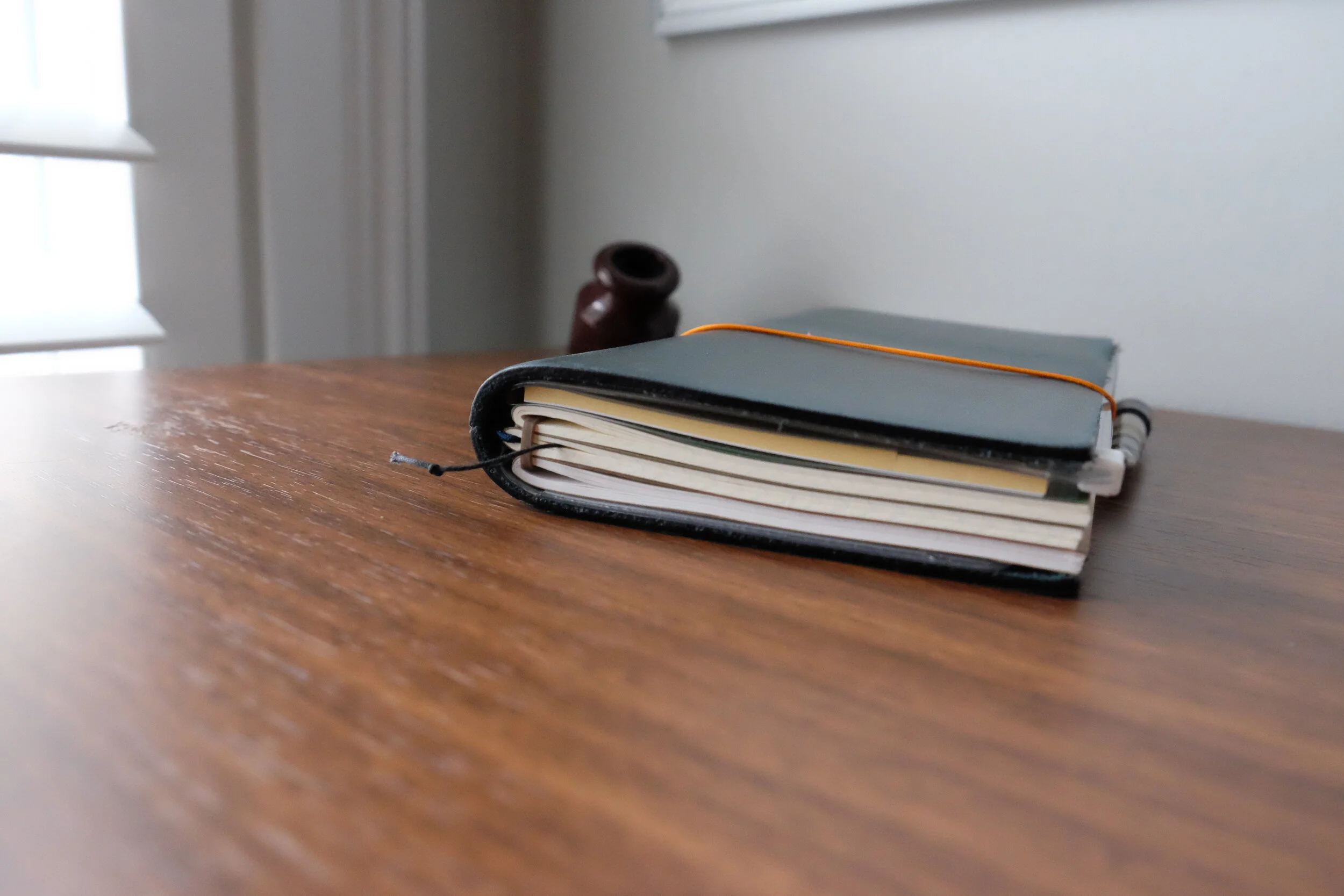
My current Standard Traveler’s Notebook is set up with three paper inserts and two accessories - in other words a total of FIVE refills + accessories. This obviously increases the thickness and weight of the notebook, but it also transforms it into …

My current Standard Traveler’s Notebook is set up with three paper inserts and two accessories - in other words a total of FIVE refills + accessories. This obviously increases the thickness and weight of the notebook, but it also transforms it into a powerful all-in-one tool.

Traveler’s Notebooks and Accessories in the T.G.S. Curated Shop

All of the Traveler’s Notebooks, refills, and accessories pictured here are available for purchase in the T.G.S. Curated Shop. As an authorized Traveler’s Company retailer, we carry Notebook Starter Kits, MD Paper Refills, Planner Refills, Specialty Paper Refills, and Accessories, in addition to TRC Brass products such as pen cases, rulers, and clips. Please feel free to reach out through the site if you have any specific questions about Traveler’s Notebook products and how to use them. If you’re interested in reading further on my own Traveler’s Notebook setup, check out this recent post in which I walk through the standard setup pictured here.

In How To, Guide, Notebook Review, Planners Tags Traveler's Notebook, Traveler's Company, How To
4 Comments

An Old Favorite, Often Overlooked: The Quo Vadis Habana Journal

February 17, 2021

Maybe it’s the fact that this year represents my tenth anniversary of becoming a serious pen-and-paper hobbyist, but I’ve found myself going back through my stationery drawers and pulling out products I used to use a lot, but for whatever reason have set aside. One of these is the Quo Vadis Habana, which was my go-to daily journal/everyday notebook for about two years in the early 2010s.

Yes, that’s dot grid Clairefontaine paper!

Better known for their planners than their notebooks, Quo Vadis is distributed in the United States by Exaclair, alongside French stationery products from Rhodia, Clairefontaine, and Herbin. While the notebooks are made in the U.S., they use Clairefontaine paper, so it’s probably safe to assume there’s a relationship between the brands beyond distribution. Back when I first used the Habana as my primary notebook, they featured the exceptionally fountain pen friendly, white lined 90g Clairefontaine paper. At some point, they moved to an ivory paper that wasn’t as versatile, and the Habana notebooks started to disappear from fountain pen-oriented retailers.

Today, the lined Habana journals still use the “new” ivory paper, which is labeled as 85g Clairefontaine paper that doesn’t perform quite the same as the 90g paper found in Clairefontaine Classic notebooks. While it works ok with fountain pens, you’ll likely see spots of bleed-through with very wet nibs. That said, while I was placing a recent Exaclair order for the shop, I noticed that the Habana is now available once again with 90gsm Clairefontaine dot grid paper, bringing the Habana back onto my radar as a serious workhorse notebook option.

Quo-Vadis-Habana-Lie-Flat.jpeg

So What Do I Enjoy So Much About the Quo Vadis Habana?

At first glance, the Habana might appear to be a standard A5-ish notebook, but it has a couple of features that I enjoy in addition to DOT GRID CLAIREFONTAINE PAPER (which I don’t think I’ve ever seen before, so I’m excited). First of all, the Habana will lie flat on a desk. The softer leatherette cover, coupled with the sewn binding and 80 sheet / 160 page format, keeps the notebook flexible enough to stay open on its own. Second, the Habana measures slightly larger than your traditional A5 notebook, at 6.25” x 9.25, offering more writing space while remaining slimmer than most notebooks. When I used the Habana regularly, I had a pretty heavy travel schedule and prioritized a notebook/journal that easily slipped into a briefcase. The Habana’s soft cover and slim size was flexible enough to carry on the go, while remaining durable.

View fullsize Habana vs. Rhodia Webnotebook
View fullsize Habana vs. Rhodia Webnotebook Thickness

Dot Grid Habana Notebooks Are Now Available in The Curated Shop

Not only am I happy to welcome the Quo Vadis Habana back into my own personal rotation/recommendation list, but I’ve added the Dot Grid Habana Journals to the shop in both red and black covers. I started the store in order to feature quality products that don’t necessarily register on the stationery hype train, and while this one may seem about as boring as it gets, standard functional notebooks such as the Habana and the Rhodia Webnotebook fill core needs in the kit of any working stationery enthusiast. I may add additional colors in the future, and I’ll be watching the paper to see if Quo Vadis goes back to 90g on the lined version.

The Gentleman Stationer is an Authorized Retailer of Clairefontaine, Rhodia, and Quo Vadis products through the T.G.S. Curated Shop.

In Notebook Review, TGS Curated Shop Tags Quo Vadis, Quo Vadis Habana
Comment

A Closer Look: Best Notebooks for a Commonplace Book

February 10, 2021

One of the new habits I've been trying to adopt in 2021 is keeping a commonplace book, which, to me, is a notebook that serves as a repository of notes, quotes, and clippings from books and articles I've read. There are many different ways “to commonplace,” in terms of how you organize your notes and index the information. Personally, I'm still experimenting with different techniques and plan to write more on this in the future, as it's become a bigger part of my everyday life and writing setup.

One thing I have thought a lot about (unsurprisingly) is which notebook works best for my style of notetaking and commonplacing. There are a range of different factors to take into account, but for me the key considerations are (1) paper versatility, meaning that the paper works well with a wide range of writing instruments; (2) portability, meaning that the notebook can move with me, not only when I travel but also when I change work locations; and (3) archival options, meaning that the notebook will hold up to long term storage and can easily be organized for posterity - after all, one reason to organize reading notes in this manner is to be able to go back and look things up later. I don’t feel like this is mere “gear obsession.” Rather, by finding a system that works for me on the front end, I will have a consistent set of notes that will be easy to reference for years to come.

  1. Write Notepads Hardcover Notebook. My current commonplace book lives in one of these lined A5 hardcover notebooks from Write Notepads. Lined paper typically isn't my preferred ruling, but ultimately (1) the paper quality and (2) the ability to store a durable hardcover notebook over the long-term won out. I can't emphasize how great these notebooks look on a shelf, and the sturdy binding will ensure they last a long time. While I’m happy with this notebook, the downside is size, as you end up having to carry an extra hardcover book with you - not a minor thing if you’re like me and prefer to read physical books as opposed to using e-readers.

  2. Traveler's Notebook. Though I’ve enjoyed the Write Notepads Hardcover Notebook, I'm considering moving my commonplace book inside my Traveler's Notebook, likely to a 128-page, "Lightweight Paper" refill. The paper quality on this refill is excellent, and while it's not labeled as such, I assume it is Tomoe River paper. Why move to a Traveler's Notebook? Portability and the ease of having all of my various notes, planners, and journals under one cover, but separated into different refills. I also use one of the PVC zippered pouches to carry some Book Darts linemarkers, and if you use sticky notes, there's even an insert for that! The downside to Traveler's Notebook inserts would appear to be the ability to archive them, but the availability of refill binders, each of which holds five used Traveler’s Notebook inserts, may solve this issue.

  3. Nanami Paper Seven Seas Writer or Crossfield. If you exclusively use fountain pens, and/or want a notebook with as many pages as you can cram into it, Nanami Paper’s Seven Seas series offers nearly 500 pages of Tomoe River Paper. This A5 notebook also fits many standard leather covers, including those sold directly by Nanami, and the stand-alone notebook is durable enough to withstand a long "shelf life" after it's filled. You'll want to keep up on your indexing as you go, however, as 500 pages will hold a LOT of notes.

  4. Index Cards, or Alternatively, Pocket Notebooks. Ryan Holiday, who writes The Daily Stoic website and has published several books, is a big proponent of commonplacing, and he also uses an index card system that's incredibly versatile, especially if you plan to use your reading notes as research for a book or another larger writing project. (Obviously, index cards are much easier to organize by topic than notes in a notebook.) The downside to this system, at least for me, is storage, since it requires a large box (or boxes) to store and index the cards. I also see how one could utilize this system with pocket notebooks, if you don't fancy the idea of carrying loose cards with you on the go. Field Notes pocket notebooks are relatively inexpensive, and you can file them away by topic using the Archival Box with included dividers.

And finally, something different...

Day One Journaling App. I’ve actually started to use two tools for commonplacing: a physical notebook and the Day One app on my phone and computer. Basically, I use a notebook if I'm taking notes on a book or magazine article that I'm reading in physical form, and I use Day One to collect links, book recommendations, and quotations from articles that I'm reading on my phone, tablet, or computer. If you haven't used Day One, it was originally designed as a journaling app but can also serve as a flexible notetaking or commonplacing tool for organizing information using dates and tags. While I don’t necessarily encourage anyone to go entirely paperless because I believe there are concrete benefits to thinking “offline” and writing things out by hand, this app is very deep, with lots of functionality.

UPDATE: A Late Addition….

I don’t recall exactly where I picked this tip up, but sometime during 2020 I started sticking “library pockets” in the back of my books, that I would use to hold index cards for notetaking while I was traveling or reading. I’d later transcribe my notes from the notecards into my commonplace book. The habit has stuck (especially for books I can’t or don’t want to annotate or mark up), but I WAY over-purchased library pockets, and accidentally ordered more than a hundred of them. I don’t want to just throw them out, so I’m giving them away. If you order a notebook from the Curated Shop (hopefully for commonplacing but it’s not necessary), I’ll throw in a couple of these pockets, free of charge. The promotion will last until I’ve exhausted my excess supply. (Just to be clear, you’ll receive two pockets per person, per order, not two pockets per notebook.)

Disclaimer: This post does not contain affiliate links, though I have chosen to stock many of my favorite items in the T.G.S. Curated Shop so that I can sell them directly. Sales through the Curated Shop and the T.G.S. Patreon Program are how I support the site.

In Editorial, Notebook Review Tags Commonplace Book, Best Paper
8 Comments

Last Call for "Old" Tomoe River? The Galen Leather Everyday Book

January 9, 2021

Over the summer, the pen community learned that the company responsible for manufacturing Tomoe River paper was changing its manufacturing processes, which would result in the “new” Tomoe River having a different feel than the current version of the ultra-thin, fountain pen friendly paper that many of us have come to know and love. For the record, I have not had the opportunity to compare the new paper side-by-side with the old, but if you’re interested in reading about the differences, I would refer you to these posts by Yagan at Macchiato Man and Daryl from Atelier Musubi. From what I can tell, Tomoe River paper will continue to be fountain pen friendly, but with a different texture (more tactile), a slightly thicker page, and a less pronounced tendency to showcase sheen on certain inks.

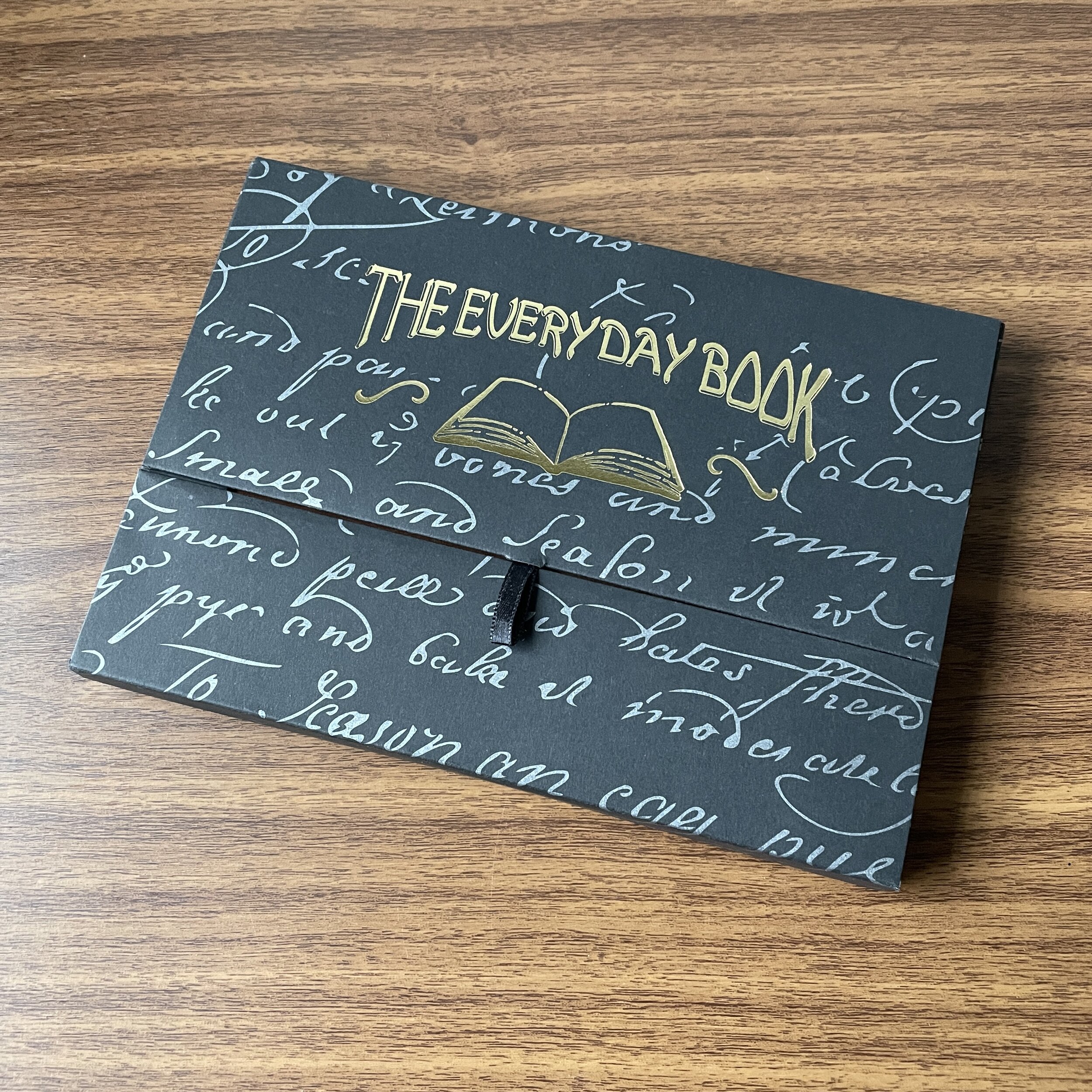
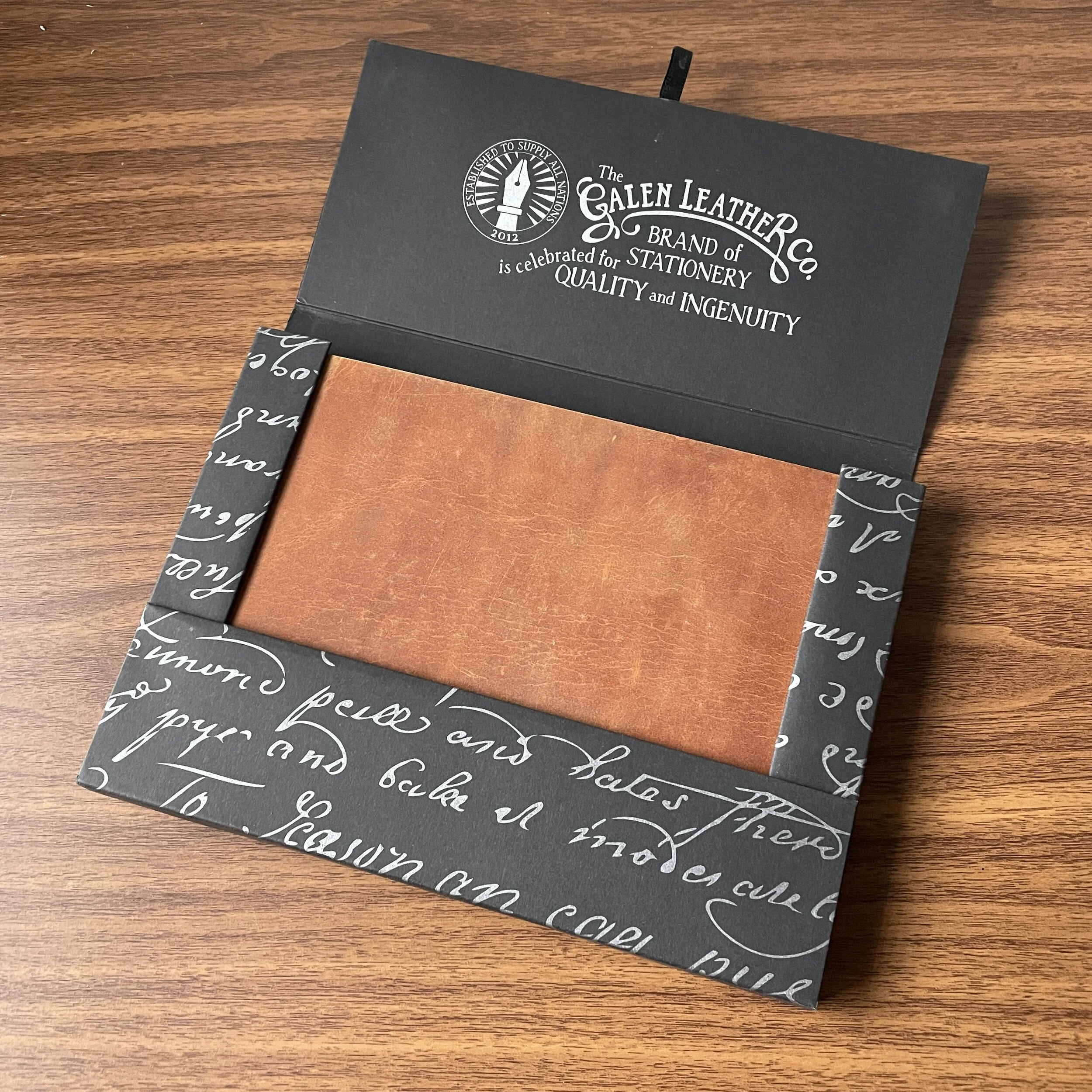
Each Everyday Book comes packaged with a leather blotter and writing guides, which can be used to create a ruled page by placing the guide sheet behind each page of Tomoe River Paper.

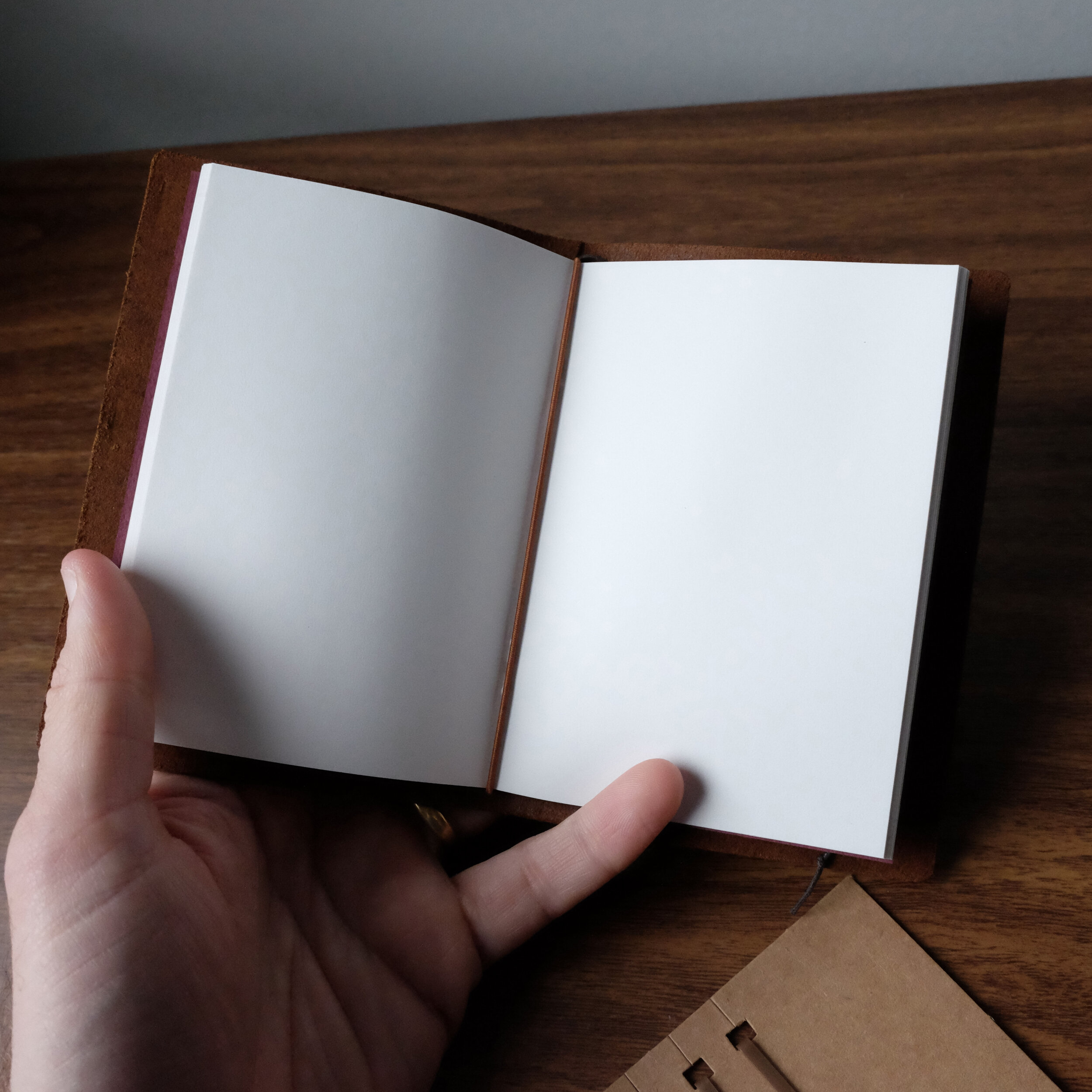
That said, as the title of this post implies, it’s still possible to get your hands on the old version of Tomoe River paper. Both Galen Leather and Atelier Musubi have large stocks, and have indicated that they will continue to use the old version until their supplies are exhausted. Today, I will take a look at Galen Leather’s leatherbound “Everyday Book,” a 200 page/400 sheet notebook that features the blank, 52gsm white Tomoe River variant and is an excellent choice for those looking for an unlined Tomoe River notebook or journal.

For pretty much every Galen Leather product I have owned, I’ve opted for the brown “Crazy Horse” leather. I love how brown distressed leather looks as it ages, especially on a book. The leather cover manages to be thin without feeling flimsy, and the flexibility allows the notebook to open and lay flat. While the Everyday Book contains blank pages, it ships with lined and grid writing guides, as well as a leather blotter in case you need to close your notebook before the ink dries. (Tomoe River paper is known for its relatively long dry times.)

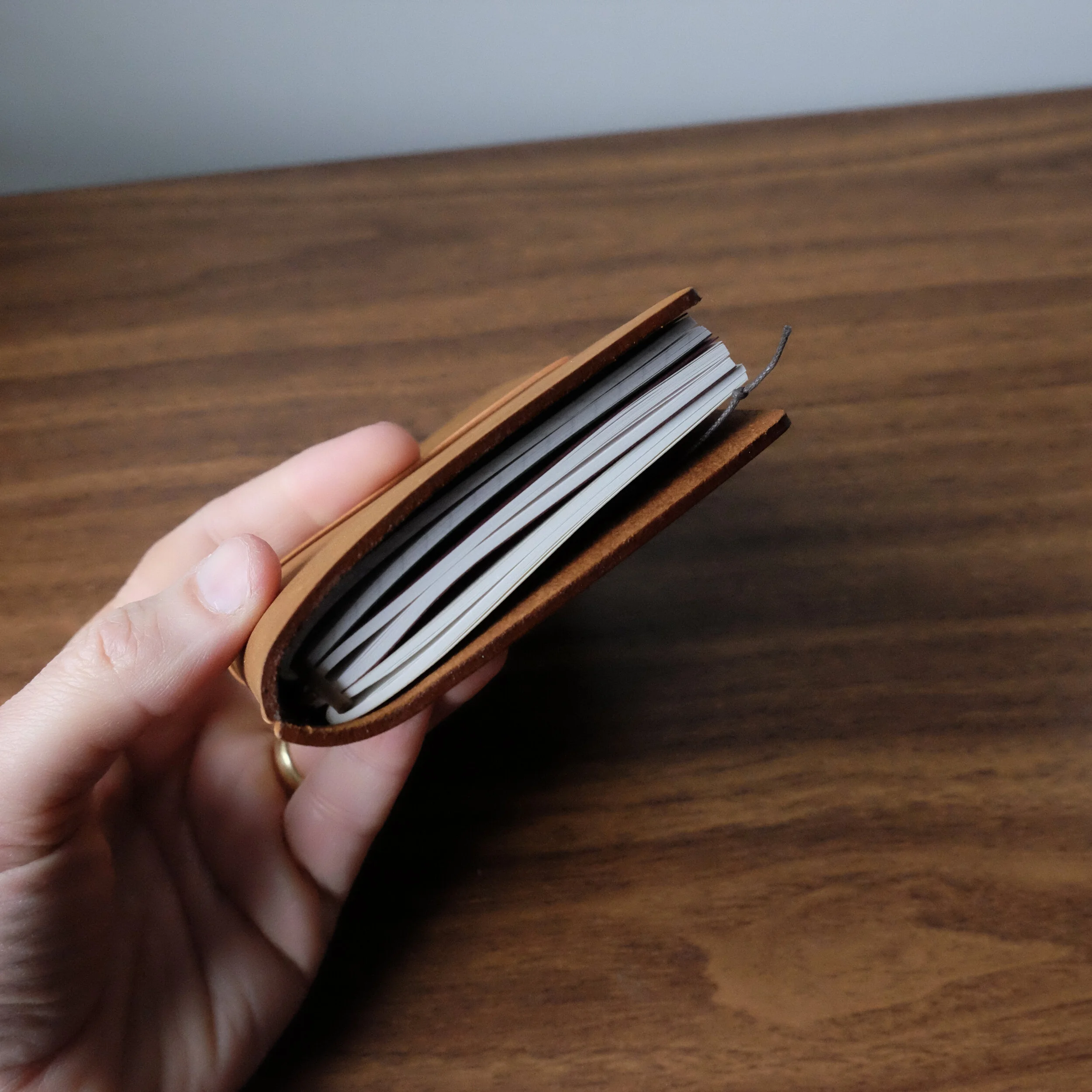
Tomoe River paper is beloved for its thinness, demonstrated here by comparing the 200-sheet Everyday Book (middle) against two other notebooks (Write Notepads Hardcover Notebook and Life x Kleid Noble Note) that contain around 100 sheets of different paper.

Takeaways and Where to Buy

Galen Leather has rapidly expanded their product offerings from leather notebook covers and accessories to include notebooks, desk accessories, and portable writing boxes/desks. I’m a huge fan of Galen Leather, including this notebook, and have used their products for years. You can purchase the Everyday Book (or “Everyday Blank Notebook” as it’s sometimes called) directly from the Galen Leather website. The A5 leather notebook starts at $36, with A6 and B6 sizes also available for $24 and $29, respectively. Some colors and sizes are currently sold out, possibly due to a run caused by those stocking up on old Tomoe River products before vendors have to move to new stock.

View fullsize Galen Leather Everyday Book Packaging
View fullsize Everyday Book Packaging Crazy Horse Brown

A Note on Tomoe River Paper Alternatives

Personally, I won’t be stockpiling “old” Tomoe River paper. It doesn’t sound as though the new paper will be any different for my purposes, as I actually prefer slightly thicker, more tactile paper, and don’t pay much attention to ink sheening or shading. For those interested in reading further about other fountain pen friendly papers that I enjoy, be sure to check out my series, “Best Paper for Everyday Writing.”

Disclaimer: Galen Leather sent me the notebook pictured in this review free of charge, for review purposes. I have not been otherwise compensated for this review. This post does not contain affiliate links.
In Notebook Review Tags Tomoe River, Notebook Review
1 Comment
← Newer Posts Older Posts →
Store Hours and Events
Shop T.G.S. Online
Updated 2026 "Best Pens" Guide
No results found
On The Paper Trail: Live In Nashville Event Tickets Now Available!
TGS_25 Roterfaden Restock Notification
Hierarchies of Fountain Pen Friendly Paper

Join Our Patreon!
Subscribe to the TGS E-mail List

Featured Posts

Featured
Everyday-Stationery-Bags
July 25, 2026
What's the Best Everyday Stationery Bag? My Own Considerations and 5 Options for Pen Show Season
July 25, 2026
July 25, 2026
Graphilo-Kobeha-Paper.jpg
July 11, 2026
Paper Review: Graphilo by Kobeha
July 11, 2026
July 11, 2026
Pilot-Custom-Heritage-92.jpg
June 6, 2026
Workhorse Pens: Pilot Custom Heritage 92 Fountain Pen
June 6, 2026
June 6, 2026
The Gentleman Stationer RSS

View Cart

© Digital Divide Media, LLC, 2014-present.

All content is the exclusive property of Digital Divide Media, LLC, d/b/a The Gentleman Stationer, including “The Gentleman Stationer” website and trademark, and should not be reproduced without express written permission.  All rights reserved.

All content containing paid advertising, affiliate links, or sponsored content will be plainly disclosed by a disclaimer when/if featured.

Contact Information

Website Terms and Conditions

Store Shipping Policy and Return Policy

Privacy Policy and Cookie Policy

Accessibility Statement

Powered by Squarespace