• Blog
  • Shop
  • Podcast
  • Resources
  • Archive
  • About
  • Contact
  • Cart
  • Sign In My Account
Menu

The Gentleman Stationer

Vintage Living in the Modern World.
  • Blog
  • Shop
  • Podcast
  • Resources
  • Archive
  • About
  • Contact
  • Cart
  • Sign In My Account

Pen Review: Cross Peerless 125 Fountain Pen

August 22, 2020

Many would argue that the remaining old-line American pen brands are mere shells of their former selves. Parker and Sheaffer, the two most known for fountain pens, have changed ownership multiple times, and while they have consistently produced pens for more than a hundred years, quality has varied wildly. A.T. Cross, (or “Cross”) traditionally has been known more for its ballpoints, mechanical pencils, and rollerballs, and particularly for serving as the official supplier of pens to the White House for use in bill signing ceremonies. From the 1960s to the present, the ultra slim Cross “Century” became a ubiquitous college and/or high school graduation gift in the United States. In recent years, Cross has taken steps to expand their offerings to include more higher-end fountain pens, a move that coincides with the company’s acquisition of Sheaffer from BIC.

Cross fountain pens first came to my attention a few years ago when I reviewed a Star Wars-themed Cross Townsend from Goldspot, which featured a “Stormtrooper”-inspired design and a Pelikan nib. Perhaps recognizing their own manufacturing limitations, higher-end Cross pens have begun to incorporate nibs from other manufacturers, including not only Pelikan but Japanese company Sailor, who made the nib on the pen I plan to review today, the Cross Peerless 125.

According to the Cross website, the Peerless line incorporates design elements from several earlier pens in the Cross catalog, fusing them together into a much larger pen than you typically see Cross release. (One critique I’ve had of the brand in the past is that I tend to find the mainline Cross pens, such as the Century, far too slim.) The Cross Peerless 125 reminds me more of chunkier American pens such as Sheaffer’s Legacy Heritage, which may not be coincidental since Cross now owns Sheaffer.

Don’t get me wrong, the Peerless 125 is a big pen, and this combination of size/weight is likely at the limit of what I can use comfortably.

The Peerless 125 features a lacquered metal body with an oversized cap, which posts deeply and comfortably despite its size. The threaded cap closes securely with 2-3 turns. I enjoy how the threads are compressed so as not to interfere with your grip when writing with this pen, and I find the wider section quite comfortable to use. If you’ve been following me on Instagram, where I’ve been posting my “daily user” to the Stories over the past week or two, you’ve seen the Peerless 125 get a lot of use.

As I mentioned earlier, the 18k nib on the Peerless is manufactured by Sailor for Cross. Though there are no “Sailor” markings, the nib and feed are unmistakeable, as is the quality. This stiff medium nib writes a smooth, Japanese medium line with just a touch of tooth - all Sailor hallmarks. For those who can’t stand the Sailor converter due to its low ink capacity and tendency to fall apart, you’ll be glad to hear that the Peerless 125 uses a Cross proprietary converter, which holds more ink and feels fairly solid. It also threads into the section for a secure fit.

The one design feature I’m not crazy about is the Swarovski Crystal embedded into the cap, in place of a traditional finial. At the same time, given the gloss finish of the pens and the engraved striations on the lacquer, it does sort of work.

Takeaways and Where to Buy

You have to give credit where credit is due: Cross has upped its game over the past few years, not only increasing the overall quality of its fountain pen offerings, but also moving away from the staid “high school graduation gift” market and taking on a more creative, even playful, tone with its designs. I’ve enjoyed using the Peerless 125 and could certainly see myself keeping this pen in my personal collection as a daily user. Cross uses the tagline, “The finest writing instrument we’ve ever brought to market.” I wholeheartedly agree.

As a bit of a personal interest project over the coming months, I plan to explore more modern offerings from “traditional” pen companies such as Parker, Sheaffer, Cross, and Waterman, which modern enthusiasts tend to overlook. While pens from these companies arguably aren’t what they once were, back in their “golden age” heyday, their offerings have improved quite a bit from even five years ago.

The Cross Peerless 125 is available in three lacquered variants - Obsidian Black, Quartz Blue Engraved (pictured here), and Titanium Grey Engraved - priced at $350 MSRP with most selling for $250-280 at retail. This price point places the Peerless in direct competition with Sailor’s 1911 and Pro Gear offerings, and since the Peerless features a Sailor nib, it’s a nice option for those looking for the writing experience that a Sailor nib offers but prefer a larger pen with more heft, not to mention a higher-capacity threaded converter.

Cross also makes the Peerless 125 in a more expensive 23k Gold Plated “Citizen” special edition finish (priced at $625), and a “Medalist” finish (selling for around $452). While I acquired my Peerless 125 from Pen Chalet, these two finishes are available at site sponsor Goldspot.

Disclaimer: I purchased this pen from Pen Chalet, using store credit generated through the Pen Chalet affiliate program. Since I am in the process of winding down participation in third-party affiliate programs in favor of a reader-supported model (via Patreon and the Curated Shop), this post does not contain affiliate links, but I do encourage you to purchase from Pen Chalet! Many thanks.
In Pens Tags Cross Peerless 125, A.T. Cross, Fountain Pen, Pen Review
6 Comments

First Impressions: Leonardo Momento Zero in Primary Manipulation

August 15, 2020

It’s been a while since any pen has received as much acclaim as the recent collaboration between Leonardo Officina Italiana and Jonathon Brooks of the Carolina Pen Company. Jonathon’s “Primary Manipulation” acrylic features more than six pigments mixed to create a swirled pattern of incredible depth, and back when we still had pen shows, pens made from these materials were always the subject of an early rush at the Carolina Pen Company table. So, when Leonardo first teased this collaboration a couple of months ago, you can imagine the hype. I was lucky enough to snag a pen in each of the two patterns: “Stromboli” (with green as the predominant color) and “Vesuvio” (where red predominates).

I’ve previously reviewed the Leonardo Momento Zero and the Momento Zero Grande, with the special edition Arlecchino making my list of favorite products from the first half of the year. The “Primary Manipulation” MZG easily knocks that one off the list (though the Arlecchino is still a great pen). Leonardo did justice to this unique material, in that the design and finish on the Momento Zero Grande really shows off its depth and vibrancy.

The depth on this particular area of my Stromboli pen is absolutely stunning. Check out that purple swirl! Given the nature of this material, no two pens are alike.

In addition to the unique materials, this version of the Momento Zero Grande is the first pen in my collection to feature Leonardo’s new high-capacity piston filler, which holds 1.5ml of ink. Prior versions of the Momento Zero Grande, such as the Arlecchino, featured a “captured converter,” which still held a good amount of ink but wasn’t a true integrated piston. I believe that going forward, new models of the Momento Zero Grande will feature the high-capacity piston.

The “Vesuvio” model in-hand. Despite its size, the Momento Zero Grande feels incredibly light posted.

As I’ve mentioned before, the Momento Zero Grande shows that an oversized fountain pen can still be comfortable to use, provided the pen is well-balanced and steps are taken to keep the weight down. Comparing the two pens in hand, the Primary Manipulation featuring the integrated piston is actually lighter and less back-weighted than the Arlecchino, making it the easier pen to post. (Overall, the Primary Manipulation weights 1.2oz inked, while the Arlecchino weighs in at 1.4oz. Neither is particularly heavy as far as larger pens go.)

I’m developing quite a collection of special edition Leonardo’s in rare materials. From left, the Arlecchino Momento Zero Grande, a standard Momento Zero in OMAS “Burkina” celluloid, the Stromboli, a standard Momento Zero in OMAS “Burlwood” celluloid, the Vesuvio, and a standard Momento Zero in OMAS “Arco Verde” celluloid. The three pens in OMAS materials formed part of a limited edition “Maestro” set of which only 15 were made.

Takeaways and Where to Buy

Everything that Leonardo continues to do impresses me, and hopefully this collaboration with Jonathon on the “Primary Manipulation” model is the beginning of a trend where pen companies and smaller artisan makers like Jonathon collaborate to bring some truly unique pens to the market. Personally, things have seemed a bit stale lately, and this project was just what I needed to rekindle my interest.

The two Primary Manipulation models shown here with the Arlecchino limited edition (far left).

The standard Momento Zero Grande is priced at $329 for a steel nib version, and $549 for a 14kt version, which I consider very good value for a pen of this quality. Special editions such as the Momento Zero Primary Manipulation are priced slightly higher, with Goldspot selling it from $599 (an incredible value given the uniqueness and current limited availability). While Leonardo produced a relatively small number of pens for this initial run, the Primary Manipulation pens form a non-numbered special edition, and the word on the street is that more pens are on the way. I ended up having to hunt for my pens, since this edition was in high demand, and ordered my Stromboli and Vesuvio pens from Appelboom in the Netherlands and Casa della Stilografica in Italy, respectively.

Disclaimer: I purchased both pens pictured here with my own funds for my own collection. I did not receive any discount unavailable to the general public and paid standard retail. This post contains links to paid sponsors and affiliates.

In Pens Tags Pen Review, Leonardo Officina Italiana, Leonardo Momento Zero Grande
2 Comments

Introducing New Pokka Accessories: Aluminum Cap and Keyring Dock

August 4, 2020

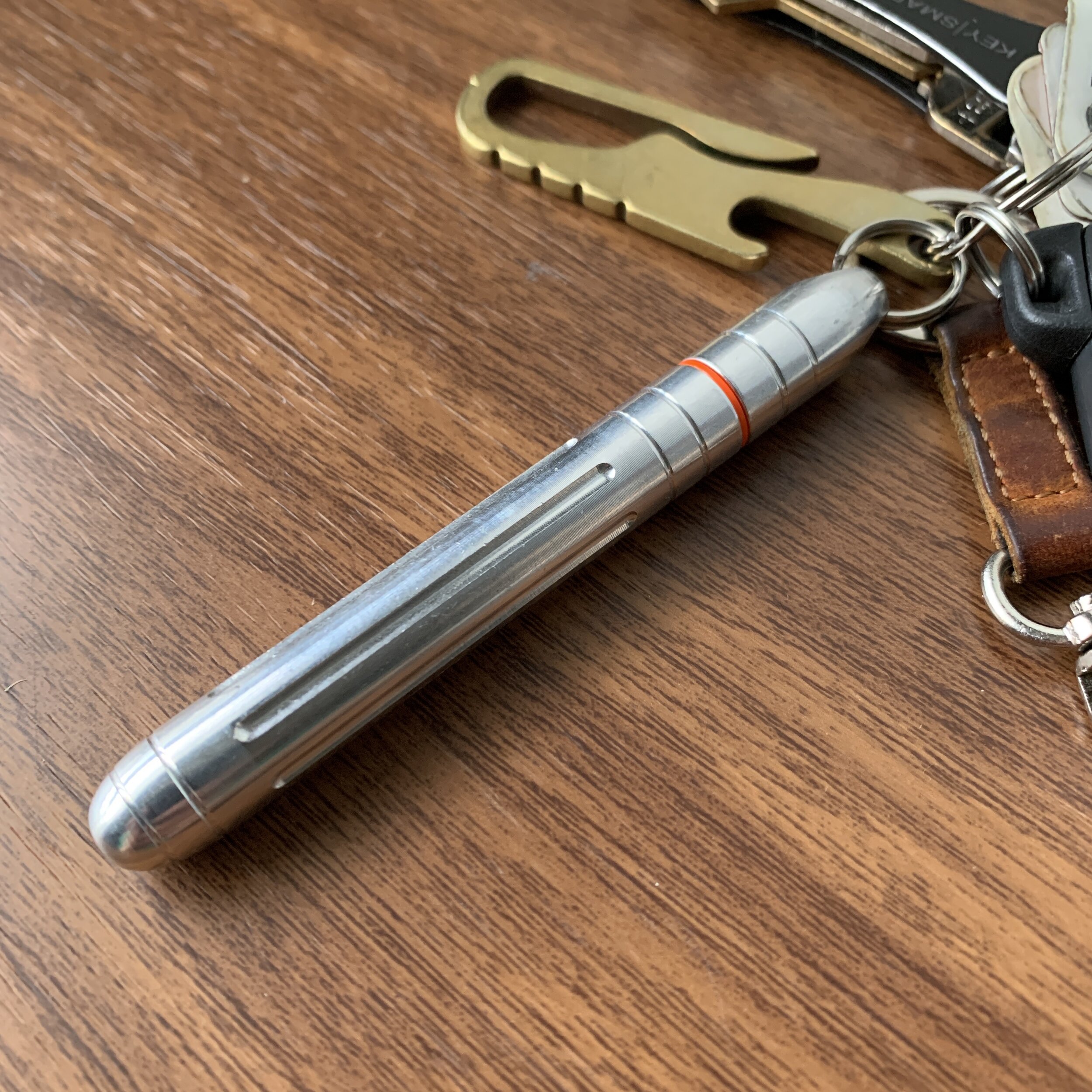
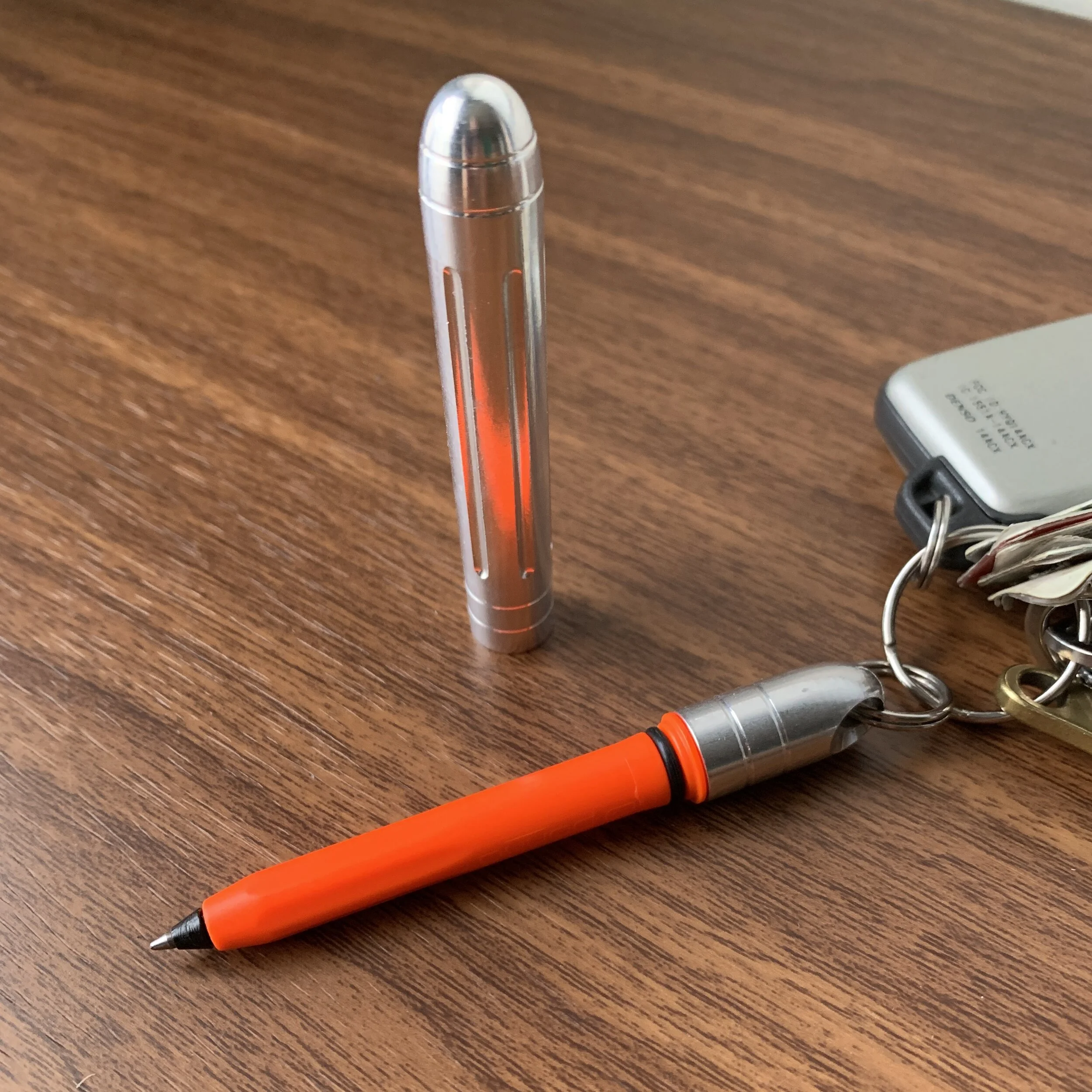
People love their Pokka Pens, and Pokka recently released a new line of accessories that can make your Pokka an even more essential part of your everyday carry. I’m currently stocking both the Pokka “Dokk” keyring docking system, as well as the Pokka “Jakket” aluminum cap, both of which you can pair with any Pokka Pen using the secure Pokka o-rings included on every pen barrel. Note that all Dokks and Jakkets are sold separately, and do not come with a pen.

View fullsize Pokka Jakket on Pokka Dokk
View fullsize Pokka Jakket Uncapped
View fullsize Pokka Dokk Keyring
View fullsize Pokka Jakket Capped

Finally, in response to multiple requests, I’m now stocking three-packs of Pokka Refills, available in blue and red. If you’ve been despairing because you don’t like the black ink included with your Pokkas, swap ‘em all out!

In Pens, TGS Curated Shop Tags TGS Curated Shop, Pokka Pens
Comment

Pen Review: Schon DSGN Pocket Six Fountain Pen

August 1, 2020

One product that makers have tried to perfect over the years, with inconsistent results, is the pocket fountain pen. It’s a hard product to do correctly. Fountain pen filling systems have never been designed for the rigors of pocket carry, and pens holding large reservoirs of ink tend to leak (or “burp”) ink into the cap when the pen gets jostled or there’s a shift in temperature or air pressure. Moreover, many pocket fountain pens end up too small for comfortable longer writing sessions, or feature smaller No. 4 or No. 5 nibs, which for some reason tend to have ink flow and other quality control issues at a higher rate than larger nibs.

The cap threads onto the barrel to post securely. Nearly everyone will need to post this pen to write comfortably.

After perfecting the design on his Classic Machined Pen - an excellent pocket ballpoint - pen and watchmaker Ian Schon set out to develop a true “pocket fountain pen” that he refers to as the “Pocket Six,” because - you guessed it - it features a full-size No. 6 nib. Due to its combination of design, functionality, and ability to accept interchangeable JoWo nib units, I can safely say that the Pocket Six is the best execution of the “Pocket Fountain Pen” concept on the market right now.

For a pocket notebook to go along with your pocket fountain pen, my go-to choice is the Write Notepads Copper Anniversary Edition.

There’s no one characteristic that sets the Pocket Six apart from its competition - it’s an all-around well-designed pen with excellent fit and finish. The selling point that gets the most attention, however, is that namesake No. 6 JoWo nib. Ian specifically designed the cap and section to hold this larger nib, which lives up to its billing in that it generally offers more consistent ink flow and a smoother writing experience than the smaller nibs found on other “pocket” fountain pens. While JoWo nibs are still “stock” nibs and therefore occasionally need tuning, the JoWo nib unit is probably, overall, the most reliable stock nib unit available, and therefore used by most custom penmakers. To have this nib in a pocket fountain pen is a huge plus.

The Pocket Six is so small, closed, that three of them easily fit into my hand at once.

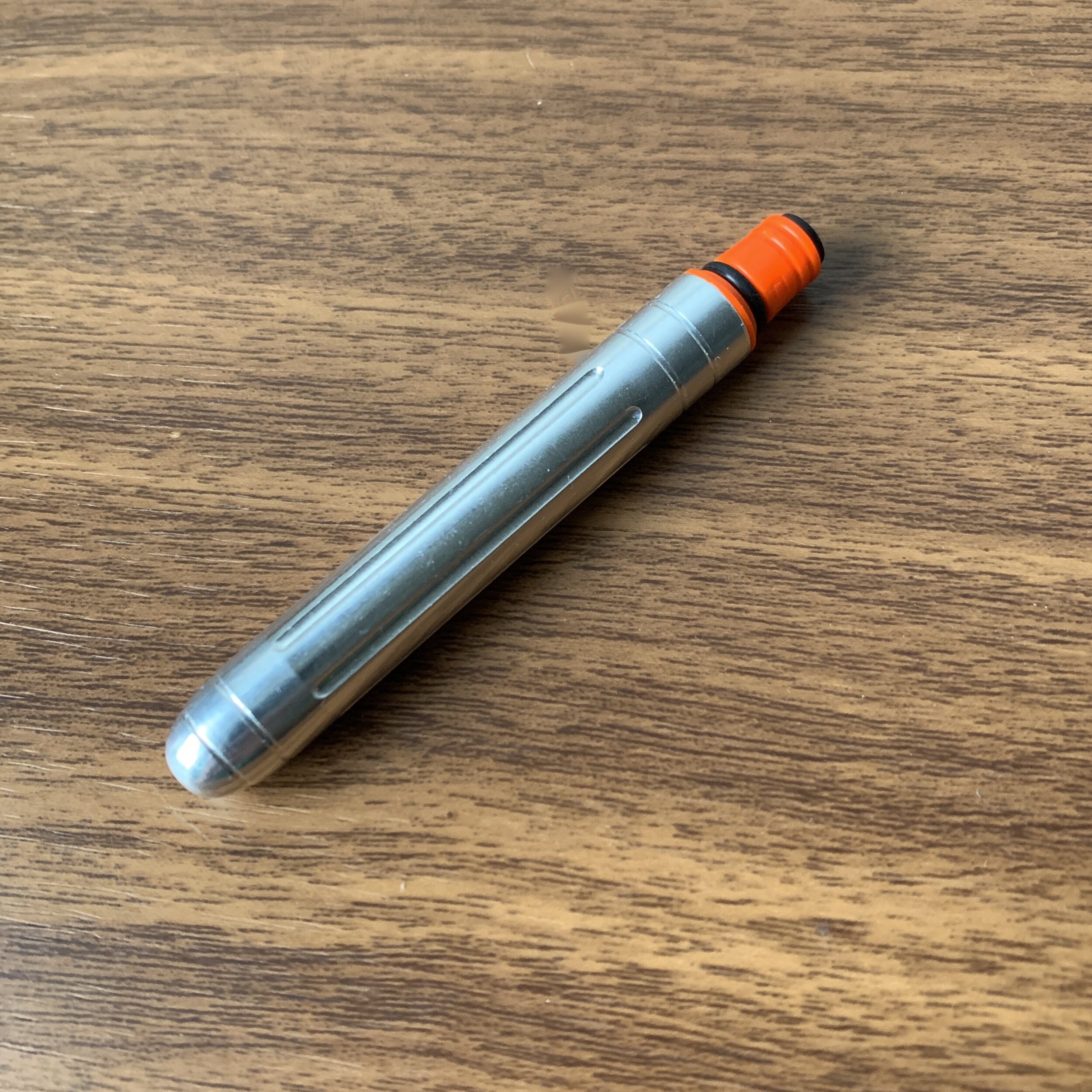
Closed, the Pocket Six is easily “pocketable” at 3.5 inches long. Unless you have tiny hands, or are used to writing with pencil stubs or gripping pens with the ends of your fingers, you’ll need to post the pen to write, and that’s how the Pocket Six was designed, with threads on the end of the barrel to post the cap securely. Fully extended, the pen sits at a comfortable five inches, which for me is long enough to use it for pretty much any writing scenario. While the Pocket Six is a metal pen, Ian uses lightweight aluminum, so even with a brass section I had no issues with fatigue. As you might expect from a pen this compact, it fills with short international cartridges, and since it’s metal, I wouldn’t eyedropper it.

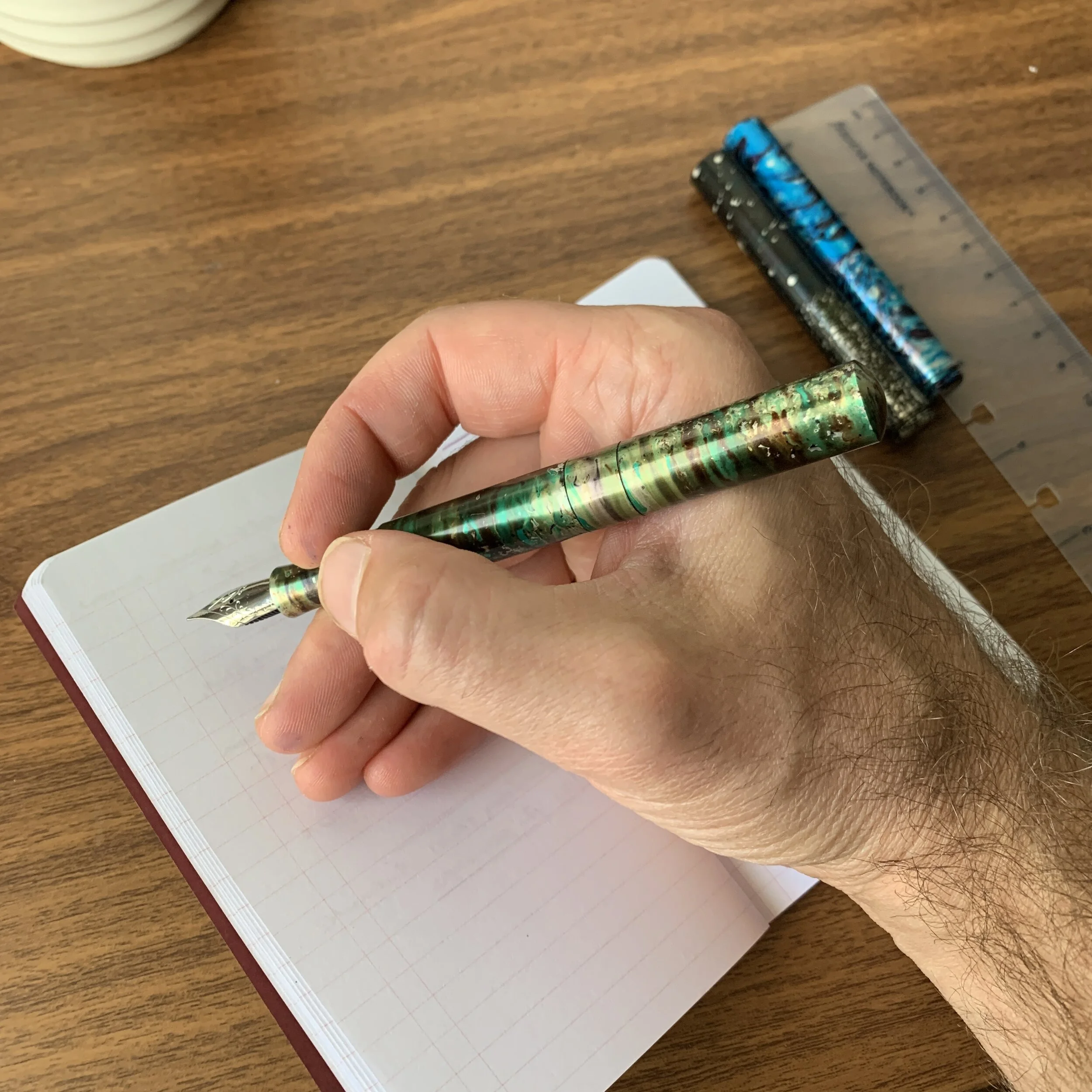
View fullsize Schon DSGN "Malachite"
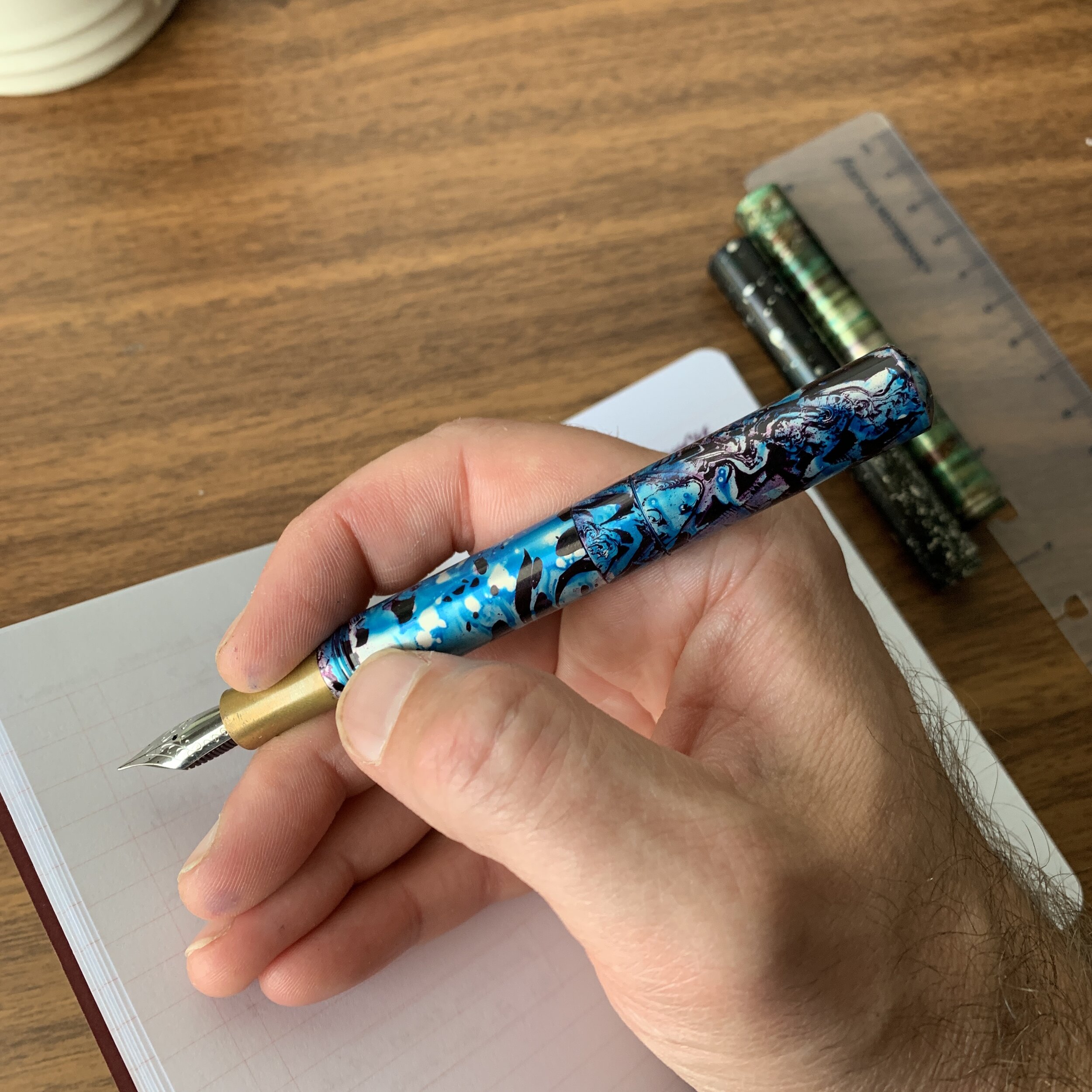
View fullsize Schon DSGN Blue/Purple/Black Swirl
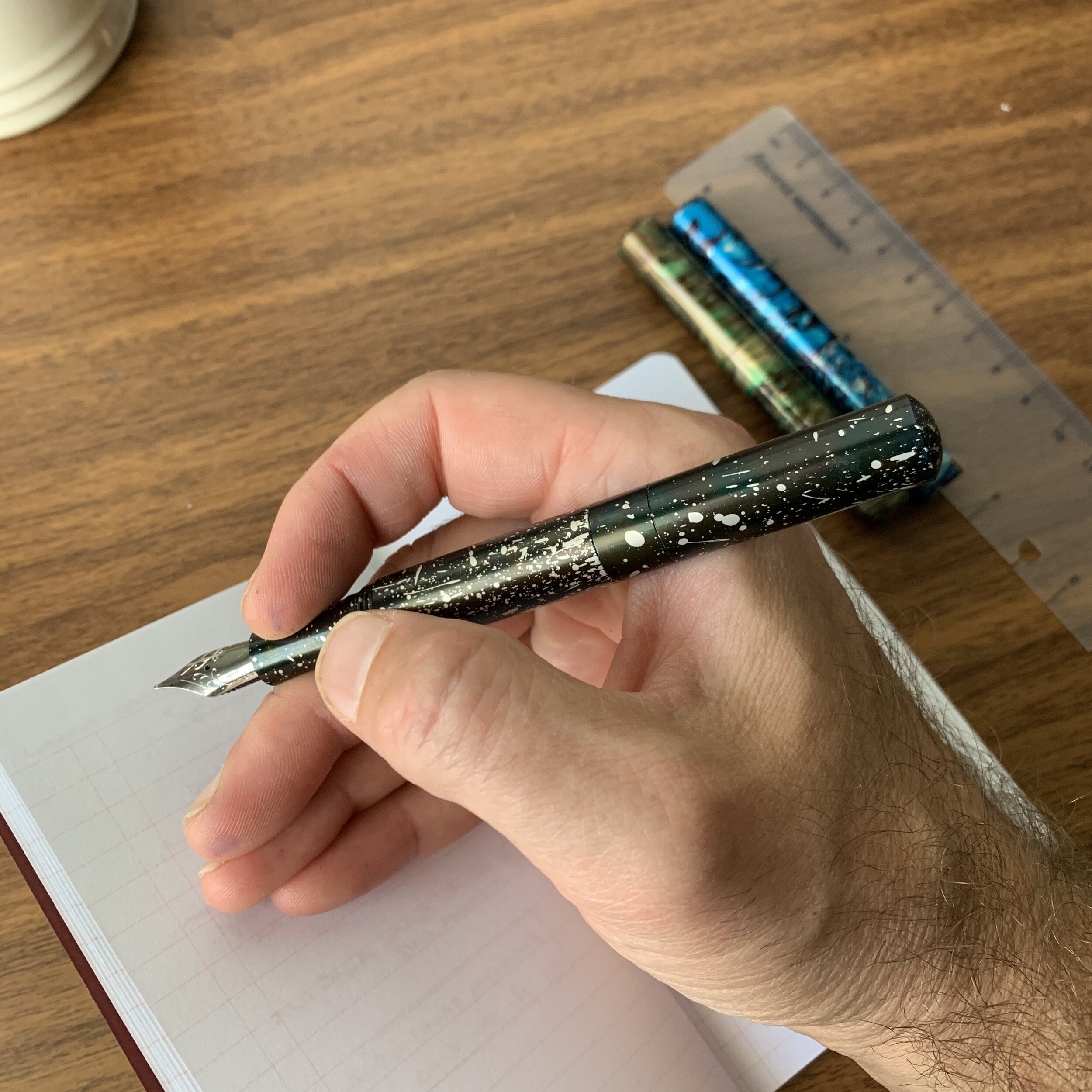
View fullsize Schon DSGN "Deep Sheen"

I now own three Pocket Six fountain pens: I picked up my first in at the Philadelphia Pen Show, in a special blue, purple and black anodized finish with a brass section. and recently added two more from Ian’s ongoing “online pen show”: one in “Deep Sheen” (a black and silver mottled finish with dark blue and green “sheen” undercurrents) and another in “Malachite” (a green/blue/grey/brown/black pattern with a real mineral quality to it). Ian also offers standard editions in aluminum, brass, and copper, including a few pens with “hammered” textures both on the body and section. Moving forward, when pen shows resume, I think it’s safe to expect that the Schon DSGN table will become a standard destination, much like Franklin-Christoph, where people can’t wait to see what new prototype colors and patterns Ian has been able to devise.

Takeaways and Where to Buy

As I mentioned earlier, the Pocket Six has quickly become my favorite pocket fountain pen on the market. All three of mine are currently inked and see heavy use on a daily basis. Of my three, the Malachite is my favorite aesthetically speaking, followed by my blue pen from Philly (not sure that it has a name) and the Deep Sheen, but I enjoy every one. I can pretty much guarantee that I’ll be adding one or more new Pocket Sixes annually, since they’re like Kaweco Sports - eminently collectible!

You can purchase the Schon DSGN Pocket Six directly from Ian via his website. Since all pen shows are currently suspended, there’s unfortunately no way to view the pens in person before you purchase, but let’s be honest: I’ve never seen a bad one. If you have been looking for a pocket fountain pen with a reliable nib and a creative design or finish, you absolutely need to give the Pocket Six a try. Prices range from $118 to $135 for an aluminum pen, while brass and copper models can cost more, especially if you opt for the hammered texture which takes more time to finish. These prices are on par with Kaweco AC Sports and Art-Sports, and for the level of workmanship and creativity that goes into these pens, are more than fair.

Disclaimer: I purchased the three fountain pens featured in this review with my own funds, for my own use. I was not compensated for this review.

In Pens Tags Schon DSGN, Schon DSGN Pocket SIx, Pocket Pens, Pocket Fountain Pen, Pen Review
4 Comments

Pen Review: Pilot Custom Heritage 912 with PO Nib

July 15, 2020

Three years ago I reviewed the Pilot Custom Heritage 912 with Pilot’s flexible “FA” nib, and decided that while I enjoyed the classic look of the pen, that particular nib wasn’t for me. At the time, I predicted that once I had the chance to try the “PO” (or “Posting”) nib - Pilot’s take on the “ultra extra fine” or “needlepoint” trend - I would end up purchasing a Custom Heritage 912 for myself. It took longer than expected, but I was right.

In certain aspects of my work (i.e. annotating documents and working on very cheap recycled paper) it’s advantageous for me to be able to write extremely small. In addition to standard Japanese extra-fine nibs, my collection features several hand-ground needlepoints and also standard “specialty” nibs like Platinum’s “Ultra-Extra Fine”, which I’ve previously reviewed and which is now increasingly available at retail outside of Japan. I’m just now getting around to exploring what the other Japanese pen companies like Pilot and Sailor have to offer in this regard.

Yes, that’s how the tip’s supposed to look!

The first thing you need to understand about Pilot’s PO nib is that it’s intended for a very specific user, meaning that you shouldn’t purchase this pen without careful consideration. For starters, the Custom Heritage 912 costs around $200 whether you purchase from your domestic U.S. retailer or overseas, so it’s not in the “impulse buy” category. While you used to be able to save money buying on eBay or Amazon, the current pandemic has caused shipping rates to rise, cutting into the “discount.” Second, the PO nib is extremely stiff - firmer than any nib I’ve ever used - so if you’re someone who likes even a little cushion when writing, you’ll probably want to take a hard pass on this pen. Those two things notwithstanding, I can comfortably say that Pilot’s PO nib offers my favorite out-of-the-box “ultra fine” or “needlepoint” writing experience on the market.

This nib was originally intended for writing on cheap postcards, which apparently used to cost much less to send through the Japanese postal system than standard mail. The point of the nib has been turned down to reduce ink flow and to prevent feathering on this less expensive, more fibrous paper. While you may still get some bleedthrough, in my experience this nib makes a fountain pen usable on even the cheapest recycled copy paper.

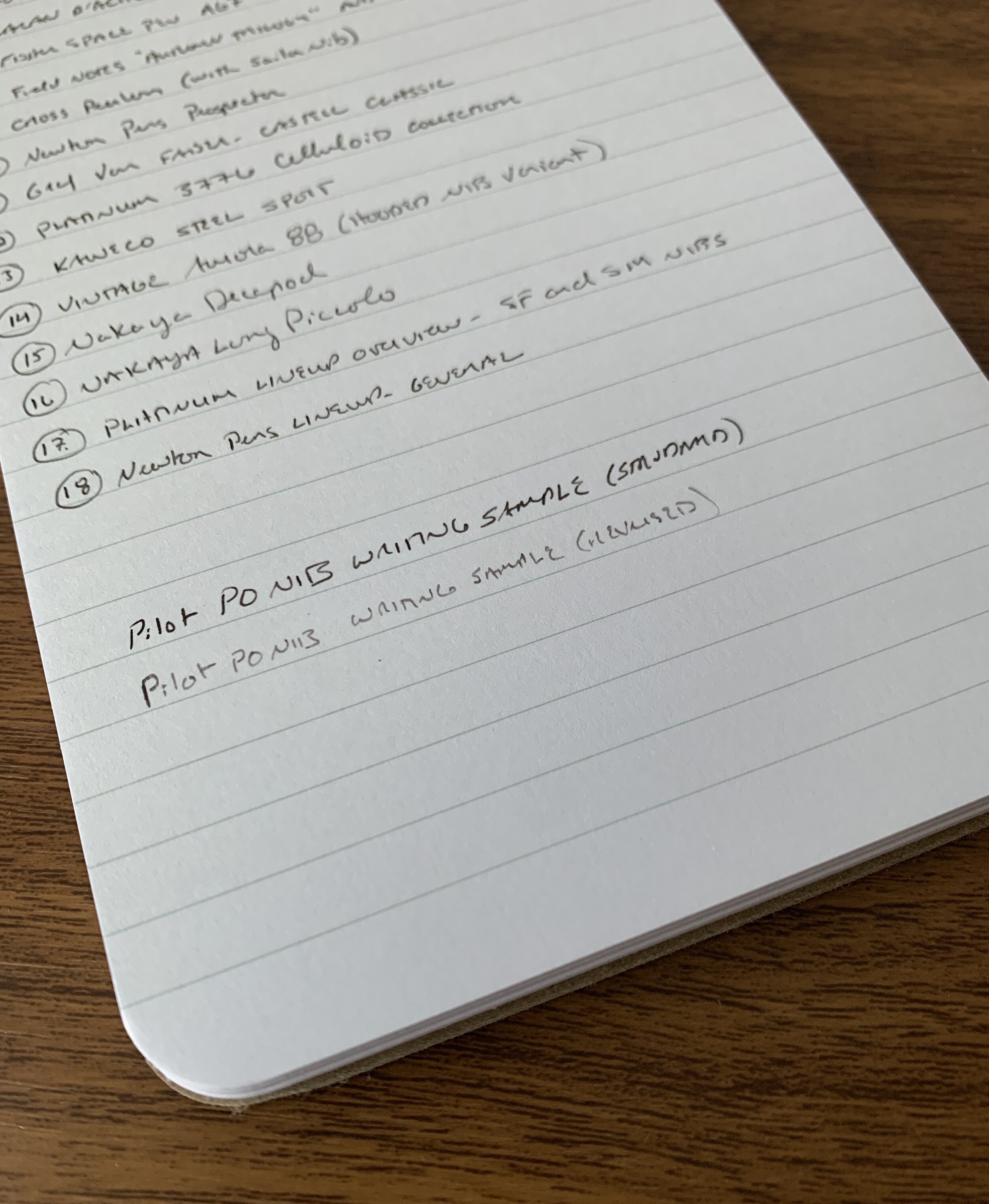
A writing sample showing how you can write even smaller if you flip the PO nib over and write using the reverse side.

A writing sample showing how you can write even smaller if you flip the PO nib over and write using the reverse side.

Takeaways and Where To Buy

Dare I say that the Pilot Custom Heritage 912 with a PO nib might be the “ultimate note-taking pen” for those of us that like to cram as much writing as possible onto a page? This workhorse might not be flashy, but it showcases the best of what Pilot has to offer nib-wise. While you can purchase this pen with a couple different standard nib sizes (EF and Soft Fine), most people opt for a specialty nib, including the PO nib featured here, the SU (stub), music, FA (flexible), and Waverly. As you can tell from my review above, I love the PO nib, and just wish it wasn’t so hard to find in the U.S.

Update: As of 2026, Pilot has expanded its specialty nib offerings stateside, including making a range of nibs available in the Custom 912 and Custom 743 models. We stock a selection of both, including the PO nib as available.

The Gentleman Stationer is supported by purchases from the T.G.S. Curated Shop and pledges via the T.G.S. Patreon Program. You can also come visit us at our physical stationery store in Nashville, Tennessee.

The Pilot Custom Heritage 912, shown here compared against a Write Notepads Reporter-style Notebook, available for sale in the TGS Curated Shop.

In Pens Tags Pen Review, Pilot, Pilot Custom 912, Pilot PO Nib
1 Comment
← Newer Posts Older Posts →
Store Hours and Events
Shop T.G.S. Online
Updated 2026 "Best Pens" Guide
No results found
On The Paper Trail: Live In Nashville Event Tickets Now Available!
TGS_25 Roterfaden Restock Notification
Hierarchies of Fountain Pen Friendly Paper

Join Our Patreon!
Subscribe to the TGS E-mail List

Featured Posts

Featured
10-Fountain-Pens-Favorite-Inks
August 22, 2026
Three Keeper Inks: Choosing Inks for 10 Fountain Pens
August 22, 2026
Read more →
August 22, 2026
Everyday-Stationery-Bags
July 25, 2026
What's the Best Everyday Stationery Bag? My Own Considerations and 5 Options for Pen Show Season
July 25, 2026
Read more →
July 25, 2026
Graphilo-Kobeha-Paper.jpg
July 11, 2026
Paper Review: Graphilo by Kobeha
July 11, 2026
Read more →
July 11, 2026
The Gentleman Stationer RSS

View Cart

© Digital Divide Media, LLC, 2014-present.

All content is the exclusive property of Digital Divide Media, LLC, d/b/a The Gentleman Stationer, including “The Gentleman Stationer” website and trademark, and should not be reproduced without express written permission.  All rights reserved.

All content containing paid advertising, affiliate links, or sponsored content will be plainly disclosed by a disclaimer when/if featured.

Contact Information

Website Terms and Conditions

Store Shipping Policy and Return Policy

Privacy Policy and Cookie Policy

Accessibility Statement

Powered by Squarespace