• Blog
  • Shop
  • Podcast
  • Resources
  • Archive
  • About
  • Contact
  • Cart
  • Sign In My Account
Menu

The Gentleman Stationer

Vintage Living in the Modern World.
  • Blog
  • Shop
  • Podcast
  • Resources
  • Archive
  • About
  • Contact
  • Cart
  • Sign In My Account

The Baron Fig Squire in Charcoal

First Impressions of the Baron Fig Squire: The Pen Is A Mighty Sword

March 26, 2016

I rarely write first impressions of products immediately after I receive them, but I'm going to make an exception for something I've been anticipating for months.  In case you missed it, last fall Baron Fig launched a Kickstarter for their own custom-designed pen, the Squire. The design is unique, and can best be described as something of a hybrid between the Ajoto Pen and the Retro 51 Tornado.  The Squire uses the same great Schmidt P8126 refill as the Retro 51 Tornado (though it's branded Baron Fig).  I've never used this refill in the .6mm form, as opposed to the standard .7mm, and I absolutely love it.  I may need to give Retro 51 another shot, but the Squire sets a high bar.  

Build

This is a brushed aluminum pen, designed with purposeful simplicity.  There were two Kickstarter color options:  silver and charcoal.  I opted for charcoal, since I already have plenty of silver pens lying around here, and I'm glad that I chose this finish, though I'd probably categorize the color as more of a steel gray (or, dare I say it, "blue steel"), than a charcoal.

As described, the pen is medium-sized and perfectly balanced in the hand, and the refill extends using a twist mechanism that functions smoothly.  The only "drawback" on the design front is the branding.  I would have preferred that they omit the "sword logo" and "Baron Fig" from the body of the pen, in favor of just brushed aluminum, but that's a personal preference and others might not care.  The packaging I love.  The bottom half of the box doubles as a desktop pen stand for the Squire.         

View fullsize IMG_0902.jpg
View fullsize IMG_0903.jpg
View fullsize IMG_0904.jpg

Writing Sample

The ink flow on this refill is generous, and on the verge of being slightly too wet.  If you write with a heavy hand, as I tend to, you will experience some show-through and bleed on cheaper paper.  Interestingly, I was able to see the slightest bit of show-through in my Hobonichi Techo, of all things.  BUT, the flip side to that is the smoothness of this refill.  As a daily writer, that alone should keep me coming back to this pen, since pretty much any ink that I use bleeds through the cheap paper I have to use at work. 

A writing sample for the Baron Fig Squire (Schmidt P8126 .6mm capless rollerball refill).  Like any liquid ink pen that writes a wet, smooth line, you're going to have slight feathering and possibly even some bleedthrough on cheaper paper.  This Nock Co. Dot-Dash pad works very well. 

Price

Kickstarter pricing for the Squire started at $50 shipped.  Pre-order pricing on the Baron Fig website is slightly higher, at $55 plus shipping.  That price might fall somewhat if the Squire takes off and Baron Fig benefits from scaled-up production, but it's the same price point as the Karas Kustoms EDK, which uses the same refill.  Both pens are priced fairly for pens of their quality.  

Takeaways

The verdict is still out on things like durability and practicality (particularly the lack of a clip and whether that will affect my personal use) but Baron Fig is onto something with the design of this pen.  Most importantly, they clearly understand how to successfully deliver a high quality product on time, so I think we can look forward to new entries in the Squire line, via Kickstarter or otherwise. Personally, I'd love to see a mechanical and/or clutch pencil in this form factor.  

Further Reading

If I've piqued your interest in the Squire, check out Andy Welfle's Woodclinched blog. Andy took a sneak peek at the Squire prototypes back in November during his visit to Baron Fig HQ (jealous), and has a comprehensive review along with backstory.   

DISCLAIMER:  This post contains affiliate links, through which I may be compensated a small amount if you purchase an item from certain sites linked to in this article.  While I'd greatly appreciate it if you use these links to purchase something you are interested in, you are, of course, under no obligation to do so.  Many thanks! 

In Refills, Pens Tags Pen Review, Baron Fig, Squire, Schmidt P8126
6 Comments

The Platinum 3776 Century demonstrators in Chartres blue (below) and Bourgogne (top).

Pen Review: The Platinum 3776 Century: Chartres and Bourgogne

March 24, 2016

I've really gotten into Japanese pens over the past year.  Sailor and Pilot are quite possibly my two favorite brands at the moment, and now Platinum has caught my eye.  I have very little experience with Platinum's offerings--I owned a preppy or two when I was first starting out, but only recently tested their higher-end pens.  Overall, I'm very impressed.  

First Impressions

The packaging on Platinum pens is unremarkable.  The pens arrive in a blue clamshell box with white satin interior.  It's functional, but that's about it.  What's inside the box is a different story. Platinum's flagship pen is the 3776 Century (apparently the number is a reference to the height of Mt. Fuji), and I opted for the colored demonstrators.  Over the span of a month, I picked up both the "Chartres" blue demonstrator pen, as well as the "Bourgogne" red demonstrator.  These are gorgeous pens: they are translucent, but only slightly so, and the color is incredibly deep and not cheap-looking at all.  You can tell the pen is solidly built.  For those of you not familiar with French history/geography, Bourgogne is a reference to a wine varietal/region, and Chartres blue is a reference to the unique color of the stained glass in the Chartres Cathedral.

Bourgogne Fountain Pen Unposted.  These pens are large enough to use without posting.  Here, you can also get a sense of the material.  It's a demonstrator, but the translucence is only slight.  This gives the pens a higher-quality feel than your ordinary plastic demonstrator.

In a perfect world, I would have purchased the blue pen with rhodium trim, but I wanted Platinum's "Ultra Extra Fine" specialty nib, which only comes in the gold.  The Bourgogne pen also only comes in gold trim, which looks very nice.  Again, the clip strongly resembles the hardware on Nakaya pens.  

Bourgogne pen posted.  The cap posts pretty deeply, 

One pet peeve, however, is that these pens don't come with a converter.  It irritates me to no end when pen companies do this:  anytime you are spending over $50 on a pen (much less the $200+ these pens command on the U.S. market), the converter should get thrown in free of charge.   

Nibs

The nibs on my pens turned out to be a mixed bag.  The UEF nib had some flow issues, and while I've been able to increase inkflow on my own enough to make the pen usable, it will need to be tuned at the Atlanta Pen Show.  The UEF point is tiny, however, and you can write as small as you could ever possibly desire with this nib.  Once it's tuned properly, I imagine that I will like it quite a bit. 

View fullsize Platinum Medium Nib
View fullsize Platinum UEF Nib/Feed
View fullsize Platinum UEF Nib
View fullsize Platinum Medium Nib Writing Sample
View fullsize Platinum UEF Writing Sample

On the other hand, the medium nib in my Bourgogne demonstrator was exceptional out of the box.  I might say that it writes even better than the medium nib on the Nakaya I once owned.  (That's not a coincidence--Nakaya uses Platinum nibs.)  I have not experienced a single skip or hard start with this pen.  Platinum uses a patented "slip-and-seal" internal cap that keeps the pen from drying out for up to a year of non-use.  I don't plan on testing this feature anytime soon, but it's nice to know about, I guess.

Value Proposition

This is where things get tricky.  Platinum pens apparently are much cheaper in Japan than they are here in the U.S.  For example, the Chartres blue demonstrator retails for approximately $228 at U.S.-based retailers, while those based in Japan (or who import directly from Japan) sell this pen at a much lower price point.  While I typically try to support U.S-based retailers where I can, it's too much to expect customers to pay $150 extra on the basis of loyalty alone.  I would note, however, that if you purchase from Amazon or eBay, you might get stuck addressing nib issues, etc. on your own, or experience long wait times returning the pen.  For this good of a deal I'm willing to take that risk, but others may not want to deal with it.     

Takeaways

At $75, the Platinum 3776 is an excellent value proposition and moves itself into competition for the "best first gold-nibbed pen" list (subject to the potential-lack-of-actual-customer-support qualification I mentioned).  For a little more than a TWSBI Vac Mini or a 580 AL, you get a 14K nib that's pretty much the same as you would find on a Nakaya.  I am withholding judgment on the UEF nib for the time being, until I get the issues sorted out, but I can strongly recommend the stock (F,M,B) Platinum nibs.  The medium I have is one of the best mediums I've ever written with.  

If You're Interested in Further Reading...

Check out Azizah's review of the Bourgogne demonstrator at GourmetPens, as well as Junee from Alt. Haven's review of the Chartres pen.  

In Pens Tags Platinum, Pen Review
3 Comments

Pelikan advertises its Stola III fountain pen as a "starter" pen for the business world. 

Pelikan Stola III: A New Entry Level Contender?

March 16, 2016

The Pelikan Stola III has a very professional, understated look.  With this pen, Pelikan clearly is trying to step away from the playful look of the lower-cost Pelikano, Future, and Twist and offer a pen with the same inexpensive quality that won't look out of place on the desk of an office professional in more "traditional" settings.  Pelikan markets this pen as "a modern writing device for a successful start into the business world."  If that's their goal, Pelikan has largely succeeded, though the relatively short barrel, inability to post, and the lack of any variety in nib size will probably limit the size of the audience who can use this pen for a true daily writer.     

Presentation and Build

Starting with the packaging:  very nice and appropriate for the pen's price point.  It won't win any design awards, but the cardboard clamshell box holds the pen nicely and offers better protection than the simple cardboard sleeve used by Lamy for the Safari and the AL-Star.  

The packaging on the Stola is appropriate for the pen's price point:  simple and understated, yet still sophisticated.

Inside the box, the Stola looks solid and well-made.  The body of the pen is entirely crafted from metal:  according to Pelikan, the cap is crafted from aluminum and the barrel from brass, topped with silver lacquer and a black coated metal clip.  For a metal pen, it's not unduly heavy and is fairly well balanced.  The section is plastic. 

If you like to use your pens unposted, the Stola should work fine for you.  Unfortunately, it's a touch short for me to use comfortably for longer writing sessions. 

The one concern I have about build quality on this pen is the "inner cap", which is an insert (typically plastic) fit inside the cap of a fountain pen to create an airtight seal and help keep the pen from drying out.  The internal cap on the Stola appears to be a piece of clear molded plastic friction-fit into the cap, which creates a decent seal when the pen is closed, but won't permit the pen to post easily.  You can jam the cap down onto the barrel, but it will work itself free after a few seconds of writing.  My concern is that posting the pen repeatedly will crack the inner cap and/or cause it to come free--it just doesn't look all that sturdy.  For that reason I would recommend not trying to post this pen.   

Capped in the hand, the Stola is a medium-sized pen.  

Filling system

Again, for the entry-level market, Pelikan bills the Stola as a cartridge pen, but I had no problem inking it up and using it with a Schmidt converter.  Curious Side Note:  like other people who received this pen for review, the Pelikan cartridge that came with the pen exploded inside the pen barrel.  This is probably due to the fact that these pens passed through an area still experiencing below-freezing temperatures in transit rather than any underlying quality issue with the Pelikan cartridges, but I do find it curious that this happened to multiple people. 

Nib

Pelikan makes very nice stainless steel nibs, and the Stola III is no exception.  I don't know whether the nib is made in-house at Pelikan or not, but it's quality, and I haven't experienced any hard starts or skips.  A big drawback for me personally is that the pen is only available in a medium nib.  Due to sturdy build on this pen, it would be a perfect candidate for a "bag" or "car" pen, that I leave inked up for daily writing here and there.  For those kinds of pens, though, I typically prefer a fine or extra-fine point to minimize bleed-through on the cheap paper you inevitably have to write on during the day.  The Stola, at least in its current incarnation, is too broad for me to use consistently. 

The Pelikan Stola only comes in a medium stainless steel nib. 

Pelikan Stola III writing sample.  The medium nib leaves a moderately wet line.  I had no skips or hard starts. 

Takeaways

There is probably a market for this pen, and judging from consumer reviews on Pen Chalet, buyers are generally satisfied.  The $36 retail price places this pen at a slightly higher price point than the Lamy Safari and at about the same level as the AL-Star.  That the Stola only comes in a medium nib, however, docks it a notch in my book.  Also, the inability to post the pen makes it unusable as a true daily writer for me.  That said, I found the section on the Stola very comfortable to use, so if Lamy's triangular grip doesn't work for you, or if you find the Pilot Metropolitan uncomfortable to hold due to the "step-down" from the barrel to section, you may want to give the Pelikan Stola III a try.  On the whole, there wasn't anything about the Stola that nudged this into "great" or "excellent" pen territory, but it's certainly a good writing instrument, and if you're looking for a basic daily knockaround that you don't have to worry about excessively, you could do far worse.      

If you are interested in the Pelikan Stola, it's available from our sponsor Pen Chalet for $36 in both fountain pen and rollerball versions. Pen Chalet offers a wide variety of pens and accessories, and it's where I do a large portion of my pen and ink shopping.  Ron's prices are excellent, he runs regular promotions, and any orders over $50 receive free shipping. Importantly, Pen Chalet is an authorized retailer of all the brands they stock, and will stand by their products if you have any problems.

DISCLAIMER:  I was provided this pen by PenChalet at no cost for review purposes. This post contains affiliate links, through which I may be compensated a small amount if you purchase a pen from any of the sites linked to in this article.  While I'd greatly appreciate it if you use these links to purchase a pen you are interested in, you are, of course, under no obligation to do so.  Many thanks! 

In Pens Tags PenChalet, Pelikan, Pen Review
5 Comments

The TWSBI Eco, featured here in white, has a hexagonal cap with the red TWSBI dot. 

Pen Review: TWSBI Eco

March 9, 2016

The TWSBI Eco may come closest to dethroning the Lamy Safari as the most popular pen you can buy under $30.  With it's super smooth nib, modern design, and excellent piston-filling system, I can recommend the Eco to anyone, not just beginners.  While not all pen people may appreciate its looks, this is a solid writer, and may even supplant the TWSBI 580 in my rotation.    

Build.  The Eco has two things to offer that distinguish it (in a good way) from other pens in its price range: a comfortable grip section, and a barrel length suitable for both posted and unposted use.  First, the grip section (and the rest of the barrel) is round, and very comfortable to hold.  The Lamy Safari (what I would deem the Eco's main competitor) features a triangular grip, supposedly to help students hold their pen correctly, but at the end of the day this mostly serves to limit the pen's appeal because many people simply can't use this grip comfortably.  Also, by eliminating the faceted barrel, many people have speculated that the Eco will last longer and be less prone to cracking due to reduced stress on the plastic. 

I regularly use the Eco both posted and unposted.  Some people find that posting the cap on the Eco makes the pen unwieldy.  The cap may not be the prettiest thing to look at, but it weighs next to nothing and I don't think that posting it renders the pen unreasonably long or uncomfortable to write with.  Regardless, unlike the Safari, the body of the Eco is long enough to allow me to write comfortably with the pen unposted.   

It's a bit longer than my personal preference, but I can still use the TWSBI Eco posted. 

Aesthetics/Design.  People either love or hate the Eco's design.  I like it because it's different. True, there's a bit of a mismatch between the round barrel and the chunky, faceted cap and piston knob, but somehow the design works.  The Eco is a modern, minimalist fountain pen, and looks exactly like what one would expect a modern, minimalist fountain pen to look like. To deliver a pen at the $30 price point, you pretty much have to use plastic, so criticism that the pen "looks cheap" is misplaced--the Eco is intended to be an inexpensive pen, and to knock it because it looks "plasticky" or because it has a less expensive clip than the TWSBI 580 strikes me as unfair.  

The cap and the clip on the TWSBI Eco have generated 

The Nib.  If there's one area where TWSBI has improved by leaps and bounds over the years, it's with their nibs, which I believe are made by JoWo.  Both the Eco and the Vac Mini (which I recently reviewed) feature a #5 stainless steel nib, and both of my pens are excellent writers. Like my Vac Mini, I picked up an Eco with a medium nib,  I'd characterize it as a "true medium," slightly on the wet side.  While the Vac Mini can occasionally hard-start or skip, due to the nature of a vacuum filling system and how ink is delivered to the feed, I have had zero flow issues with the Eco.     

A shot of the TWSBI Eco nib and round, transparent section.  For some reason, I love the clear section on the Eco.  You can really see how the ink saturates the feed and works its way down to the nib.

Takeaways.  I can recommend the TWSBI Eco for anyone looking for a good daily writer that won't break the bank.  It's certainly not limited to beginners or people looking to buy their "first fountain pen".    That said, there are a couple reasons why the Eco won't dethrone the Pilot Metropolitan and others anytime soon as my recommended first-choice for an entry-level fountain pen.  First of all is price. The Metropolitan is less expensive, and with the new Retro-Pop collection, the colors aren't necessarily limited to black, silver, and gold.  The Eco sits at a slightly higher "next step" price point.  As I've said before, I'm also hesitant to recommend a piston filler as a "first pen," since many fountain pen newbies are uncomfortable starting out filling from a bottle.  

The TWSBI Eco does, however, sit appropriately near the top of my "Top Pens Under $75" list, and I'm considering moving it to the #1 slot.  So far, it's that good, but I want to give myself a few months with it to be sure. 

As of April 2020, you can purchase TWSBI Pens, including the ECO series, directly from The T.G.S. Curated Shop. The ECO starts at $30.99 for standard versions, and a pen with Rose Gold trim will run you $49.99.

In Pens Tags Pen Review, TWSBI, TWSBI Eco
4 Comments

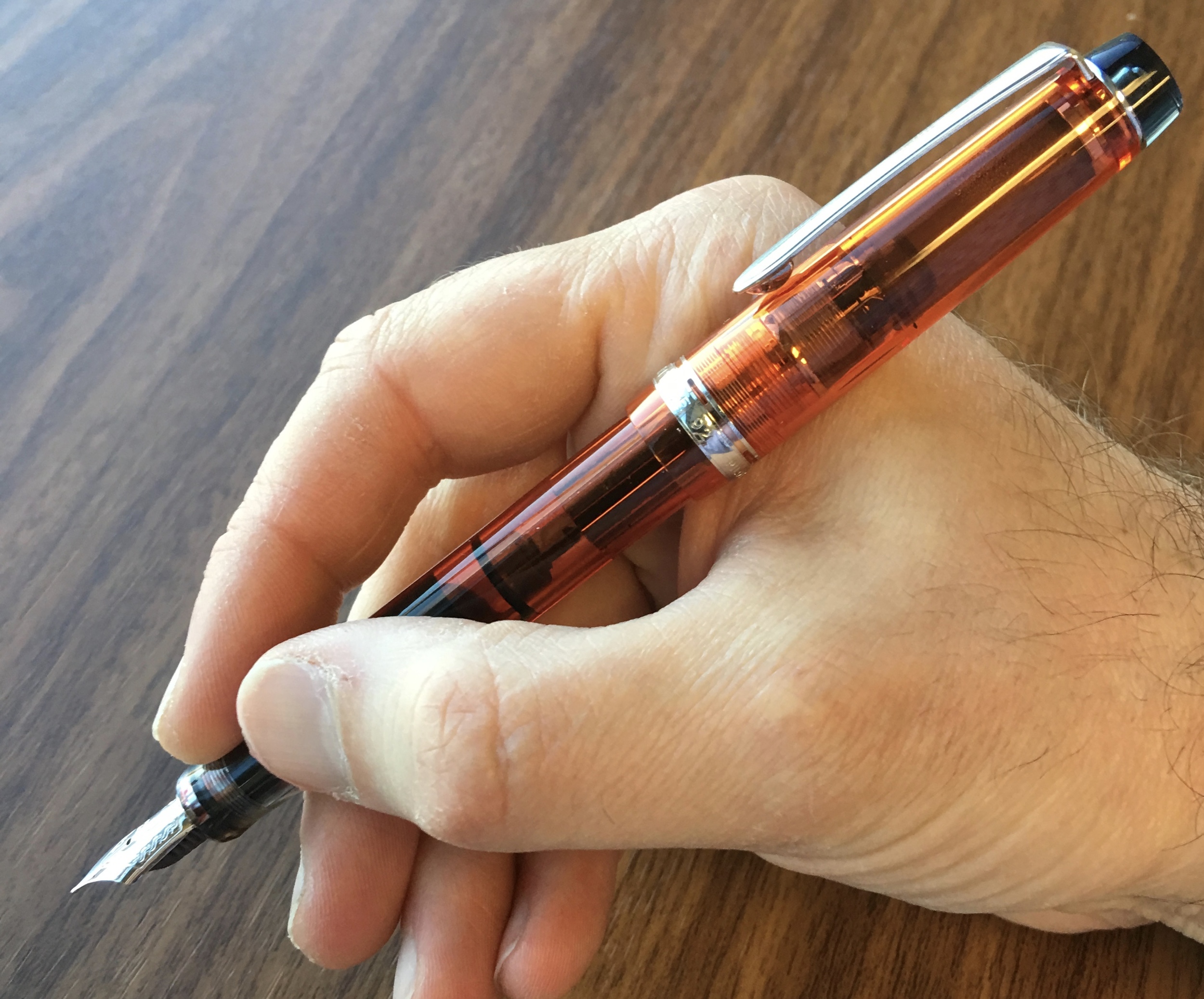
Pilot's Custom Heritage 92 Demonstrator in Orange Acrylic

Pen Review: Pilot Custom Heritage 92

March 2, 2016

I'm really mad at Pilot (or maybe I should be mad at the U.S. Distributor, Pilot U.S.A.). Why? Because Pilot makes a pen that is nice-looking, and an exceptional writer, but is only available in the U.S. in one color with an MSRP set twice as high as in Japan.  I'd go so far as to say that this pen could be a flagship offering for Pilot here in the States, yet it gets little love or attention, probably because of the price.

The pen that I am talking about, is of course, the Custom Heritage 92 demonstrator.  The clear version is sold by U.S. retailers, including PenChalet. Pilot also makes three different colors of the demonstrator in the same transparent plastics as the Custom 74 line:  Blue, Orange, and Smoke.  Unfortunately, as of the time of writing, these versions are Japan-only, but are still easily accessible through Amazon and eBay.     

General Build and Appearance

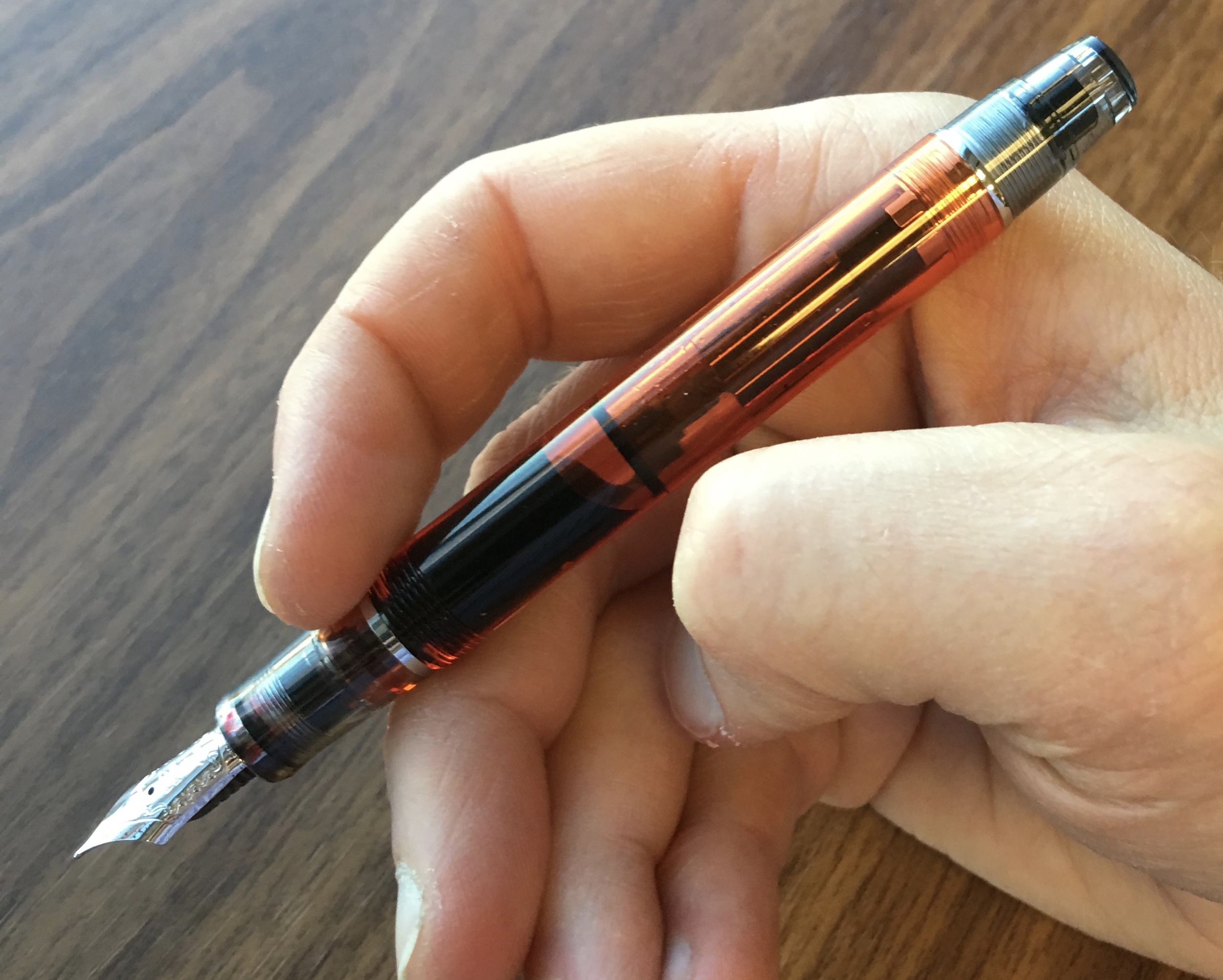
The Custom Heritage is a solid pen.  Some colored plastic demonstrators feel cheap, but not this one.  The barrel, cap, and especially the piston mechanism (discussed further below) all feel especially solid.  It's a nice mid-sized pen:  big enough to use comfortably posted or unposted, but not so huge that it weighs down the front of a shirt pocket or is otherwise inconvenient for daily carry. 

View fullsize Pilot Custom Heritage Posted
View fullsize Pilot Custom Heritage Unposted

As I mentioned, the color scheme on these demonstrators is substantially similar to the color scheme on the Custom 74 demonstrators available here in the US.  One difference is that the end caps are transparent gray, which sets off nicely against the orange. I've always wanted a pen in Pilot's clear orange acrylic--now I just have to pick up a blue version as well, which has a sapphire-like quality and is also stunning.  

The piston knob on the Custom Heritage is gray, which accents the orange nicely.

The Fine-Medium "FM" Nib

The Custom Heritage sports a 14K gold number 5 nib.  Pilot's standard gold nibs are springy--they're not semi-flex nibs like the "FA" nibs and the nibs on a Pilot/Namiki Falcon, but you can squeeze out a touch of line variation.  What's unique about the nib I have, though, is the width.  Pilot makes a "FM" nib (or a Fine-Medium), which is the perfect width for me to use as a daily writer. On more absorbent paper, the FM nib leans more to the medium side; on Rhodia or Clairefontaine, the nib writes more like a Western fine.  In terms of ink flow, the pen writes perfectly out of the box.  It has just a hint of feedback.    

Pilot Number 5 "FM" nib in 14K.

You can definitely squeeze some line variation out of the Pilot FM nib--it's not a nail--but I wouldn't call it "flex" or even "semi-flex."

A Piston Filler that Fills Completely and Is Easy To Clean

I saved what I consider the best aspect of this pen for last.  In my piece on pen cleaning that I published a while back, I lamented how piston fillers had fallen out of my good graces because they were more difficult to clean.  Not so with this pen!  The piston mechanism is smooth and extremely efficient, meaning that the pen will take a full fill of ink, and on the flip side, will take a full fill of water when you are trying to clean it.  Many piston fillers will only fill the ink chamber 3/4 or 2/3 full, which not only fails to maximize the ink capacity of the pen but requires repeated flushing to clean it.  I've been using this pen with red ink (among the most difficult colors to clean), and I've been able to flush this pen completely clean with only 3-4 cycles of the piston. 

Flushing the Pilot Custom Heritage 92 when I received it for the first time. This pen is full of water. Notice that there is only one slightly visible air bubble in the upper left of the ink chamber.

Takeaways

I love this pen, and it's jumped to the top of my queue since I received it a few weeks back.  (I do a lot of copy editing, and there's something about writing with red ink in an orange demonstrator that I find incredibly satisfying.)  It’s increasingly rare to find any gold-nib piston filler from a major pen company in the $200-300 range, so this pen is up there with the Lamy 2000 as an option for purchasing a first gold-nibbed pen.  As of 2026, we carry the Custom Heritage 92 in our own shop, though the colored demonstrators are no longer available.        

Some Extra Credit

A few other people have reviewed the Pilot Custom Heritage.  Mike Dudek over at The Clicky Post reviewed the clear version with a medium nib, and Pete Denison has reviewed the blue version, also in a FM nib. 

If you're interested in reading further on the reasons why pens are priced differently in various markets, I recommend to you this piece by Ian at Pens!Paper!Pencils!  You can also check out Pilot's reply to Ian's piece, as well as this reaction by Dr. Deans at Pen Economics.     

In Pens Tags Pen Review, Pilot, Pilot Custom Heritage, Demonstrator
1 Comment
← Newer Posts Older Posts →
Store Hours and Events
Shop T.G.S. Online
Updated 2026 "Best Pens" Guide
No results found
On The Paper Trail: Live In Nashville Event Tickets Now Available!
TGS_25 Roterfaden Restock Notification
Hierarchies of Fountain Pen Friendly Paper

Join Our Patreon!
Subscribe to the TGS E-mail List

Featured Posts

Featured
10-Fountain-Pens-Favorite-Inks
August 22, 2026
Three Keeper Inks: Choosing Inks for 10 Fountain Pens
August 22, 2026
Read more →
August 22, 2026
Everyday-Stationery-Bags
July 25, 2026
What's the Best Everyday Stationery Bag? My Own Considerations and 5 Options for Pen Show Season
July 25, 2026
Read more →
July 25, 2026
Graphilo-Kobeha-Paper.jpg
July 11, 2026
Paper Review: Graphilo by Kobeha
July 11, 2026
Read more →
July 11, 2026
The Gentleman Stationer RSS

View Cart

© Digital Divide Media, LLC, 2014-present.

All content is the exclusive property of Digital Divide Media, LLC, d/b/a The Gentleman Stationer, including “The Gentleman Stationer” website and trademark, and should not be reproduced without express written permission.  All rights reserved.

All content containing paid advertising, affiliate links, or sponsored content will be plainly disclosed by a disclaimer when/if featured.

Contact Information

Website Terms and Conditions

Store Shipping Policy and Return Policy

Privacy Policy and Cookie Policy

Accessibility Statement

Powered by Squarespace