• Blog
  • Shop
  • Podcast
  • Resources
  • About
  • Archive
  • Contact
  • Cart
  • Sign In My Account
Menu

The Gentleman Stationer

Vintage Living in the Modern World.
  • Blog
  • Shop
  • Podcast
  • Resources
  • About
  • Archive
  • Contact
  • Cart
  • Sign In My Account

The Best Paper for Everyday Writing, Part III: The Best Spiral Notebooks

April 16, 2020

Welcome to Part III of my ongoing series, "Everyday Writers: The Best Paper for Everyday Writing," in which I've been taking an extended look at the different types of paper I use in my daily life, with a focus on work. When it comes to office supplies - as in, supplies that actually get used in the office - the traits I value most are (1) versatility and (2) cost effectiveness. You can't get much more versatile or cost effective than the traditional spiral notebook.

Some people love spiral bindings and others hate them. Lefties complain about how the binding gets in the way and hurts their hand, and even righties aren't immune to this problem if, like me, you always write on both sides of the page and wind up with a right-sided binding when you flip the notebook. Personally, the ability to fold the notebook over and easily tear sheets out even if the pages aren't perforated outweighs any inconvenience. I also appreciate the fact that a spiral notebook lays flat and, now that companies have started to make notebooks in "landscape" orientation, can fit perfectly underneath the keyboards most of us use for our daily work.

I use both the A4 and A5 Clairefontaine notebooks, which feature a sturdy wire binding and relatively durable covers. Clairefontaine’s thicker paper also stands up better to the wear and tear of a spiral binding, and I’ve noticed fewer sheets coming loose over time.

Because they aren't designed to look nice on a bookshelf, spiral notebooks also tend to cost less than hardcovers (though decent paper will still be much more expensive than the $0.25 drugstore notebooks we used in school). While you do sacrifice durability and a nicer appearance, I tend to use my spiral notebooks for tasks that require “disposable” paper: brainstorming, testing pens, jotting review notes, and - for the day job - notes that may need to be torn out and shredded for confidentiality purposes. If you use your notebooks in the same way I do, this paper doesn't need to be the most fountain-pen friendly, further helping to reduce cost, and both Doane Paper and Studio Neat make excellent spiral notebook options if you can tolerate a little bit of bleedthrough with wider nibs and/or wetter inks.

  1. Clairefontaine Side Wirebound Notebooks. In terms of versatility, my longtime favorite spiral notebook comes from French paper company Clairefontaine. Before they were widely available in the United States, I used to lug suitcases full of these notebooks back from France whenever I visited, which would be enough to get me through the year or two between trips. These spiral notebooks are available in A4, A5, and B6 sizes, as well as in single or 4-subject format. While I prefer the Seyes or "French" ruling, Clairefontaine also makes graph and lined paper. Those looking for dot grid will have to go with Write Notepads or Rhodia.

  2. Write Notepads Spiral Notebooks. Last year, Write Notepads revamped their spiral bound notebook offerings to include more fountain pen friendly paper, which is among some of the best I've used. I also appreciate the more subdued cover design, which not only makes these exceptional notebooks to use at the office but strongly resembles something you would see in a midcentury office supply closet - and that's a good thing! Write Notepads makes a dot grid version, and also added a lined "Landscape" notebook that fits well in the space on your desk below the keyboard.

  3. Rhodia Spiral Notebooks. Over the years, Rhodia seemingly has replaced Clairefontaine as the "standard" fountain pen friendly paper recommendation. And the brand has a lot to offer: It's widely available (often found in local art supply stores), relatively inexpensive, and high quality. Personally, while I don't dislike Rhodia, and use their A5 and A4 pads extensively, I find Clairefontaine and Write Notepads paper to be more consistent. I do love that Rhodia makes spiral notebooks with microperforated sheets that can easily be removed.

  4. Doane Paper Idea Journal. Of all the notebooks on this list, the Doane Paper Idea Journal offers the best value proposition, with 100 sheets/200 pages of Doane's signature "Grid+Lines" paper. As remarked above, Doane Paper isn't as suitable for fountain pens as some of the other options on this list, but generally handles fine and extra-fine nibs well enough. The bigger question for many people is whether the somewhat quirky paper ruling meets their needs. Personally, I love it, especially for sketching out flow charts or detailed lists where I want the option to write very small.

  5. Studio Neat Panobook. Finally, this last entry is perhaps the most specialized. Specifically designed to fit beneath an Apple keyboard, Studio Neat’s “Panobook” is a landscape or "panoramic" notebook that's a bit narrower than the Write Notepads version. Since it also features dot grid paper, you can change the orientation of the Panobook and use the notebook vertically, transforming it into an extra-large steno pad or reporter's notebook. Like Doane Paper, the Studio Neat Panobook isn't the most fountain-pen friendly option out there, but if you're judicious with the nibs and ink you use, it should be workable.

I really wish every notebook came with the option of French or Seyes-ruled paper. You can check out my full review here.

Takeaways and Further Reading

If I had to stock my office with two choices, they would be the A5 Clairefontaine French-ruled notebook and the Write Notepads dot grid spiral, because the paper works the best for my style of writing. I love these two versatile rulings, and not only does the paper in both notebooks handle pretty much any fountain pen nib or ink, but it also works well with rollerballs, gel pens, ballpoints, and, of course, pencils. With perforated pages, they would be absolutely perfect, but I guess you can't have it all.

If you haven’t already, don’t miss the first two installments of my “Everyday Writers: Best Paper” series, Part I: Best Hardcover Notebooks, and Part II: Top Five Slim Softcover Notebooks.
In Top 5, Notebook Review Tags Everyday Writers, Paper, Spiral Notebook, Write Notepads, Clairefontaine, Rhodia, Doane
3 Comments

The Best Paper for Everyday Writing, Part II: Top Five Slim Softcover Notebooks

April 4, 2020

The second category of paper that I’m going to discuss as part of my “Everyday Writing” series is probably the one that I use the least: slim softcover notebooks. It’s not that I don’t find these notebooks “bad” in any way, it’s just that they rarely meet my personal needs. I tend to be hard on notebooks, and often a soft cover - particularly those made from paper or card stock - will wear quickly, fall off and need to be reinforced with tape before I actually finish the notebook. I also generally prefer to use a single book for multiple projects, relying on an index or bookmarks to separate pages by subject matter. This is mainly a matter of convenience, since I don’t want to have to carry too much when I commute or travel. That said, many people who like to use individual notebooks for different projects swear by the slim softcover format, and I’m slowly coming around and beginning to incorporate them into my workflow, particularly for projects like logging household expenses and home improvements, where the notebook lives on a desk and not in my bag.

  1. BaronFig Vanguard Softcover Notebook. At $12 for a pack of three, BaronFig’s Vanguard softcover notebook is one of the best buys out there if you like smaller, “single-subject” books. I enjoy BaronFig’s paper, and while it’s not the most fountain pen friendly option out there, it’s certainly good enough for my use case, especially at this price point. Baron Fig will also periodically release limited edition Vanguard notebooks, such as the current “New York City” softcover set.

  2. Write Notepads Paper Notebook/Journal. The surprise hit from the Baltimore Pen Show, where I sold out of these Write Notepads notebooks/journals in a matter of hours. These lined notebooks contain the same premium fountain pen friendly paper found in Write Notepads’ larger spiral notebooks, and come in a wide array of cool colors with a design reminiscent of vintage books that you might have stolen from your parents’ office supply closet back in the day. I absolutely love Write Notepads’ paper, and they’re one of the only brands I currently carry in my curated shop. (They’re now restocked!)

  3. Studio Neat Totebook. At a higher price point that the previous two options, Studio Neat’s Totebook sells in packs of 2 for $20, but offers a slightly more durable leatherette cover, 100gsm dot grid paper, and 8 perforated sheets at the back. If I were to choose a softcover notebook as a “daily carry”, it would likely be the Totebook simply due to durability. I also love that Studio Neat includes archival stickers that you can use to label the spine of your notebook when you’ve finished.

  4. Life Noble Note A5 Sidebound. If you want both quantity (in terms of sheets in a notebook) and quality (in terms of premium paper), consider Life, a premium Japanese brand that makes some of the best notebooks around. At $20 per notebook, they’re expensive for a softcover, but you get 100 sheets of paper. The question, at least for me, is whether a softcover notebook will survive long enough for me to actually use all of this paper.

  5. Midori MD Notebook Light. Midori is another exceptional Japanese paper brand that makes softcover “Light” notebooks in both A5 and slimmer B6 sizes. The great thing about these notebooks is that Midori makes PVC covers. I’ve not tried this, but I’ve heard you can fit two volumes of the “Light” notebooks into one cover. Midori paper is quite versatile and handles fountain pen ink well.

Both the Studio Neat Totebook and the BaronFig Vanguard are best described as “A5-ish”. They are both slightly smaller than a standard A5 notebook, whereas the Write Notepads Paper Journal is a closer match at 5.5” by 8.5”.

Takeaways and Final Thoughts

Though this particular format is not a personal favorite, that doesn’t mean it won’t meet your needs. If you best organize your thoughts and projects using separate notebooks for different topics, the slim softcover format is a highly cost effective way to do that, especially if you need more space than a pocket notebook can provide. As I mentioned above, if I had to pick one notebook from this list, I’d roll with the Studio Neat Totebook, if for no other reason than the increased durability offered by the leatherette cover.

The Studio Neat Totebook pleasantly surprised me, and I’m looking for a way to get this notebook into my workflow soon. I previously reviewed Studio Neat’s “Panobook” panoramic spiral notebook, and if they' ever decide to use the Totebook’s paper in that format, I’d buy a dozen immediately. I’m becoming a fan of the Panoramic notebook for computer work.

Further Reading 

Don’t miss “The Best Paper for Everyday Writing, Part I: Best Hardcover Notebooks.” If you’d like to read further on my recommendations for “Everyday Writing” tools other than paper, please check out my posts “Choosing the Best Pens and Pencils for Life” and “The Best Fountain Pen Inks for Daily Use”. I also recently updated my “Best Pens” recommendations page, which contains multiple lists of pen recommendations for users at different price points and experience levels.    

Disclaimer: The three notebooks pictured in this review were provided to me free of charge as product samples.

In Notebook Review, Paper Products, Top 5 Tags Everyday Writers, Best Paper, Softcover Notebooks, Slim Softcover, paper
2 Comments

The Best Paper for Everday Writing, Part I: Best Hardcover Notebooks

April 1, 2020

I offered a seminar at last month’s Baltimore Pen Show titled “Everyday Writers: Choosing the Best Tools for Home and Office,” and I had planned to focus on pens and ink. What surprised me during the Q&A session at the end of the seminar was the extent to which everyone wanted to talk paper. This came as a pleasant surprise - while it can be more “fun” to go pen shopping, selecting the right paper and ink often makes the biggest difference in terms of how well a specific combination of tools will work in an everyday writing setup. We spent a solid twenty minutes discussing various paper options at different price points, and ever since I’ve been considering how best to frame my paper recommendations on the blog. 

Different Categories of Paper for Different Purposes

You have to break paper recommendations down by format, and I don’t believe there can be a standard, generalized set of recommendations because different formats lend themselves to different use cases and needs. For example, the paper in your legal pad or desk pad probably doesn’t need to be as high quality (or expensive) as the paper in a hardcover or spiral notebook where you’ll likely need to write on both sides of the page. Today, I plan to start by discussing what I call “bound hardcover notebooks,” sometimes casually referred to as “Moleskine replacements.” There’s a reason that Moleskine notebooks took off in the early 2000s: the brand managed to package a vintage-inspired, nostalgia-driven look into a convenient form factor. While the paper was never the greatest quality, writers, journalers, and office professionals all loved the combination of a relatively durable hardcover, elastic closure, and catch-all envelope that let you carry your thoughts and ideas with you anywhere you went.

From left, the Endless Recorder, the Lamy A5 Hardcover Notebook, and the Baron Fig Confidant “Work/Play III” Limited Edition.

Today, of course, multiple companies have built on the “Moleskine” concept, and consumers have such a wide array of options that it’s begun to get confusing. My goal here is to narrow this category down to five solid recommendations for versatile hardcover notebooks that offer a balanced combination of durable construction, quality paper, and a reasonable price point.

My Five Favorite Hardcover Notebooks

  1. Endless Recorder. The most fountain-pen friendly notebook on this list contains 192 pages of 68gsm Tomoe River paper, which not only will handle essentially any fountain pen ink you can throw at it, but has slightly more texture than the lighter-weight 52gsm version. From a functionality perspective, I love that Endless includes 16 perforated sheets at the back of the book, and if they ever made a version in which all pages were perforated, I’m not sure that I’d use anything else. I’ve been using the Endless Recorder as my work notebook for the past several months, and the green leatherette cover has held up remarkably well despite being subjected to rough handling and transport in various bags, backpacks, and suitcases. The combination of paper and price point makes the Endless Recorder hard to beat. Read my review here.  

  2. Leuchtturm 1917. The “better classic Moleskine.” If you enjoy Moleskine’s visual aesthetic - especially in all black - and simply want a basic notebook with better paper, Leuchtturm offers just that at under $20. For a while, Leuchtturm notebooks were becoming as ubiquitous as Moleskines, and you might see them at local brick and mortar book and art supply stores. Lately, however, they’ve become more difficult to find, even at pen stores, presumably due to increased competition in this segment that’s left retailers reluctant to stock up due to slower-moving inventory. Read my review here.

  3. Lamy Hardcover Notebook. Lamy recently released their own series of hardcover notebooks, and the version pictured here contains 192 pages of 90gsm paper, which performs similarly to, if not slightly better than, the paper in Leuchtturm and Baron Fig notebooks. What I’m really enjoying about this Lamy notebook is the ruling: Lamy has developed their own version of the “grid plus lines” ruling first made famous by brands such as Doane Paper, only this time in a more fountain-pen friendly notebook.

  4. Rhodia Webnotebook. The Rhodia “Webbie” has served as many people’s standby notebook for years, though it only comes in two colors (black and orange). If you enjoy Rhodia’s smooth paper in pad or spiral-bound form, there’s no reason you need to change. The Webbie’s leatherette cover also has a soft texture with a pleasant feel, if that’s your thing.

  5. Baron Fig Confidant. Don’t read anything into Baron Fig’s placement in the fifth slot on this list. My Confidant notebooks are one of the most-used stationery products in my rotation. Some people report inconsistencies with Baron Fig’s paper, especially when using extremely broad or wet fountain pens, but to me this paper offers one of the most enjoyable writing experiences out there for pencils, and it works just fine with fine or medium nib fountain pens. Baron Fig’s paper has a tactile feel to it that’s difficult to describe, and it performs well enough that I have no trouble using it for nearly any purpose. Note that the Confidant is the one book on this list that does NOT have an elastic closure, if that’s important to you. Read my review here.          

Lamy’s latest notebook might rapidly move up my recommendations list if I continue to enjoy this ruling as much as I have recently. I appreciate the versatility in terms of being able to write large (on the lines) or small (in the grid), depending on what exactly I need to do at the moment.

Also, if you’re tired of boring black, Lamy’s shiny covers and, yes, love of neon green, offers some variety.

Takeaways and Final Thoughts

I go through about 3-4 hardbound notebooks a year at work, and always have another two or three devoted to specific projects, so this is one area of my tool kit where it’s important for me to get things right. All things considered, the Endless Recorder is my current top choice for a general purpose, “workhorse” notebook. It contains top-notch 68gsm Tomoe River paper that works well with a range of writing instruments from fountain pens to pencils, and can be found for less than $20 (which I would typically consider a steal for a Tomoe River notebook). In general, price is less of an issue with bound notebooks than it used to be. Increased competition in this market segment has driven most brands below the $25 price point, and you can take advantage of periodic sales and coupon codes to stock up when you run low. 

Further Reading 

If you’d like to read further on my recommendations for “Everyday Writing” tools, please check out my posts “Choosing the Best Pens and Pencils for Life” and “The Best Fountain Pen Inks for Daily Use”. I also recently updated my “Best Pens” recommendations page, which contains multiple lists of pen recommendations for users at different price points and experience levels.    

Disclaimer: The three notebooks pictured in this review were provided to me free of charge as product samples.

In Notebook Review Tags Everyday Writers, Paper, Hardcover Notebooks, Best Paper
1 Comment

Notebook Review: Oxford USA Hardcover Journal

December 18, 2019

Those of you who spent your youth (and let’s be honest, still spend their adulthood) stalking the aisles of stationery stores will probably be familiar with Oxford, a brand with a reputation for making high-quality stationery that’s attractively priced and widely available. A representative for Oxford’s parent company reached out several weeks ago to ask whether I’d be interested in reviewing their new hardcover notebook/journal. Oxford has partnered with Monadnock, one of the oldest family owned and operated paper mills in the U.S. According to the contact who sent me the journal, this book is entirely sourced, printed, and bound in the U.S.A.

Since this journal is bound like a regular hardcover book, it won’t lay flat, but it’s sturdy and will last for quite some time.

The Oxford USA Journal contains 192 pages of the aforementioned Monadnock paper, in a Smyth-sewn binding with a charcoal grey, hardback linen cover embossed with an American flag logo. It has a sturdy, well-made feel to it, and the super-picky among us will be glad to know that the end of the ribbon bookmark appears to be heat-fused to reduce fraying. It’s a tastefully designed notebook/journal that I would have no problem carrying anywhere, including at work.

A bit more background information is included inside the back cover.

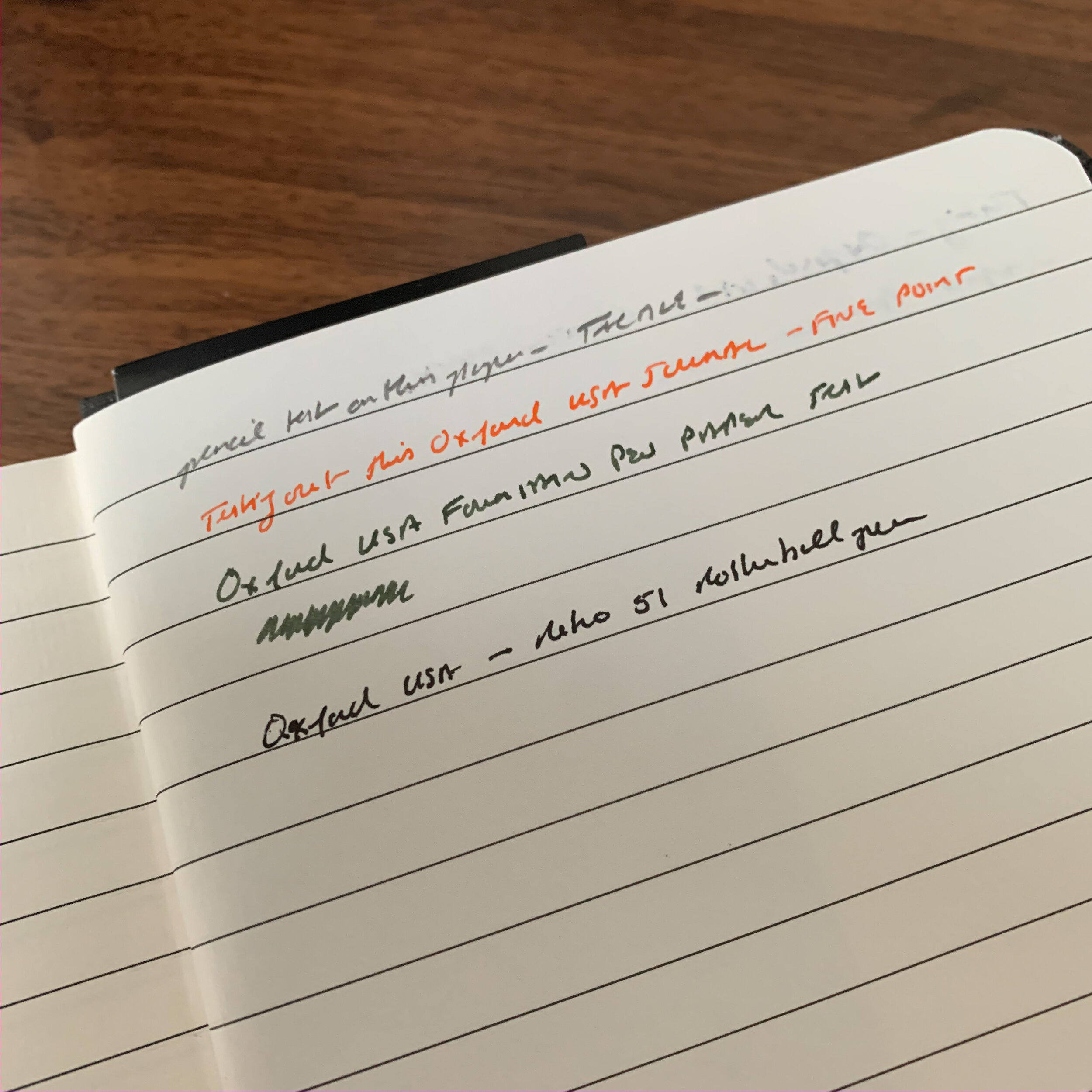
But of course, as with any higher-end notebook, what everyone wants to know about is how the paper performs with various inks and fountain pen nibs. The answer: Surprisingly well, and better than expected. I tested the paper with a Retro 51 rollerball (.7mm Schmidt refill), a Lamy 2000 EF nib, and a Sailor fine nib, and while there was some show-through with very minor bleed-through, I could still use both sides of a page. A wet Graf von Faber-Castell medium nib pushed the paper a bit too far, and feathering/bleed-through became an issue. If I had to make a comparison, I would equate the performance to the heavier-grade paper used in certain Field Notes editions like “Lunacy” or “America the Beautiful.”

View fullsize Writing Sample
View fullsize Writing Sample: Reverse Side

Takeaways and Where to Buy

Oxford apparently shares common ownership with TOPS stationery (maker of the famed “Double Docket” legal pad), which makes me hopeful that this notebook will receive a wide release. If this journal were to appear at Staples, Target, etc., I’d venture that it would do really well. The cover feels solid and the paper will meet the needs of the overwhelming majority of people. I do wish the ruling were slightly narrower and not quite as dark, but that’s a personal preference.

Currently the only place I’ve been able to locate these notebooks for sale is Amazon, and even there they appear to be sold through third-party office supply wholesalers. Priced at just under $20 (shipping included), this seems reasonable for a quality hardbound notebook. I plan to keep my eye out for this notebook in stores in the coming year. Curiously, these books are not yet featured on the TOPS website, which leads me to believe that they have not yet officially launched. Many thanks to Oxford for sending me this product and making this review possible!

Disclaimer: Oxford USA sent me this journal for review purposes, free of charge. This post contains affiliate links.

In Notebook Review Tags Notebooks, Oxford USA
1 Comment

Notebook Review: Filofax Notebook and Clipbook

December 11, 2019

Last week I reviewed some new products from Letts of London, and in that same shipment I received a couple of samples from Filofax, Letts’ sibling brand. I’ve been a regular Filofax user over the years - their A5 organizer was my go-to organization system through college, law school, and for the first few years of work after graduation. I fell away from the Filofax as most of my professional calendaring went digital, and my binder-style paper planner was replaced by books like the Hobonichi Techo, which I would use more as a journal.

Filofax Notebook in “Architexture” cover, A5 size.

Presumably sending shifting trends, Filofax has evolved as a company over the past decade. In addition to their classic organizers, they have launched a series of notebooks that not only feature extremely high-quality paper but are flexible in how you can use them. Taking a cue from disc-bound notebook systems such as Levenger Circa or Staples Arc, the Filofax notebooks feature “movable” pages that can be rearranged within a sturdy wire binding. The 100gsm paper feels and performs similar to Rhodia, and is available in blank, dot grid, lined, and graph rulings. The key selling point of this notebook system is its flexibility over the traditional Filofax organizer: you can certainly use it as a dated planner if you want (Filofax sells “Diary” refills), but I would envision using the included dividers as a way to organize research notes for a work project or a longer piece of writing. Since the notebook is a standard A5 size, you can use Filofax’s proprietary punch to clip in notes from your own A5 notepad. (Other sizes are available, though you’ll have to purchase A4 from Europe as it appears the U.S. store doesn’t carry it.)

For those who prefer the traditional Filofax six-ring binding, Filofax also sells the “Clipbook,” a similar product with a flexible structure but only 80gsm paper, which won’t work as well for my own personal use. While liquid ink pens such as fountain pens and rollerballs work ok, you will see some minor bleedthrough and feathering. That said, if you already have a Filofax Organizer and the “punch” accessory, you know that you can create your own paper refills using whatever paper you prefer.

Filofax Clipbook in A5. While some people might be sold on the ringed-binder system, I definitely prefer the more streamlined look of the Notebook.

The Clipbook binding will look familiar to devoted Filofax users.

While I found the 100gsm Filofax Notebook paper superb, the standard 80gsm paper in the Clipbook does not hold up as well to fountain pens.

Takeaways and Where to Buy

Of these two products, the Notebook is the clear winner for me. The 100gsm paper handles fountain pen ink quite well, and Filofax’s “movable” page system is more convenient than disc-bound notebooks, since the Filofax binding covers the back of the binding and you don’t have the discs sticking out and at risk of coming loose in your bag. Though the Filofax Notebook does not allow you to upgrade the size of the notebook by substituting in a higher-capacity binding, in my experience these sort of moveable-page notebooks become unwieldy to the point of being unusable once you pass a certain point. (It becomes nearly impossible to flip through the notebook without pages falling out.) Thus, I don’t feel that I would be losing anything by moving to the Filofax Notebooks over a Circa or an Arc, which do let you substitute in bigger discs if you need them to hold more paper.

Filofax Notebooks are available in A4, A5, Executive, Letter, and Pocket sizes, ranging from roughly $14-26, depending on size and design. The “Architexture” A5 Notebook pictured here is priced at $23.95 and comes with 56 sheets of ruled paper, four dividers and a ruler included. The Clipbook is more expensive, with the A5 version shown here priced at $29.99 and larger sizes priced at $49.99 or more. All products can be purchased directly from Filofax. For whatever reason, the 100gsm Notebook paper is less expensive than the 80gsm paper sold for the Clipbook: A5 notebook refills cost $4.99 for 32 sheets, whereas the A5 Clipbook refill costs $5.39 for 30 sheets. If you’re planning to invest in this system for the long run, however, by far the most economical choice would be to purchase a Filofax notebook punch and make your own refills.

Disclaimer: Filofax sent me the two notebooks featured in this review free of charge, for review purposes. I was not otherwise compensated for this review. Many thanks to Filofax for making this review possible.

In Notebook Review Tags Notebooks, Discbound Notebooks, Filofax, Notebook Review
Comment
← Newer Posts Older Posts →
Store Hours and Events
Shop T.G.S. Online
Updated 2026 "Best Pens" Guide
No results found
On The Paper Trail: Live In Nashville Event Tickets Now Available!
TGS_25 Roterfaden Restock Notification
Hierarchies of Fountain Pen Friendly Paper

Join Our Patreon!
Subscribe to the TGS E-mail List

Featured Posts

Featured
Everyday-Stationery-Bags
July 25, 2026
What's the Best Everyday Stationery Bag? My Own Considerations and 5 Options for Pen Show Season
July 25, 2026
July 25, 2026
Graphilo-Kobeha-Paper.jpg
July 11, 2026
Paper Review: Graphilo by Kobeha
July 11, 2026
July 11, 2026
Pilot-Custom-Heritage-92.jpg
June 6, 2026
Workhorse Pens: Pilot Custom Heritage 92 Fountain Pen
June 6, 2026
June 6, 2026
The Gentleman Stationer RSS

View Cart

© Digital Divide Media, LLC, 2014-present.

All content is the exclusive property of Digital Divide Media, LLC, d/b/a The Gentleman Stationer, including “The Gentleman Stationer” website and trademark, and should not be reproduced without express written permission.  All rights reserved.

All content containing paid advertising, affiliate links, or sponsored content will be plainly disclosed by a disclaimer when/if featured.

Contact Information

Website Terms and Conditions

Store Shipping Policy and Return Policy

Privacy Policy and Cookie Policy

Accessibility Statement

Powered by Squarespace