• Blog
  • Shop
  • Podcast
  • Resources
  • About
  • Archive
  • Contact
  • Cart
  • Sign In My Account
Menu

The Gentleman Stationer

Vintage Living in the Modern World.
  • Blog
  • Shop
  • Podcast
  • Resources
  • About
  • Archive
  • Contact
  • Cart
  • Sign In My Account

Notebook Review: MOO Hardcover Notebook

November 30, 2016

While many excellent notebooks pass through my hands on a regular basis, you can only use so many, forcing you to make some hard choices if, like me, you have a never-ending (and ever-growing) stockpile/backlog. That said, I think that the new MOO Notebook is going to make the decision on what I'm using next pretty easy. 

The Moo Notebook ships in a slipcase, which will look outstanding on your shelf once you're finished filling your notebook.

MOO is a stationery company perhaps best known for their high-end business cards and other business stationery. They recently released their first notebook, and were kind enough to offer me one for review. How do I like it? Well, I've already purchased two more (along with a swanky leather business card holder). 

MOO is known for their packaging, and a lot of thought and attention obviously goes into it. 

First things first: this is a classy-looking hardcover notebook, starting with the packaging. The notebook that I received came packed in a black gift box, and included a matching slipcover and pencil. The notebook itself is hardbound in charcoal/gray cloth, with lime green highlights on the inside cover to make things interesting. The notebook also came with an embossed MOO pencil! If you're looking for a gift for a notebook lover this holiday season, look no further - the Moo Notebook will impress.  NOTE: (Please see my update at the bottom of this post about retail packaging compared with what I received, which is apparently a promotional bundle.)
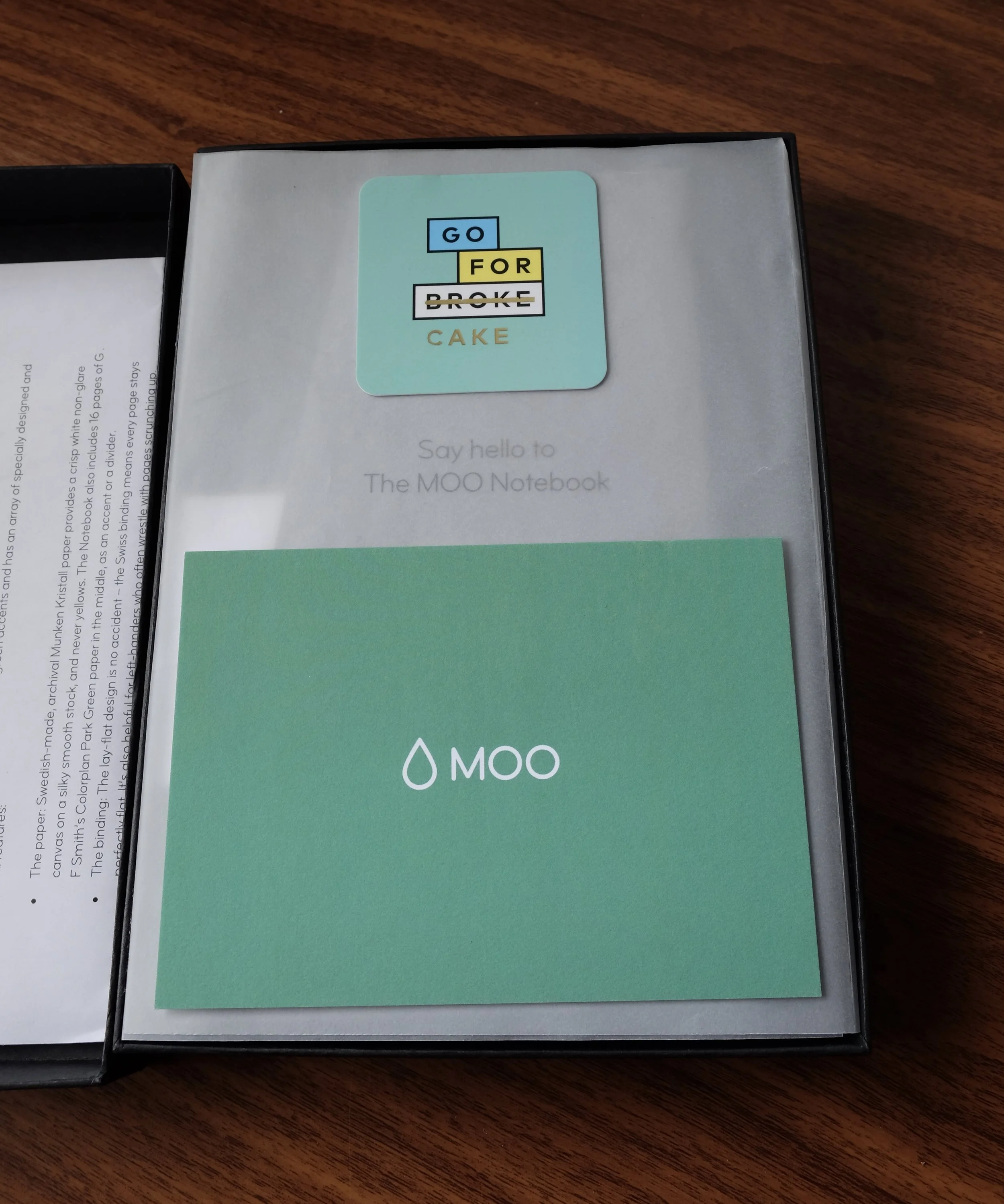
A few samples of additional MOO stationery ship with the notebook.

A few samples of additional MOO stationery ship with the notebook.

The MOO pencil included with my notebook, labeled "Go Forth and Write." A nice touch! 

So what about the paper? It's fairly heavy Munken-Kristall (Swedish) ruled paper that is suitable for most pens. None of the pens that I tested bled through, including fine and medium nib fountain pens, though I suspect that if you took a super wet stub or broad nib to this paper you might have a different experience. For the vast majority of people, however, this paper will do just fine. I personally would prefer a narrower ruling (or even graph or dot grid), but I can - and will - use this paper without an issue.   

The MOO Notebook features 160 ruled pages of Swedish Munken-Kristall paper. I saw no bleed-through or show-through with any of the various pens and inks that I tested. 

A couple design features make the MOO notebook unique from anything else I've seen on the market. The first is the binding. MOO uses a coptic-style binding, with a cover that separates from the spine in order to allow the notebook to lay flat more easily. The second is the inclusion of a seam of blank light green paper in the middle of the notebook that you can use as sketch paper, or even as a divider to break the notebook into different sections.      

The MOO Notebook's unique binding and center seam 

I worry that recently I've sounded like a bit of a broken record, giving high marks to most of the notebooks I've reviewed. After thinking on it, however, it's because much of what is coming onto the market these days is just that good.  I love the fact that the majority of new notebooks that I've had the opportunity to try have been fountain pen-friendly. It finally seems that notebook manufacturers are starting to "get" what stationery enthusiasts are looking for, and realize the extent of the demand out there for nice-looking books with good paper. 

Price Point and Where to Buy

You can buy these notebooks directly from MOO online, and you all are lucky! Until December 5, 2016, you can get the MOO notebook for $13.99 (!!??!), which is 30% off the already reasonable retail price of $19.99. I did a double take when I saw that one, then promptly ordered two more. Most of MOO's other goods are on sale as well. It's probably safe to say that you won't find a better quality notebook at the $13.99 price point, provided you like the aesthetics. 

Even at the regular price point, given the overall quality of this product, $19.99 is a steal. When I first opened the box and saw the notebook, I would have pegged this as a $30 product, easily. Kudos to MOO for putting this out there at an accessible price. The MOO Hardcover Notebook should do well, and I look forward to seeing whether or not MOO introduces graph or dot-grid versions in the future. 

**Update**

I heard from the folks at MOO, who let me know that the Black Box and Pencil are special promotional packaging for the notebook's launch. Notebooks purchased from the MOO website will include just the hardcover notebook and the slipcover. My apologies for any confusion, but at the MOO Notebook's attractive price point, the packaging issue doesn't change my opinion that this is still an excellent deal and would make a nice holiday gift! 

Disclaimer: I received this product from MOO free of charge for review purposes, though I have since purchased additional books using my own funds. I was not otherwise compensated for this review.
In Notebook Review Tags MOO, Notebook Review
3 Comments

Notebook Review: Dingbats* Medium A5+ Notebook

November 23, 2016

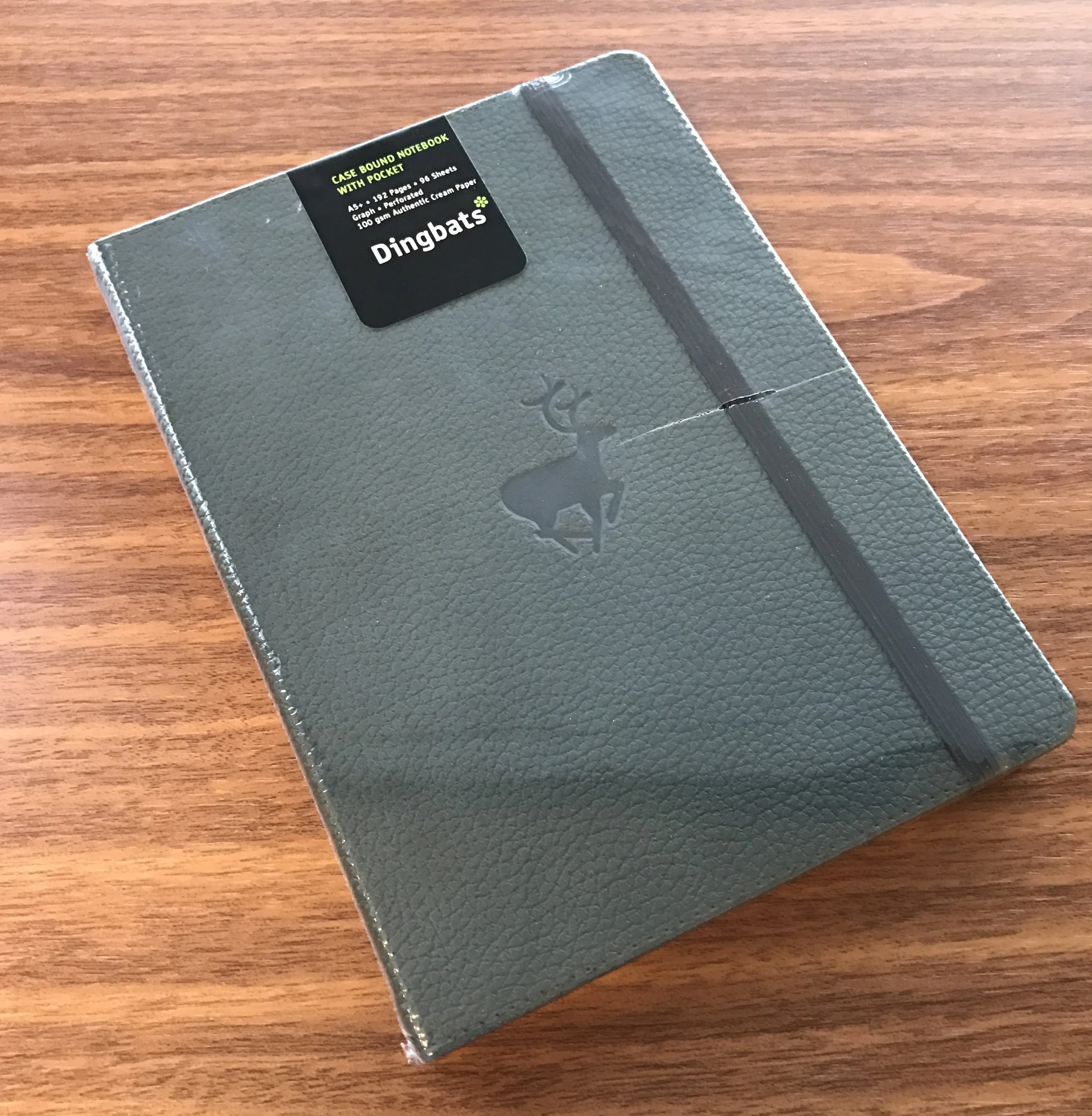
I continue to be amazed at the sheer number of new stationery brands being brought to my attention on a near-daily basis. A few weeks ago I was asked to review a new notebook from Lebanon, marketed under the name of Dingbats*.  Dingbats* (the asterisk is part of the name) launched a Kickstarter project that did not fund, but they still managed to get their notebooks manufactured and have diligently been working to gain visibility in an increasingly crowded notebook/stationery market.

View fullsize Dingbats* A5+ Packaging
View fullsize Dingbats* Logo
View fullsize Dingbats* History

According to their website, Dingbats* notebooks are manufactured by hand in Lebanon. Mohamad, the proprietor, is a descendant of one of the oldest established Lebanese stationery companies, who now looks to carry on his family's business for another generation. This bit of history makes these notebooks unique to me and immediately piqued my interest.

One great feature of the Dingbats* notebook is that it lays completely flat when open.

The Dingbats* notebook features a very soft synthetic leather cover embossed with an animal design, 100gsm cream/ivory paper, and all the other trappings of the modern, "nice bound notebook": inner pocket, elastic closure, and ribbon bookmark. What interests me about these Dingbats* books, and what will likely set them apart in the larger market, are (1) a pen loop; (2) the fact that all 96 sheets are micro-perforated, allowing you to easily remove pages from your notebook for scanning, filing, shredding, etc.; and (3) a reliable lay-flat design. Be aware that these notebooks are slightly larger than your standard A5 (It's labeled A5+), measuring 8.4 x 6.3 inches. I suspect they will not fit an A5 notebook cover, if you are looking for a refill. 

The inner pocket on the back cover. Check out the pattern on the end paper! 

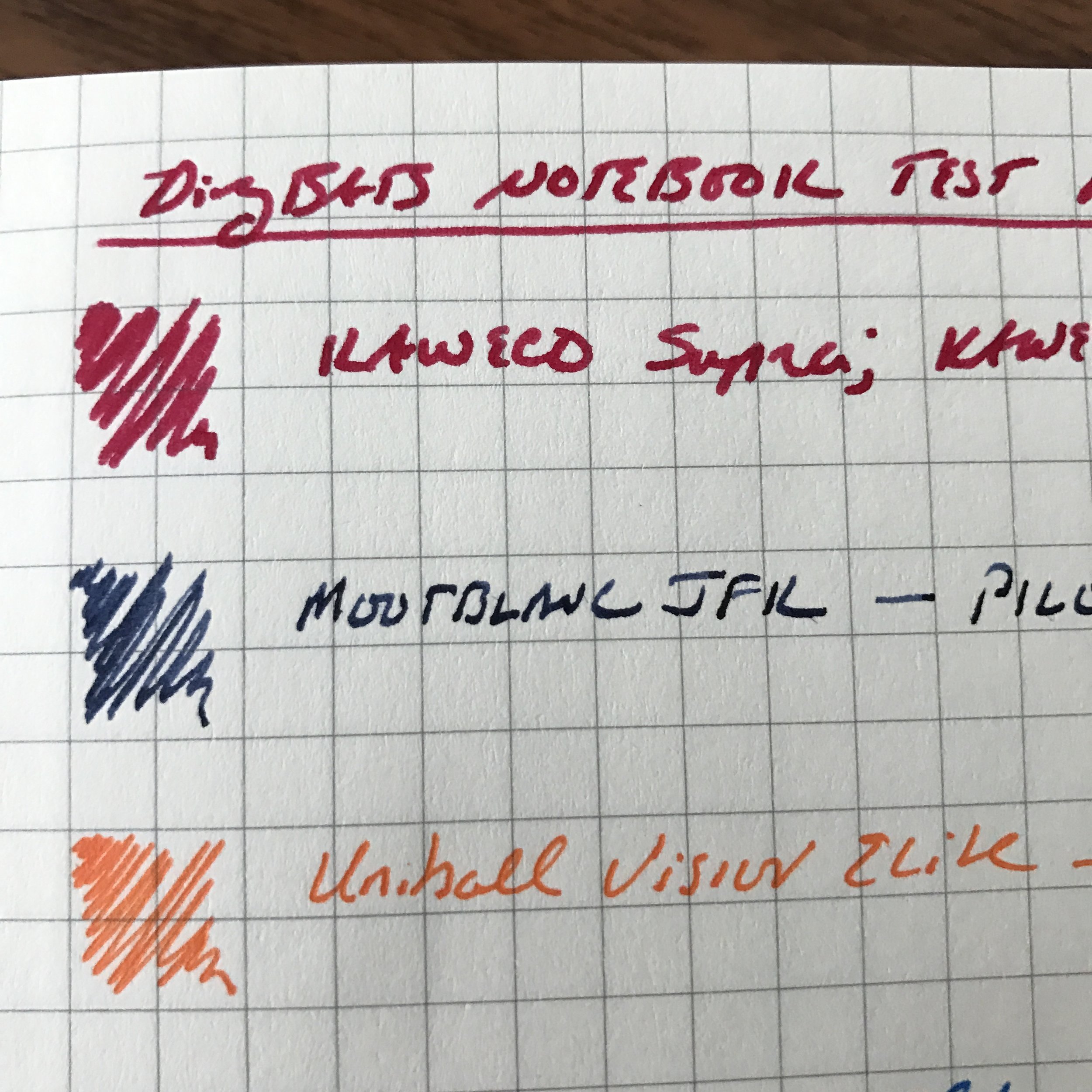
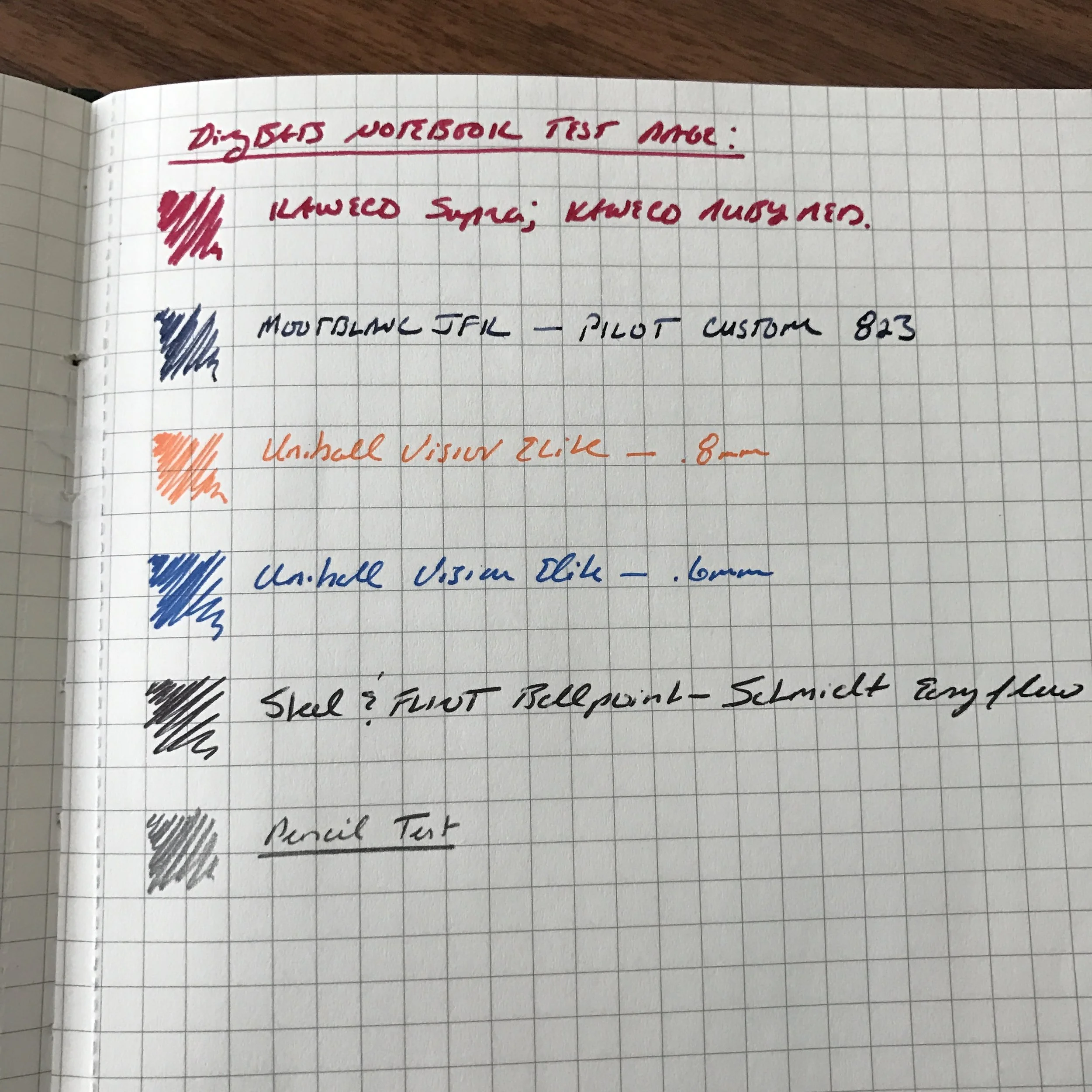
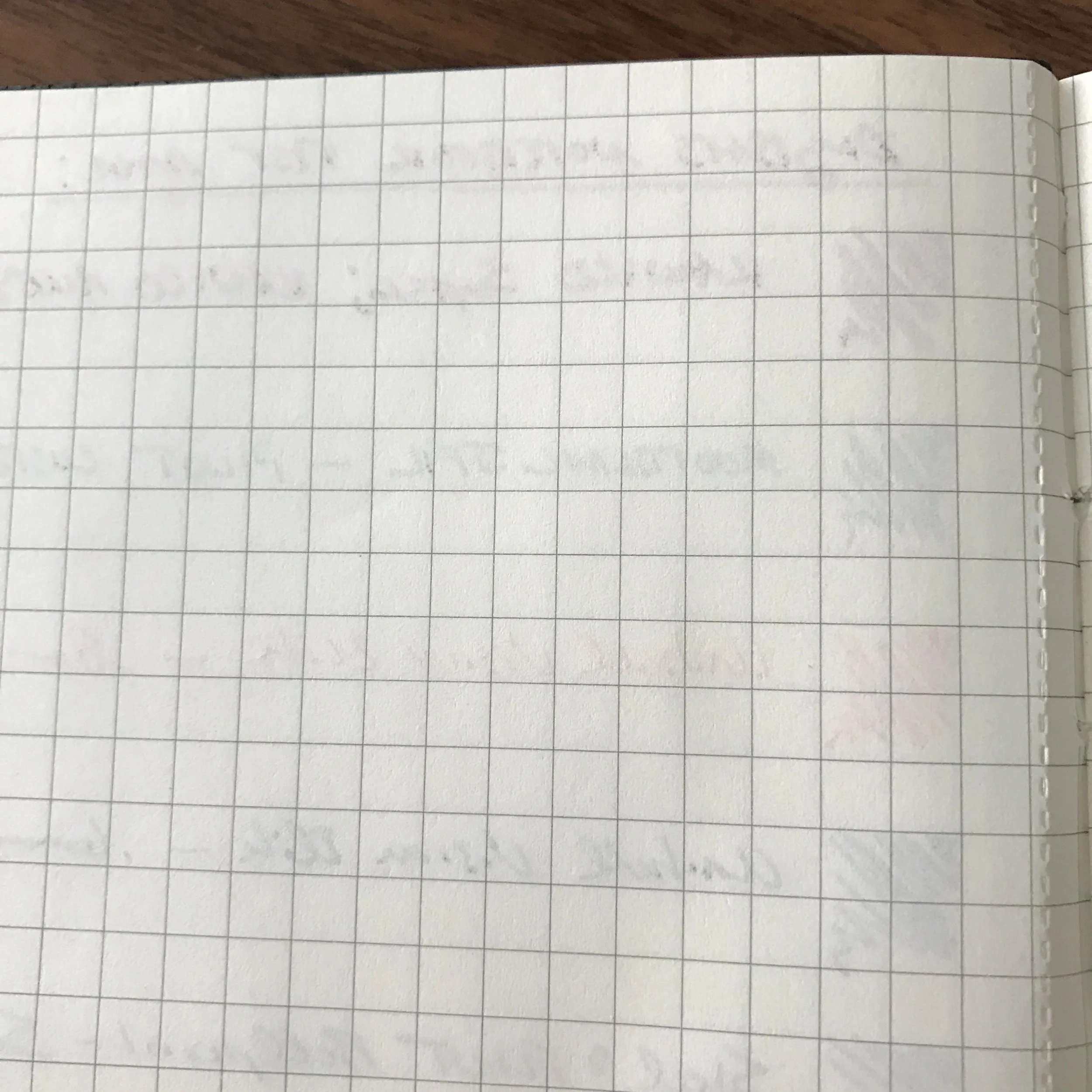
So how does the Dingbats* notebook write? In short, it's a good notebook that I would characterize as fountain pen friendly and will play nice with most of your other pens and pencils. I really tried to push the paper, pressing down hard with a fairly wet medium nib, and was only able to get the slightest hint of show-through on the other side. There was no noticeable feathering or bleeding.

Dingbats* Writing Sample
Dingbats* Writing Sample 2
Dingbats* Writing Sample Flip Side

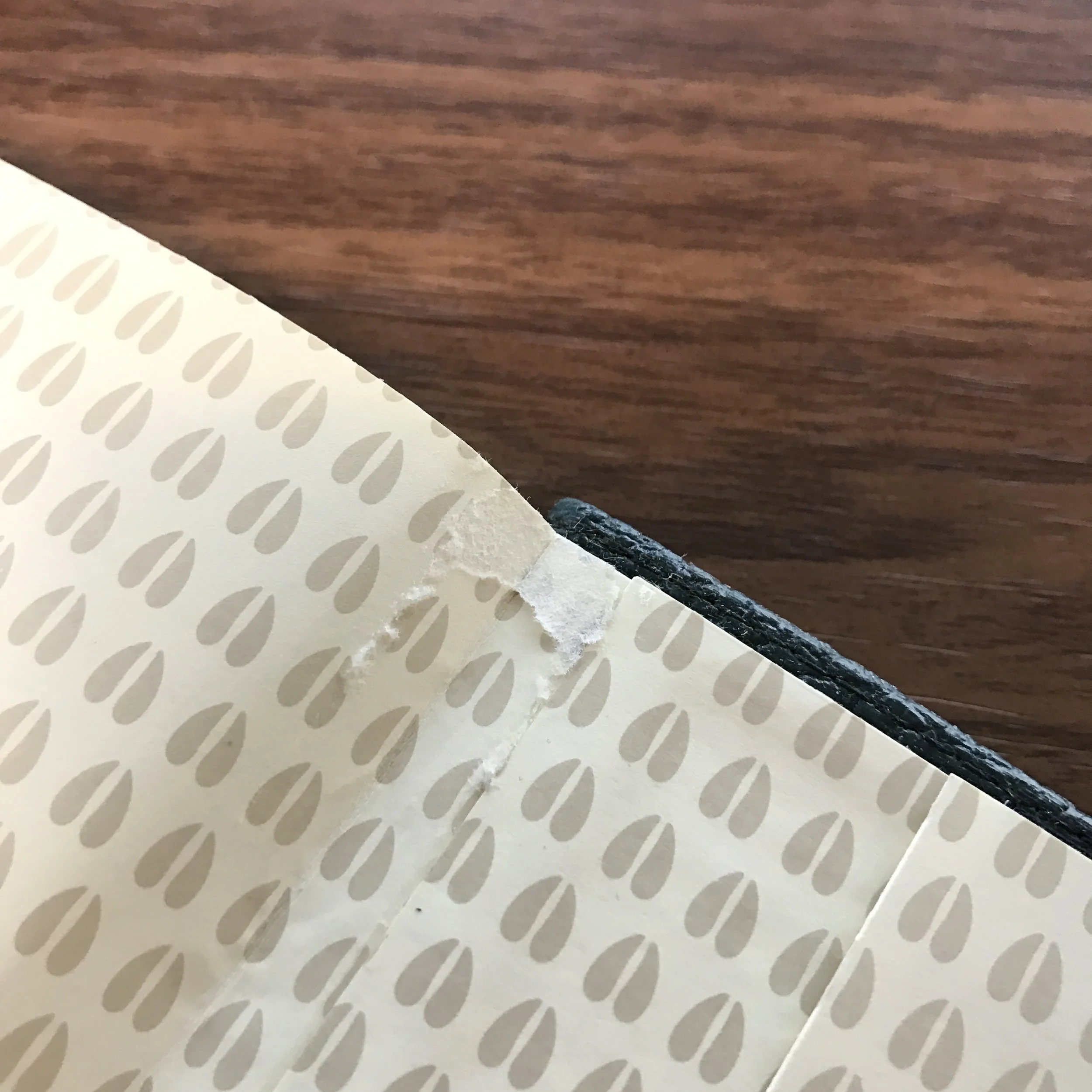
My only critique of this notebook is that mine has some minor issues with the glue on the binding. Some of the pages were stuck together, so in a couple instances I had to manually separate them in order to get the notebook to lay completely flat. There was a similar issue with my back inside cover, where glue appears to have leaked out from under the inner pocket and caused the heavier stock paper of the end pages to stick together. None of this impacts the functionality of the notebook, of course, and I've noticed similar issues in first-generation products from other brands as well (like the Baron Fig Confidant). I'd expect to see these issues get worked out in the future. 

View fullsize Glue Issues
View fullsize Sticking Pages

Update: I heard back from Dingbats*, and they confirmed that the glue issue was a problem with a small number of notebooks from their initial batch, that should no longer be in retail channels. In other words, this shouldn't be an issue going forward. 

Takeaways and Where to Buy

Dingbats* makes a nice leather notebook that I think I'll enjoy using once I finally finish this Leuchtturm 1917 I've had going for a while. The paper is heavy enough stock to use with most pens, and I LOVE the perforated pages. While the book I received had a few hiccups, I'm not a notebook perfectionist (I pretty much destroy them, after all) so this wouldn't stop me from buying/using more Dingbats* notebooks. Honestly, if I didn't already have notebooks coming out my ears, I probably would pick up a couple more to stash away.

Dingbats* notebooks are sold via Amazon. The medium notebook featured in this review sells for $20, which is fairly standard for this type/quality of product.  Dingbats* offers other sizes as well, including a much larger "A4+" (11.8 x 8.5), a top-bound "A6+" (4.1 x 6.1), and some "pocket" A6 notebooks (5.5 x 3.5). Please check them out and give them a try.

Disclaimer: Dingbats* sent me this notebook for review purposes, at no charge.   

In Notebook Review Tags Notebook Review, Dingbats*
Comment

Notebook Review: Portland Leather Goods Journals and Notebooks

November 12, 2016

If there's one thing I can never have too many of, it's nicely bound notebooks and leather notebook covers. Even if it's impossible for me to use them all myself, if I see a nice one, I pick it up regardless of the time of year, because notebooks make excellent holiday gifts and hardly ever go unappreciated. When the folks at Portland Leather Goods reached out and asked if I'd like to review some of their Triple Wrap and Snap leather journals, I jumped at the chance. They were generous enough to send over three different samples of various models, and they're all exceptionally well made.

Specs and Construction

Portland Leather Goods journals are handmade in Portland, Oregon from full grain cow leather. The covers have been nicely finished; they aren't roughly cut like a lot of cheaper options out there. At the same time, the leather is not over-finished. It has a rugged and rustic look that I like, leaving some marks such as small scratches, blemishes, freckles, and brands. This isn't a notebook that you should be afraid to get scuffed or dirty or toss in your bag unprotected. It's going to look even better as it shows its age. Portland Leather appreciates having a lot of character in the leather, reminiscent of a good leather travel bag or a pair of leather work boots. 

As I mentioned, Portland Leather Goods sent me three products: two medium journals in both the "Triple Wrap" and "Snap" styles, as well as a small notebook/wallet that has two credit/business card slots. All three turned out absolutely gorgeous. My personal favorite is the "Snap" style, and I've gotten the most use out of the smaller notebook, which could easily double as a travel wallet. While the Triple Wrap journal is attractive and well made, I open and close my notebooks a lot through the day, and the leather strap that holds the journal closed ends up being just a touch too fussy for regular use. That said, it would make a great travel journal or sketchbook, for more leisurely writing or drawing sessions where quick deployment isn't an issue.

From left, the medium Snap journal with the "Golden Mean" brand, the small Snap journal, and the Triple Wrap journal with the "Tree of Life" brand. 

You can also choose from a wide variety of custom brands for your notebooks. I chose my three favorites: the "Tree of Life," "Golden Mean," and "Stormtrooper" options. The marks are fire branded into the leather, so yes, they're there to stay. All three are very well-defined and look very nice on the journals - understated and not overly ostentatious.  

I love the "Tree of Life" brand. 

An up-close shot of the "Golden Mean" brand. 

The medium-sized Triple Wrap journal open. The refill on the medium journal is held in by an elastic cord, similar to the Midori Traveler's Notebook. 

Fountain-Pen Friendly Paper

Portland Leather Goods markets its products as journals, not journal/notebook covers, so each notebook comes with a lined or blank notebook insert. They haven't cut corners here - this is quality paper. These notebooks are made from heavy stock that handles most ink fairly well, and the Kraft paper cover and stitched binding should hold up well. The notebooks contain 44 sheets (88 pages front and back), and you can purchase refills directly from Portland Leather Goods in their online shop.  

I've not had any issues with fine or medium fountain pens bleeding or feathering on the Portland Leather Goods Paper.

My one quibble is that the ruling on the lined version is a touch wide for my taste. While a plain/blank notebook is available, Portland Leather Goods does not offer a graph or dot-grid option, which is my preferred paper stock. That said, I was able to test out the small and medium notebooks with some other refill options I had lying around. Here's what works: 

  • The "Small" journals are compatible with a Field Notes-size pocket notebook or smaller. 
  • The "Medium" journals will work with a Large Doane Paper Utility Notebook (5*7), which is probably what I will end up using for everyday purposes since I love Doane's grid paper. The medium-sized Baron Fig Vanguard is just slightly too large to fit.  

The small Snap Journal fits Field Notes-sized pocket notebooks (see the Calepino peeking out). 

Takeaways

I'm impressed. Portland Leather Goods makes excellent leather journals at a reasonable price. It all comes down to whether the style fits your personal preference. Many thanks to the folks at Portland Leather for sending over these gorgeous notebooks and journals to try.  

You can purchase directly from Portland Leather on their website. Pricing is extremely reasonable given the quality of the craftsmanship. The small journal starts at $28, the medium at $38, and a large (9*6) at $48. 

Disclaimer: I was sent these products free of charge for review purposes. I was not otherwise compensated for this review. All views expressed herein are my own. 

In Notebook Review Tags Notebook, Portland Leather Goods
Comment

The Slice Planner's "Clockface" diagram provides a visual representation of how you spend your time each day.

The Slice Planner (on Kickstarter Now!)

October 26, 2016

Kickstarters upon Kickstarters, that seems to be the theme for this month! Out of all the projects that I've had the opportunity to review, however, the Slice Planner has been the first where I've seen the project and thought, "I have a clear use case for that and I can't find it anywhere else on the market." 

The Slice Planner claims to be "built around [the] core concept of easy synchronization between your paper notebooks and all your digital calendars, whether you use Outlook, Google, or Apple." It looks to accomplish this by combining a high-quality notebook with an app that makes it easy to scan handwritten entries into your digital calendar. Other companies have attempted similar "digital notebooks" in the past, with middling success. The most well known has been Moleskine, which sells an Evernote-integrated notebook and a "smart writing" pen/notebook set, which appears to have since been integrated on some level with the Livescribe 3 Smartpen. Slice Planner looks to take this idea a step further by offering reliable calendar integration.

So why does this project interest me? Recently, I've been looking for a notebook which can serve as a kind of "work journal," keeping track of how much time I spend on the various projects I have going on at any given time (including both the day job and the blog). The Slice Planner struck me as a good candidate. More than one week in, I'm very happy with how things have worked out, and can see myself using this notebook in this role going forward, regardless of how the app turns out.  

The Notebook and "Clockface"

Photo courtesy of Slice Planner. This shows both the clothbound and leather versions, and also provides a fairly good indication of the size (approximately A5). 

Before I even get into any of the "techy" features, or how the Slice Planner fares with its stated goal of "bridging the physical and digital divide," I want to say this: the Slice Planner is a great notebook, and the notebook itself is enough for me to back this Kickstarter, even if I never end up using the bundled app.  

My gray Slice Planner. 

The notebook measures 5.5 x 8 inches, is clothbound, and contains two ribbon bookmarks and the omnipresent elastic strap to hold the book closed. The book itself seems very well made, and has held up well to my daily use. It's ever-so-slightly larger than a Baron Fig Confidant, but sports a similar cloth binding and lay-flat design. 

The Slice Planner compared against the Baron Fig Confidant (top). The Slice Planner is slightly larger than the Confidant. 

The inside of the Slice Planner features an undated, two-page-per-day layout. I love undated planners and notebooks, which avoid wasting paper on days when there isn't much to "plan" (such as days off, vacations, holidays, etc.). The left-hand page contains a "clockface" diagram which tracks 12 consecutive hours of time. You determine where on the diagram you want your day to "begin", and go from there. The right-hand page contains blank dot-grid paper for notes, diagrams, drawings, whatever.  

Many people have noted the visual similarity to the Chronodex, by Patrick Ng. While the Slice Planner certainly borrows from the Chronodex, in the sense that both use the "clock face" circular layout, it's not an exact copy. For one thing, the Slice Planner tracks only 12 hours of time, whereas the Chronodex is designed to track up to 18. The folks at Slice Planner explain this based on a survey showing that, on average, most people do not plan more than 9.5 hours a day. Personally, I find the simplified Slice Planner diagram easier to use than the Chronodex, which never stuck with me. Since I don't use the Slice Planner as my primary calendar, the 12-hour limitation isn't an issue for me.  

Yes, the Paper Is Reasonably Fountain Pen Friendly

Per the Kickstarter project page, the notebook contains "224 pages of acid-free premium Swedish paper for sketching and writing." I'll go ahead and get this out of the way first, because I know it's what everyone wants to know: Yes, it works fine with fountain pens. I experienced no bleed-through using any fountain pen I tried, which were limited to extra-fine, fine, and medium nibs. The only pen I used that exhibited some bleed-through/show-through was the Baron Fig Squire rollerball refill (which is the same as the Schmidt rollerball refill that ships with Retro 51 pens). Lamy Copper-Orange ink didn't work great (feathered a bit), but the the flip side of the page was still usable. I never tried to push this paper with especially wet nibs, but I imagine that you might see some feathering and bleeding with double broad nibs and stubs. 

Testing various inks in my Slice Planner. You can see some show through from the following day, but no actual bleed. 

Some have compared the paper to Baron Fig, but it reminds me more of Fabriano paper. The two are similar, but I've found Fabriano to be slightly more fountain pen friendly.    

The App

And, finally, we get to the digital-analog integration aspect of this project. The project page makes it pretty clear that the Slice Planner app is NOT intended to replace your regular digital calendar, but rather to complement it by providing users with extra flexibility and making it more convenient to import things like appointments and notes into your phone or tablet. 

Photo courtesy of Slice Planner. The app is designed to scan "events" from your diagram and import them into both the Slice Planner app and your calendar. The Slice Planner app will also import existing calendar appointments into the clockface diagram. 

The build of the Slice Planner app that was made available to me had limited functionality, but if it works as promised, I could see how I would use it occasionally. My day is often hyperscheduled with conference calls, appointments, hearings, etc., and needs to be broken down into time increments smaller than what I suspect the Slice Planner would be able to handle. I do plan to give the fully functional app a chance once it is released, and I'm excited to test the accuracy of the handwriting recognition feature.  

That said, I'm not entirely convinced that opening a third-party app, waiting for it to access the camera, scanning in the information, correcting any handwriting recognition errors, and verifying that the entry is correctly reflected in your calendar app of choice ends up being more efficient than simply opening Fantastical or Omnifocus (two absolutely awesome apps that I use to manage my life) and entering an appointment/task manually or via Siri or Google Assistant. I'm pretty quick with my phone. That said, I'm excited to see developers and companies acknowledging that people still use paper planners and notebooks, and trying very hard to come up with thoughtful ways to accommodate these preferences. The Slice Planner app/calendaring system may end up working very well for some people; given my specific needs, it will require a lot more testing before I know whether it's something I can incorporate into the rotation.

Should You Back It? 

UPDATE: The Slice Planner was a successful Kickstarter, and is now available for purchase via Amazon. 

I backed the Slice Planner immediately, simply because I want two more of these notebooks. As discussed above, I probably won't use this as a classic planner, but more as a journal/notebook for tracking time management and work progress. While the App could be a nice bonus, it's not what's driving my decision to support this project.

You can back the Slice Planner by visiting their Kickstarter project page. The project is almost fully funded with 30 days to go, and rewards are still available for December delivery. Clothbound and leatherbound notebooks are available; the leatherbound notebooks accept a refill which Slice Planner will be selling aftermarket.

Disclaimer: I was provided with a prototype Slice Planner for review purposes, free of charge. I was not otherwise compensated in any way for this review, and the funds that I used to back the project are my own. This post contains affiliate links.

In Notebook Review, Planner Tags Slice Planner, Notebook Review, Planner
1 Comment

My morning companions: Calepino Graph Paper Notebook and a Calepino Pencil (and Coffee).

Notebook Review: Calepino Pocket Notebooks (Graph Paper)

October 15, 2016

I've made no secret in the past about my love for France and French stationery products. I spent a year studying at the Sciences-Po Strasbourg during college, and it's where I first discovered fountain pens and fine paper (especially my personal favorite, the Clairefontaine French-ruled). I enjoy French paper because, regardless of price point, it typically handles fountain pen ink fairly well. I lived there in the early 2000s, and even then I would say the majority of the students in my class wrote with a fountain pen (though sadly it’s probably less now). But back to Calepino. 

The standard Calepino cardboard-covered notebook. Graph-ruled notebooks have green trim, blank notebooks blue, and lined notebooks red. The dot grid notebooks are a light gray cardboard with light green trim. 

Calepino is a notebook company located in Nantes, France. According to the company website, the name is a play on “Calepin”, a French word meaning “small notebook,” which is itself derived from Ambrogio Calepino, a fifteenth century Italian scholar who devoted his life to making a multilingual dictionary.  

The cover is just standard cardboard.  Nothing fancy here, though I appreciate the minimalist look. 

The first thing you’ll probably notice about Calepino notebooks is that the cover is made from a stiffer cardboard - much stiffer than books made by Field Notes and Write Notepads. I’d compare it more to the notebooks made by Doane Paper and Scout Books. To be honest, the cover is not my favorite aspect of this notebook, but apparently the cardboard was a key concept behind this design, as the notebook was inspired by a cardboard-covered notebook carried by the designer’s father. 

A writing sample on the Calepino notebook paper with two fairly wet fountain pens: a Pilot Custom Heritage 92 with a FM nib and a Pelikan M205 with a wet fine cursive italic. Note the lack of feathering. 

The paper is the key selling point for the Calepino notebook. As a pocket notebook user who likes to use a mixture of fountain pens and pencils on a daily basis, I found it just heavy enough to handle most fine-to-medium nib fountain pens without much bleedthrough, and still tactile enough for pencils. Using a super-wet nib may still cause some “pinprick” bleeding, but you'd have to really push it in order to render the back side of the page unusable. I opted for the graph notebook, which contains bright white paper with a blue-green grid.  Calepino also makes plain, lined, and dot grid versions of their notebooks. 

No bleed-through on the back of the page, at least with these pens and inks! With broader nibs you sometimes get a bit of "pinprick" bleed-through but nothing that prevent you from using both sides of the page. 

As a bit of a side note, Calepino also sells very nice, French-manufactured pencils. The one I have is a matte black pencil with a white eraser. The wood is not cedar, though it sharpens well and the graphite is dark, reminiscent of the Staedtler Norica. Calepino makes yellow and white versions too, so I may pick up a few more in the future, 

Where to Buy

I purchased a pack of Calepinos during my last visit to C.W. Pencil Enterprise in New York City, and I will most likely pick up some more (in both graph and dot grid) during an upcoming work trip to NYC next month. Calepino notebooks are $10 for a pack of three, which is standard pocket notebook pricing. Calepino packages their notebooks in a small cardboard box, rather than the belly-band + shrink wrap that other notebook companies use. This makes it much more convenient to store your hoard!     

Disclaimer: I purchased the products featured in this review with my own funds, for my own personal use. This post contains some affiliate links. 

In Notebook Review Tags Calepino, Pocket Notebook
Comment
← Newer Posts Older Posts →
Store Hours and Events
Shop T.G.S. Online
Updated 2026 "Best Pens" Guide
No results found
On The Paper Trail: Live In Nashville Event Tickets Now Available!
TGS_25 Roterfaden Restock Notification
Hierarchies of Fountain Pen Friendly Paper

Join Our Patreon!
Subscribe to the TGS E-mail List

Featured Posts

Featured
Everyday-Stationery-Bags
July 25, 2026
What's the Best Everyday Stationery Bag? My Own Considerations and 5 Options for Pen Show Season
July 25, 2026
July 25, 2026
Graphilo-Kobeha-Paper.jpg
July 11, 2026
Paper Review: Graphilo by Kobeha
July 11, 2026
July 11, 2026
Pilot-Custom-Heritage-92.jpg
June 6, 2026
Workhorse Pens: Pilot Custom Heritage 92 Fountain Pen
June 6, 2026
June 6, 2026
The Gentleman Stationer RSS

View Cart

© Digital Divide Media, LLC, 2014-present.

All content is the exclusive property of Digital Divide Media, LLC, d/b/a The Gentleman Stationer, including “The Gentleman Stationer” website and trademark, and should not be reproduced without express written permission.  All rights reserved.

All content containing paid advertising, affiliate links, or sponsored content will be plainly disclosed by a disclaimer when/if featured.

Contact Information

Website Terms and Conditions

Store Shipping Policy and Return Policy

Privacy Policy and Cookie Policy

Accessibility Statement

Powered by Squarespace